

1.
Suppression of civil liberty in the name of national security is an old story in the United States. It has happened repeatedly in times of war or fear since the early days of the republic. In 1798, just seven years after the Bill of Rights was added to the Constitution, the Sedition Act made it a crime to criticize the president; the supposed reason was the danger of French Jacobin terror infiltrating America. The Civil War, World Wars I and II, and assorted episodes of national fear were all made occasions for punishing speech and depriving people of due process of law.
We are in another bad time for civil liberties now. Under the mantle of his War on Terror, President Bush has imprisoned American citizens without trial, detained thousands of aliens in this country, and persuaded Congress to let government intrude more deeply into our private lives. In a significant respect, the danger to liberty is more serious than in past episodes. We regretted previous repressions when the war or stress ended; editors convicted under the Sedition Act were pardoned, for example, and Japanese-Americans confined in desert camps during World War II were given modest compensation years later. But it is hard to envisage an end to the current war. There are terrorist groups around the world, and they are not likely to send a joint delegation to surrender. So repressive measures may go on indefinitely unless they are stopped by the courts or by political second thoughts.
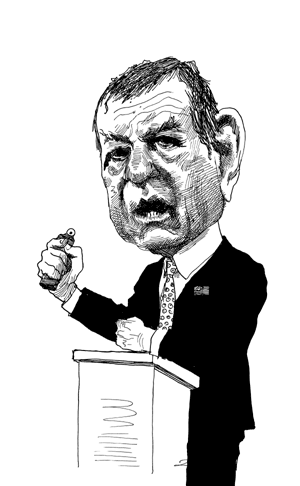
In this situation we need calm, reasoned advice on how to balance the interests of security and liberty. We have it now in a remarkable book. Michael Ignatieff brings history, philosophy, law, and democratic morality to bear on the problem. That may sound daunting, but Ignatieff is such a forceful writer that it is a fascinating book.
Ignatieff has published many books on unusually diverse subjects: history, fiction, a superb biography of Isaiah Berlin. But his main theme nowadays is human rights. He is a professor and director of the Carr Center on Human Rights Policy at Harvard. A Canadian who has lived and taught in Britain as well as the United States, he is able to bring to bear a comparative perspective on how rights are protected elsewhere. Reading him is a bit like having a conversation with an eminently reasonable but convinced and powerfully convincing man. Some of us who opposed the war in Iraq were perplexed when he took a position in favor of it. A year later he had the courage, unlike the policymakers of the Bush administration, to admit to doubts. His thinking about the subject—his open-minded weighing of interests—is something like his approach to terrorism and civil liberties.
The Lesser Evil is not a direct criticism of what the Bush administration has done to civil liberties since September 11, 2001, although it has implications for the current American situation. It is a discussion, rich with examples from past and near present, of how a constitutional democracy should deal with the phenomenon of terrorism. Ignatieff gives a clear assessment of the reality of terrorism’s menace: its immunity to fear of death, its lack of interest in political compromise or, for that matter, negotiable goals. “Evil has escaped the prison house of deterrence,” he says. So rights may sometimes have to yield to necessity—but always with safeguards to minimize the damage.
“Rights are not always trumps,” he writes.
But neither is necessity. Even in times of real danger, political authorities have to prove the case that abridgments of rights are justified. Justifying them requires a government to submit them to the test of adversarial review by the legislature, the courts, and a free media.
That guarded balancing process is what he means by the “lesser evil” approach, which he advocates. It “assesses what to do in an emergency,” he says, “with a conservative bias against infringements of established standards of due process, equal protection and basic dignity.” He examines from that perspective, as an example, the internment of Japanese-Americans in World War II. Military authorities said internment would prevent possible sabotage and thus shorten the war. The Supreme Court upheld the order, deferring to the executive branch. Ignatieff concludes:
The loss of freedom that internment will entail is such a serious blow to the individuals involved, and the likelihood that internment will shorten the war is so uncertain, that the rights abridgments cannot be justified.
Ignatieff’s formula requires, crucially, awareness that every concession to claimed necessity is just that: a derogation from established rights. “The best way to minimize harms,” he writes, “is…never to allow the justifications of necessity—risk, threat, imminent danger—to dissolve the morally problematic character of necessary measures.”
It is impossible to read Ignatieff’s calls for sensitivity and awareness in these matters without noting the bleak absence of those qualities in what George W. Bush and his people have done to civil liberties in the name of fighting terror. Their position, legally and politically, is that their measures simply raise no problem of constitutional or other rights. Attorney General John Ashcroft went so far as to say that “those who scare peace-loving people with phantoms of lost liberty…only aid terrorists.” Had the President so much as indicated a concern for civil liberties, it would have made a great difference.
Advertisement
On point after point, Michael Ignatieff’s picture of how a democratic government should react to terrorist threat clashes with the reality of the Bush administration’s practices. A principal concern is access to the courts. Ignatieff repeatedly says that any abridgments of liberty must be subject to judicial review. He criticizes American courts for their historic habit of deferring too readily to executive claims of military necessity, as in the Japanese internment decision in the Supreme Court, Korematsu v. United States, which almost all legal commentators now regard as a tragic mistake. On the specific issue of holding terrorist suspects without trial, he says that “detainees must retain the right to counsel and judicial review of their detention.”
The Bush administration’s position could not be in sharper contrast to that view. It has held two American citizens without trial for more than twenty-two months now as “enemy combatants.” And it is vigorously—I would say obsessively—maintaining that they should have no meaningful chance to contest that designation in court. Indeed, the government argues that they have no right to consult a lawyer.
The lengths to which the administration has gone to try to thwart the legal process in the enemy combatant cases is shown in the brief it filed in the Supreme Court in one of the cases, that of Jose Padilla, an American citizen arrested in the US and accused of connections with al-Qaeda. Government lawyers urged the Court to order the case dismissed because, they argued, Padilla’s lawyer, Donna Newman, had filed her habeas corpus petition against the wrong defendant, Secretary of Defense Donald Rumsfeld, instead of the commander of the Navy brig where he is imprisoned.
The brief said the Supreme Court should not consider the issue of Padilla’s right to counsel because the Defense Department had allowed Donna Newman to visit Padilla once in March—while still maintaining that it had no legal duty to do so. Newman’s visit to Padilla in fact offered no opportunity for what anyone would call consultation with a lawyer. Padilla was kept in another room, behind a glass wall. Two government officials, a lawyer and an intelligence officer, sat in on the meeting; and it was videotaped. Under those circumstances Newman could of course not ask Padilla what he had done, why he thought he was there, or any other substantive question.
The government brief recited as facts a number of damning accusations against Padilla: he
was in Afghanistan and Pakistan after the attacks of September 11, he engaged there in extended discussions with senior al Qaeda operatives about conducting terrorist operations in the United States, he researched explosive devices at an al Qaeda safehouse…, he returned to the United States to advance the conduct of further al Qaeda attacks….
But those are not facts. They are government allegations that Padilla has never had a chance to contest—and never will, if the Bush administration has its way in the Supreme Court.
The Supreme Court argument in the Padilla case, on April 28, gave no clear clues to how the Court will decide it. For the Bush administration, principal deputy solicitor general Paul Clement pressed hard the contention that Padilla’s lawyers had sued the wrong person in Secretary of Defense Rumsfeld. He insisted that the courts had no jurisdiction—so that, if his argument prevails, Padilla’s habeas corpus petition must be dismissed, without any ruling on his rights. The justices seemed closely divided in their reaction to that argument.
On the larger issues, Clement argued that Congress had authorized President Bush to detain citizens as “enemy combatants” when, on September 18, 2001, it authorized the President to use “all necessary and appropriate force” against the authors of September 11 and other terrorists. Justice Stephen Breyer asked why it was “necessary and appropriate” to use the device of indefinite detention without trial or counsel. Clement replied that it was a matter of executive discretion. He thus took the position that Congress gave the President carte blanche to do whatever he wanted to American citizens in the name of fighting terror.
Jennifer Martinez, representing Padilla, said the September 18, 2001, statute was not intended by Congress to overrule an earlier law forbidding detention of Americans without trial—a statute passed in remorse for the detention of Japanese-Americans during World War II. Chief Justice William Rehnquist observed that the grant of authority in the 2001 law was “broad.” But there was no indication, Ms. Martinez replied, that Congress envisaged a power to arrest citizens and hold them indefinitely.
Advertisement
Justice Breyer suggested that the 2001 authorization of the use of force could be read to allow only the ordinary criminal process against Americans in this country unless the government could show an extreme emer-gency. Ms. Martinez endorsed that idea, but Clement said detention was necessary in other cases to interrogate suspects and get intelligence. He said the government had every reason to do so “when somebody goes abroad for training.” That echoed the language in the government brief stating as fact that Padilla had been trained abroad by al-Qaeda, though it is only a government assertion.
There was a striking moment in the argument of the companion case of Yaser Hamdi, the other citizen held as an enemy combatant. Justice John Paul Stevens asked Hamdi’s lawyer, Frank W. Dunham Jr., whether he challenged the government’s assertions about Hamdi’s conduct. Dunham replied that he had a “substantial dispute.” But he added that he could not tell the Court what Hamdi had said about that when he was allowed to visit Hamdi—because what Hamdi said to him was promptly classified.
The Bush administration is determined to prevent judicial review of what it is doing to those who it asserts have terrorist connections. That is its position in another case now before the Supreme Court, that of the 595 foreign prisoners held at Guantánamo Bay. Families of some of the prisoners filed petitions for habeas corpus in United States courts, seeking their release on the ground that they were not involved in the Taliban or al-Qaeda in Afghanistan, or involved in terrorism when arrested in other countries. The government argues that US courts have no jurisdiction to hear the petitions because Cuba is sovereign in Guantánamo, although a perpetual treaty gives the United States absolute control of the zone.
A “decent respect for the opinions of mankind,” Ignatieff says, “requires any state fighting terrorism to respect its international obligations.” That is precisely what the Bush administration has not done in Guantánamo. The Third Geneva Convention, which the United States signed and ratified, requires that when there is any question about the status of someone detained in war, the issue be decided by a “competent tribunal.” Many such tribunals were set up by United States forces in the Persian Gulf War in 1991 to decide on the status of prisoners. But George W. Bush declined to follow the Geneva Convention in the case of the Guantánamo prisoners, saying he had conclusively determined that they were “unlawful combatants” rather than regular soldiers. That position has, as Ignatieff suggests, outraged international opinion. Lord Steyn, one of Britain’s law lords, said in a lecture last fall that the prisoners were in “a legal black hole.”
Another matter on which the Bush administration’s practice has departed from the fundamentals of Ignatieff’s prescription is secrecy. He writes: “It is never justified to confine or deport an alien or citizen in secret proceedings. Openness in any process where human liberty is at stake is simply definitional of what a democracy is.”
On Ashcroft’s orders, FBI agents arrested thousands of aliens in this country in the weeks after September 11, 2001. They were detained for long periods, with their names and places of detention kept secret. Most were then deported for such immigration violations as overstaying a visa, after deportation hearings that, by another Ashcroft order, were usually held in secret.
“A constitutional democracy,” Ignatieff says, “should keep rights abridgments to a strict minimum and limit their duration with sunset clauses.” When the USA Patriot Act was rushed through Congress in 2001, concerned members managed to insert a sunset clause requiring that key provisions enlarging government investigative powers expire in 2005 unless renewed. The Bush administration is pressing Congress to remove that clause and make the provisions permanent.
One more point of difference with the administration: “When organizations are designated as terrorist,” Ignatieff says, “they should retain the right to judicial review of their proscription. Withdrawing the rule of law from anyone in a democratic state can never be justified.” In 2001 the Bush administration seized the assets of the Holy Land Foundation, an American-based Muslim charity, saying that it was associated with Hamas, a designated terrorist organization. At an administrative hearing on Holy Land in the Treasury Department, the government used secret evidence. The organization then sought judicial review, but the courts refused to intervene. The Supreme Court denied review on March 1.
Seizing the assets of a charitable foundation without allowing it a day in court seems, on its face, to violate basic constitutional rights. Are other foundations troubled by the precedent? Some are, but there has been very little expression of outrage. Why not? Why have Americans not been more troubled by President Bush’s claim that he can detain any citizen forever in solitary confinement, without a trial or right to counsel, simply by declaring that the citizen is an enemy combatant? A brief filed in the Supreme Court by 175 members of the British Parliament, Commons and Lords, argues that Guantánamo prisoners must have a chance, in habeas proceedings, to urge that they are wrongly imprisoned. Why is there no imaginable chance that 175 members of the House and Senate would sign such a brief?
“Why are liberal democracies so quick to barter away their liberty?” Ignatieff asks. “The historical record suggests, disturbingly, that majorities care less about deprivations of liberty that harm minorities than they do about their own security.” That is surely true. Most Americans do not identify with, or care about, Jose Padilla or a Guantánamo prisoner—even if the record of United States intelligence agencies makes it impossible to regard as beyond doubt the findings that they are terrorists.
Another reason why raw violations of constitutional standards in the government’s treatment of people produce little reaction is that the government controls the facts—and distorts them. “The facts are never presented to the public simply as neutral propositions available for dispassionate review,” Ignatieff says. “…They are usually stretched to justify whatever case for action is being made.” And so the solicitor general, Theodore Olson, blandly tells the Supreme Court chilling “facts” about Jose Padilla that have not been established by any court or any fair process. In many previous administrations the office of the solicitor general, who represents the United States in the Supreme Court, could rise above partisanship and show more concern for justice than for the desires of the administration.
Finally, the public cares less than it might about civil liberties because it is afraid of terrorism, understandably so. Politicians respond to that fear because they believe, as Ignatieff puts it, that “the political costs of underreaction are always going to be higher than the costs of overreaction.” To which I would add: governments may play on the fear for political reasons. The current one does.
2.
That brings us to the war in Iraq. Whether the statements by President Bush and his colleagues that urged us to make war were lies—that is, knowing falsehoods—is a nice question. No one can doubt now that many of the statements were false. Saddam Hussein did not pose an “immediate threat to the security of our people,” as Secretary of Defense Rumsfeld said. Saddam had not “sought significant quantities of uranium from Africa,” as Bush said in his State of the Union address in 2003—when that allegation had already been dismissed by others in the administration as a canard. And so on. But they were not lies, the officials argue, because they believed the intelligence on which the statements were based. As is so often the case, they got the intelligence they wanted from the CIA and other agencies, and crudely exploited it, leaving no room for doubt or ambiguity. “They wanted to come to the conclusion that there were weapons [of mass destruction],” Hans Blix, the chief United Nations weapons inspector, said. “Like the former days of the witch hunt, they are convinced that they exist, and if you see a black cat, well, that’s evidence of the witch.”
Making the case for war by claiming that Saddam had weapons of mass destruction was a misrepresentation in another sense, too. The people pushing for the war, the neoconservatives around Bush, had been arguing for an attack on Iraq for years on an entirely different ground: that removing Saddam would open the way for a new, orderly, pro-American Middle East, less threatening to Israel. Paul Wolfowitz, the deputy secretary of defense, was candid enough to tell Vanity Fair that the claims of weapons of mass destruction were a handy “bureaucratic argument,” the “one issue everyone could agree on.”
Within a day of September 11, Rumsfeld and Wolfowitz were pressing for war on Iraq. According to Richard Clarke, the former White House counterterrorism coordinator, Rumsfeld told a top-level meeting that even though al-Qaeda was in Afghanistan, the United States should bomb Iraq because it had better targets.
The war was also sold to the public on the theory that Saddam had links with al-Qaeda and other Islamic terrorists. Bush made the claim in his State of the Union speech in 2003. No evidence has been produced of such connections, and Saddam’s secular regime was always anathema to Osama bin Laden and al-Qaeda. But the rhetorical tactic worked. A national poll in 2003 found that 44 percent of the Americans polled thought that some of the men who hijacked the planes on September 11 were Iraqis.
“The White House carefully manipulated public opinion,” Richard Clarke said on 60 Minutes. It
never quite lied, but gave the very strong impression that Iraq did it. They did know better. We told them. The CIA told them. The FBI told them. They did know better. And the tragedy here is that Americans went to their death in Iraq thinking that they were avenging September 11, when Iraq had nothing to do with September 11.
Michael Ignatieff did not base his support for the invasion of Iraq on the Bush administration’s faulty intelligence or misrepresentations. He had three reasons: first, Saddam’s terrible record of human rights violations including mass slaughter of, among others, Iraqi Kurds and Shias; second, Saddam’s possession of vast oil reserves, with all the power that gave him; third, his past efforts to acquire weapons of mass destruction—and his actual use of them. (Ignatieff had visited Halabja, where Saddam killed five thousand Kurds with a chemical attack in 1988.)
Those three realities, Ignatieff reasoned, made Saddam such a menace that they justified a preventive war by the United States. Not a preemptive war, which is one launched as the other side is about to strike, as with the Israeli attack on Egypt in 1967. Ignatieff thought Saddam might now have weapons that would justify such a war, as the Bush administration argued, but he based his position on Saddam’s potential for evil in the years ahead. An underlying motive was his humanitarian concern about the pervasive cruelty in Saddam Hussein’s treatment of Iraqis. He saw the war as a way to rid them of him and give them “their only chance to lead a decent life.”
The cost of removing Saddam, in the way America did it, has turned out to be extremely high. Iraq has been plunged into chaos, a disaster set off by the Bush administration’s inexplicable failure to prepare for the occupation. Thousands of Iraqis died and are still dying, as are Americans. Others suffered wounds that will disable them for life. Relations between the United States and some of its most important allies have been severely damaged. Popular opinion around the world has become strongly anti-American. Far from hurting terrorism, the war has stimulated terrorist recruitment and activity from Indonesia to Spain as well as in the Middle East. US officials say that groups linked to al-Qaeda, which were not active in Iraq before the war, are among those killing people there now.
In his humane concern for the life of Iraqis under Saddam, I think Ignatieff overlooked factors that were predictable, indeed predicted. When the Army Chief of Staff, General Eric Shinseki, testified that it would take hundreds of thousands of troops to control postwar Iraq properly, he was right—but he was squelched and humiliated by Rumsfeld and Wolfowitz. There were plenty of signs that the administration was not serious about the problems it would face in Iraq, a large, complex country, divided along ethnic and religious lines, that had never been a democracy. Humanitarian concerns for the Iraqi people, which administration officials now advance as a reason for the war, were never high in their motives when they planned their attack. And the falsity of the reasons actually advanced before the war, whether you call them lies or distortions or mistakes, corrupted the entire venture.
“I supported an Administration I didn’t trust,” Ignatieff wrote in The New York Times Magazine, “believing that the consequences would repay the gamble. Now I realize that intentions do shape consequences.”
For Ignatieff, the jury is still out on whether the Iraq war will be justified by the benefits to the Iraqis; he says we won’t know for three to five years. I think he is overoptimistic. As long as American forces remain in Iraq, they will arouse antagonism there and throughout the Muslim world. If they leave anytime soon, Iraq may fall into civil war. Moreover, we do not know what the outcome would have been if UN inspections had been allowed to continue, as the inspectors themselves and other countries such as France, Mexico, and Russia advocated. At the very least, the chances of genuine international collaboration on policy toward Iraq would have been increased. Brian Urquhart, a former undersecretary-general of the UN, wrote in these pages in December 2002 that the case for military action had not yet been made; but if such action did take place it would have “catastrophic consequences” if it were not “genuinely multilateral.”
I mention my differences with Ignatieff on Iraq because we agree on underlying values: a commitment to civil liberties at home and human rights abroad. But values do not tell us whether a proposed action in a particular situation will do more good than harm. There can be no automatic answer, no way of avoiding the need to make difficult judgments. The strength of Ignatieff’s thoughtful book is that it avoids reflexive answers and ideological certainties and insists on weighing choices carefully with respect to concrete human consequences.
3.
The Framers of the American Constitution gave us a wonderful structure for decision-making by the federal government: a presidency with great powers of initiative and a bicameral Congress, subject ultimately to the courts as guardians of the Constitution. The aim was not efficiency, as Justice Louis D. Brandeis said, but protection from abuse of power. Without those safeguards the United States would not likely have survived the strains of its diversity. But the system has not worked well in balancing national security and freedom in times of stress, when the executive takes charge, legislators and the public feel they lack the knowledge to compete with it, and the courts are timid. That is where Michael Ignatieff comes in, and why his book fills an urgent need in what looks to be an age of perpetual “war.”
“A democracy in which most people don’t vote,” Ignatieff writes, “in which many judges accord undue deference to executive decisions, and in which government refuses open adversarial review of its measures is not likely to keep the right balance between security and liberty.” That is an understatement, plainly so if we just open our eyes to what is happening. The President is claiming the power to imprison Americans for years, perhaps forever, without trial. Forty years after the Supreme Court said the right to counsel in criminal trials was “fundamental,” the government says it can deny those prisoners the right to consult a lawyer.
Ignatieff suggests a number of tests for what a government claims it must do to fight terror, among them these:
First, a democratic war on terror needs to subject all coercive measures to the dignity test—do they violate individual dignity?… Second, coercive measures need to pass the conservative test—are departures from existing due process standards really necessary? Do they damage our in-stitutional inheritance? Such a standard would bar indefinite suspension of habeas corpus and require all detention, whether by civil or military authorities, to be subject to judicial review. Those deprived of rights—citizens and noncitizens—must never lose access to counsel.
One more point, I think a crucial one. Rules are not enough to prevent abuse of power, Ignatieff says. They will not work “unless the sense of responsibility is widely shared among public officials…. Character is decisive.”
My own experience bears this out. The solicitors general I knew in the past, under administrations of both parties—I think for example of Simon Sobeloff and J. Lee Rankin under Eisenhower and Archibald Cox under Kennedy—would not have told the Supreme Court that Jose Padilla’s right to counsel was no longer an issue in his case because he had now been allowed to see his lawyer while government officials had eavesdropped on the meeting. Edward Levi, President Ford’s attorney general, a true conservative, would never have said that expressing concern about the loss of civil liberties in the war on terror amounted to helping the terrorists.
“The point of ethics,” Ignatieff says, “is to enable us to encounter the reality of evil without succumbing to its logic, to combat it with constitutionally regulated lesser evils, without falling prey to greater ones.”
Terrorism is frightening because it turns inside out what we regard as the basic instincts of humanity. It celebrates death instead of life. But to abandon our own beliefs because of fear is a victory for terrorism.
“When terrorists strike against constitutional democracies,” Ignatieff writes,
one of their intentions is to persuade electorates and elites that the strengths of these societies—public debate, mutual trust, open borders, and constitutional restraints on executive power—are weaknesses. When strengths are seen as weaknesses, it is easy to abandon them…. It simply means that those who have charge of democratic institutions need to do their jobs. We need judges who understand that national security is not a carte blanche for the abrogation of individual rights, a free press that ferrets out the information an executive may wish to alter or withhold….
Stripped of its sophistries, the Bush administration’s legal position is that the end, fighting terrorism, justifies the means. “Against that pernicious doctrine,” Justice Brandeis said seventy-five years ago, “this Court”—we can say this country—“should resolutely set its face.”
—Washington, April 28, 2004
This Issue
May 27, 2004
This Issue
May 27, 2004
