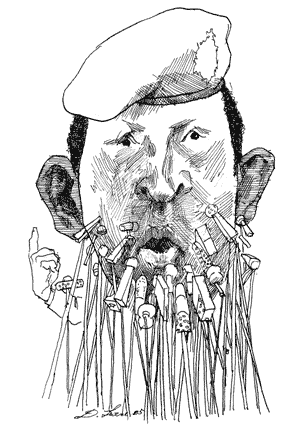
On the reality show that Hugo Chávez, President of Venezuela, stages at irregular but frequent intervals for the benefit of his nation, he is the only star. Most Sundays, he can be seen on the all-day program Aló Presidente, which is obligatory viewing for anyone who might be interested in knowing what will be on the political agenda the following week, but there are also unscheduled interruptions to the evening newscasts and telenovelas, when the President takes over the networks to discuss whatever might be on his mind.
Television is his natural medium: articulate, artless, more than a little hefty, completely at his ease, open-faced and just-folksy even when he is denouncing the press or a laggard member of his own cabinet, Chávez is indisputably fascinating, and often even endearing, when he takes over the airwaves. On Aló Presidente, which tends to start around 11 AM, he might reminisce about an episode of his past life, like the failed military golpe, or coup, that first brought him to public attention back in 1992, when he was an idealistic lieutenant colonel. (At times like this, he is likely to recite a poem, or sing.)
The President also briefly shares the screen with the studio guests. He asks beneficiaries of a particular government program to describe their part in it. Visiting intellectuals and ambassadors are asked to greet the crowd. Members of his cabinet give an accounting of themselves. Front-row guests listen and applaud, and also, perhaps, think longingly about supper and the bathroom—for once admitted to a performance that lasts much longer than the Oscars, guests cannot leave—while Chávez discourses on politics, Jesus Christ, history, the week’s events, baseball, and, at great length, himself. The Chávez show goes on forever, but, like any reality program, it never lasts quite long enough: Who will he rebuke, or dismiss, on the air? What will he say to his wife on the eve of Valentine’s Day? (The correct answer is: “Marisabel, tomorrow I’m giving you yours.”) And, since he has already persuaded the aging world-famous crooner Julio Iglesias to warble “O Sole Mio” along with Jiang Zemin, then president of the People’s Republic of China, and himself, who will he sing with next?
When he takes over all the private television stations for a talk—forming a “national network”—he is usually on his own:
Hello, my friends! A very good evening to you. National network. No time limits. We’ve gone back to the original strategy. We’d made a change, a curveball on the outside corner for a few weeks with the Thursday national networks, but no, tonight we’re going back to the original pitch; that is, whenever it’s convenient, every time it’s convenient. It could be one national network a week, or three or four a week, according to the dynamic of events. Or once a month. We’ll see. We’ll evaluate as we go according to what might be happening in Venezuela and the world. And also, no time limit. It’s nine fifteen, and I think we’ll end around midnight. We’re going to talk about a series of topics which I’m greatly interested in explaining to you, in reflecting on with you, because we’re living in times that require a great deal of reflection, a great deal of thought—and action, of course. We’re living in a peak moment of Venezuela’s history, and all venezolanos and all venezolanas must be worthy of the peak of this supreme moment. Keep your eye peeled. Alert. Careful, because there’s many campaigns that try to disinform, every day. So we revolutionaries must be clear about this. We Bolivarians must be very clear. What is going on? What path is the revolution taking? How is the revolutionary process advancing? Every day with greater optimism. I have more optimism every day. More joyfulness every day: this morning I was singing, and this evening I was singing, some song or another. Perhaps I’ll remember it later. Singing! Joyful! Taking care of people! Solving problems. Looking to the future.1
Somehow, on the screen it all makes sense.
It’s hard to imagine any other chief of state carrying off a performance like this week after week, for nearly six years. Fidel Castro is too inhibited, George W. Bush lacks the imagination, and virtually any other ruler who comes to mind lacks the power, but this the President of Venezuela has in plenty. Ten years ago, a failed golpista and retired military man, he was dependent on friends for pocket money and transportation. Today, at the age of fifty-one, he heads a state with one of the world’s great cash flows, enjoys popularity ratings of 80 percent, faces a vehement but demoralized and perhaps terminally disorganized opposition, and appears to be a magnet to women. It has been a remarkable rise to power.
Advertisement
1.
Hugo Chávez was born into a dirt-poor family at a time when oil was making his country immensely rich. The Chávezes lived far from the provinces of the fantastic oil boom, in a village on the edge of Venezuela’s vast grasslands. His father, Hugo Sr., finished sixth grade and eventually qualified as a rural schoolteacher, but he still didn’t earn enough to keep his family. Accordingly, after Hugo was born, he and his older brother were sent to live in a small nearby town, Sabaneta, with their paternal grandmother, Rosa Inés. Chávez has told one of his biographers, Aleida Guevara, daughter of Che, that he was an active, happy boy, scampering around Sabaneta after school to sell the caramelized fruit sweets his grandmother cooked in a pot at home. An engaging raconteur, he talks about clambering up avocado trees for the fruit, sneaking off to the movies to watch Mexican comedies, and helping the woman he called Mamá Rosa water down the yard, while she chatted to the plants to help them grow and he sang to them. But there is also this:
[After his younger brother Narciso was born, his parents also moved to Sabaneta] and my father built a little house…diagonally across from my grandmother’s house, which was made of thatch. My parents lived there with the other children as they came along…. [Theirs] was a little house made of [cement blocks], a rural house, but it had an asbestos roof and a cement floor.
Chávez does not say what he thought of this arrangement, but although he has remained on perfectly cordial terms with his parents (his mother, Elena, is very much the matriarch of the Chávez brood), his loyalty and family love are reserved for the memory of Mamá Rosa.
Hugo Chávez Sr. seems to have passed his unquenchable desire to be someone, and his love of politics, to his son. The older Chávez would eventually become director of education for his home state of Barinas (he is currently state governor), but this had not yet happened when the younger Chávez, against Mamá Rosa’s wishes but looking for his own way up through the world, decided to apply to the army academy in Caracas.
In their indispensable biography, Hugo Chávez sin uniforme, Cristina Marcano and Alberto Barrera Tyszka provide an account of the future president as a backcountry cadet, shy and well mannered—no reckless escapades or wild drinking nights for him—constantly measuring his social possibilities against his ambition. He loves the army, feels at home in it, graduates eighth in his class. He plays baseball, the national sport, better than well, and his fellows are surprised to see him, the provinciano, emceeing a beauty contest—and not badly, one assumes. He is articulate and likable, and by the age of twenty-one, having obtained a degree in army engineering, with a major in communications, he is the star of his own radio pro-gram. Never an outstanding student, he is nonetheless full of ideas, and soon is at the center of a group of youthful leftist conspirators in the army.
For nearly twenty years Chávez would foster his vague, romantic complot, inspired not by Marxism or any other ideology but by intellectual politicians and nineteenth-century fighters who were his heroes even before he became a cadet. Richard Gott usefully provides chapters on them in his biography, Hugo Chávez: The Bolivarian Revolution in Venezuela. One was Ezequiel Zamora, a leader of the federal forces in the unending civil wars of the nineteenth century: he fought under the slogan “Land and Free Men, Popular Elections, and Horror of the Oligarchy.” There was Simón Rodríguez, the wonderfully cosmopolitan thinker and political adventurer who signed himself “Robinson”—as in Crusoe—and was mentor to Simón Bolívar. And Bolívar himself, supreme: the daring, restless hero who liberated the Andean provinces one by one from the Spanish Crown, and who realized too late that, once separated, the new nations of Venezuela, Colombia, Ecuador, Peru, and Bolivia would never coalesce into the grand union he had dreamed of.
Chávez worships Bolívar, memorizes his proclamations, makes it a point to visit his shrines: the hero’s home in Bogotá, the sites of all his great battles, the tree under whose shade the Liberator used to rest. Marcano and Barrera point out that from an early age the future leader of Venezuela would make a point of tying all the founding moments of his own political life to Bolivarian dates. Once in power, he would also amend the name of his country to “The Bolivarian Republic of Venezuela.” But the unforgettable image is one that they report as rumor, told to them by one of Chávez’s many disaffected mentors, who says he saw it happen: during the early cabinet meetings in Miraflores palace, the official residence, President Chávez would pull up an empty chair for Bolívar.
Advertisement
How in the world did he get to the palace? As they watch him sing and expostulate and scold on their living room screens, the members of Chávez’s disconsolate opposition struggle to understand. Largely, he wanted to. He formed his first clandestine cell within the army at the age of twenty-three, worked constantly to expand it, traveled the country consolidating a core group of conspirators who dreamed with him of a better Venezuela and of their heroic role in creating it. They could change their homeland for the better, Chávez insisted, not quite sure how. He was good at hortatory speeches, both to his troops and in front of the students he ended up teaching history to at the military academy.
When he met Herma Marksman, a young, very pretty historian (his first wife, Nancy, and their children were back in Sabaneta2 ), he told her right from the start that he couldn’t marry her (partly because his mother would not give him permission to divorce Nancy), but that he wanted Herma to share his life and dreams. She did, for nine years, carrying messages around the country, taking notes at meetings, making the calls needed to keep the conspiracy going. Conspiracy to do what? Chávez seemed to be waiting for some inner voice to let him know. He contacted former guerrillas and leftist leaders, lived modestly, came up through the ranks. The country would need him; it needed saving. Oddly, he seems never to have thought of becoming active in politics.
2.
Chávez first acquired his political restlessness in a country that, like him, had already greatly improved its prospects. In 1935, at the death of the dictator Juan Vicente Gómez, Venezuela entered the modern era—entered, at last, the twentieth century, historians like to say. It had a population of barely 3.5 million then, a 90 percent illiteracy rate, no public health services to speak of, a threadwork of dirt roads in lieu of a highway system: Gómez, a monster with a kindly smile who would become the template for so many fictional tyrants, liked to run his country as if it were a hacienda. The approach worked well for him; he ruled for twenty-seven years and died in bed. Another dictator, General Marcos Pérez Jiménez, the last of a line of military tyrants who had ruled Venezuela for much of its independent history, was toppled in 1958, when Hugo Chávez was four years old. As he grew up he benefited from the stability and modernization provided by the civilian regimes that followed the Pérez military dictatorship.
The country’s enviable political stability was made possible in large part by the abundance of oil that left its seaports in those years. Seven presidents, all survivors of the struggle against the dictatorship, succeeded each other in orderly fashion, rotating power between two parties—one, the Acción Democrática, a member of the International Socialist alliance, and the other, the COPEI, allied with the Christian Democrats. But the system bred self-satisfied administrators rather than statesmen. Political debate became a matter of pro forma electoral exchanges between the two parties, both more interested in preserving the privileges of the ruling elite than in restructuring an increasingly unfair society. There was a great deal of corruption, a great deal of waste, and, as the rural population migrated toward the oil territories and Caracas, a huge accumulation of urban poverty and a dearth of public policy to deal with the needs of the poor.
Not all the oil income was lost to corruption and profligacy, though: ambitious educational systems, highways, museums, dams, and health and housing programs were created for a population that multiplied too quickly. (The last census counted some 25 million people.) The last of the big public spenders was Carlos Andrés Pérez, who nationalized the oil industry and presided over the era of Venezuela Saudita. The oil bonanza kept the rate of exchange for the currency (the bolívar, of course) so high in those years that members of the new Venezuelan upper classes, on shopping sprees from Argentina to France, became known for the phrase “That’s cheap. Give me two.” Corruption became a way of life, and by the time Carlos Andrés Pérez left office in 1979, the two-party system in Venezuela seemed bankrupt. Despite the allegations of great personal corruption that have stuck to his reputation, CAP, as he is always called, was revered by the poor after that first presidency. He is remembered as the most charismatic and forceful figure in public life until the advent of Chávez, who staged his failed coup against him. Venezuela produces very little of export value other than oil. The state oil company, Petróleos de Venezuela, S.A., or PDVSA, accounts for 80 percent of export income, 27 percent of the gross national product, and 40 percent of the government budget. Those funds were insufficient to finance CAP’s tireless spending: he left his successor to deal with the resulting inflation, crushing debt, high unemployment, and an empty treasury.
In 1988, the former president campaigned for, and won, a second term in office. A convert by then to the market approach known as the Washington consensus, he declared himself in favor of a currency devaluation, price hikes on all public services, and an end to governement subsidies—a set of measures that were similarly enforced throughout the region, in the hope that the economy would, if not recover, at least become more attractive to US banks and investors. Three weeks later, the inhabitants of Caracas staged the first riot of the century. Descending from the steep hills to which they are normally confined, thousands of caraqueños set fire to entire city blocks and looted whatever they could find.
Dozens of people had already died by the time the President called out the troops and declared a state of siege. When it was all over, more than 250 people were dead, and Hugo Chávez was left with the feeling that, as he told Gabriel García Márquez, he had missed “the strategic minute”3 : desperately poor people were in worse straits than usual and the government was failing them, imposing austerity measures when it was emergency aid that was called for and then shooting them when they rebelled. Politicians were corrupt, at the service of the rich, and incompetent to boot. The civilian two-party system Chávez had known all his life was exhausted. It was time for him to make his entrance, he thought, and he had missed his cue. He would make up for it.
Whatever his original intentions may have been on February 4, 1992, when he at last staged his coup attempt—to overthrow Carlos Andrés Pérez and install a caretaker government, or to make way for a junta that would convoke a constituent assembly—the uprising itself was a complete failure. His longtime co-conspirators fought bravely in other parts of the country, but the army did not split, and in Caracas itself Chávez surrendered with barely a shot fired. Nevertheless, his fortune was made. On the morning following his surrender the army leaders allowed him to make a live televised statement about the failed coup, intending that he would discourage the remaining rebels. They did not insist he tape a prepared statement. He talked for less than ninety seconds, but it was enough for him to establish an emotional connection with his viewers so intense as to guarantee him a permanent place in national politics. “For now,” the conspiracy had failed, he said, two words that might have earned an ordinary golpista an even more severe prison sentence. But the lucky man must have had good friends in the highest ranks of the military: he and his comrades were charged merely with “rebellion.” Two years later he was released from jail, and granted an honorable retirement from the service. Four years later, in 1998, having decided to join the politicians after all, he put himself at the front of his movement, and won 56 percent of the vote in the December presidential elections.
The size of Chávez’s victory is interesting, because in the six years he has been in power he has held various sorts of elections (including one presidential election, one to elect a constituent assembly, and two referendums) and the percentage of his vote has never reached 60. In a country where his target audience of the poor and the very poor together made up around 68 percent of the population last year, nearly half the people who show up at the polls on election day still refuse to vote for him. And nearly three quarters of the adult population has stayed away from recent elections. Chávez, who knows the voting results well, plays a high-risk game: he governs not as if he were the president of a divided nation, but as if he had a national mandate to carry out his Bolivarian revolution, as if he had taken over the presidential chair for keeps.
The definition of the President’s ongoing Revolución Bolivariana under the Quinta República,4 within a system of democracia participativa, remains hazy. Like Bolívar, he would like to unify Latin America. In Venezuela he is the center of power: Chávez has said in various contexts and in several ways that he is not averse to the word “caudillo.” The revolution’s first priority is the poor. It has some elements of socialism (although Chávez was not always so keen on Fidel Castro). Sometimes it is anti-capitalist, and sometimes not: Chávez, who talks often of his own religious faith, has referred to capitalism as el demonio, but a great many businessmen have prospered under his rule, and he has made it clear that he sees a significant role for the private sector and, most particularly, for foreign investment. What there does not appear to be much room for is the opposition.
Within three months of his inauguration the new president won a referendum authorizing him to call a constitutional convention, which replaced the “moribund” old charter with one that concentrates a great deal of power in his hands, and also threatens the very existence of an opposition: government financing of political parties’ electoral campaigns is now outlawed.
In addition, the chavista majority in the National Assembly—which under the new constitution replaced the old bicameral legislative body—increased the number of judges in the high courts from twenty to thirty-two, and made sure the new ones were pro-Chávez, thus virtually ensuring the President a majority. In the course of a lengthy, and a high-risk, confrontation with the state oil company, PDVSA, Chávez also replaced the old meritocracy with his own directorate. This has, essentially, allowed him to run a foreign policy based on oil sales to poor countries on highly favorable terms (and in exchange for their support in international politics), and to use oil income to finance his various domestic projects. Washington, in turn, is hampered in its foreign policy toward Caracas. Although the Bush administration appears to loathe Chávez and his pro-Castro policies, nearly 15 percent of the US oil supply comes from Venezuela.
3.
In downtown Caracas one afternoon I sat in a comfortable, lived-in office, talking to Marcel Granier, owner of RCTV, the largest television station in Caracas. We had talked about the difficulties of running a profitable television station when it is subject to so many long and unscheduled interruptions of its programming by Chávez. Now Granier was recalling the time chavista thugs tried to set fire to the RCTV installations (with everyone inside). I glanced at the panel of screens in his office and saw on one channel a very agitated-looking man waving about the front page of El Universal, a principal Venezuelan daily. “Him?” Granier said. “That’s just Isaías Rodríguez—the attorney general—going on about some article or another.”
It seemed alarming to have a cabinet minister getting into a public lather about a newspaper article, but Granier didn’t pay much attention; this sort of thing happens all the time, he said. Phil Gunson, of The Miami Herald and Newsweek, and Juanita León, of Semana magazine in Colombia, have also been startled to find themselves denounced on the air by high-ranking officials—León by Chávez himself, on a Sunday Aló Presidente—a distinction of sorts.
I later read the transcript of Rodríguez’s press conference: his accusations were convoluted and confused, but I gathered that what he was lamenting was that his office was being systematically attacked by a scheming body of human rights lawyers and international human rights organizations, specifically Human Rights Watch. They were, he said, working in concert with the press and the US State Department, and the proof—or part of the proof, at any rate—was that El Universal had written an editorial charging that the administration of justice was corrupt, inefficient, and barely functioning under his command. This was not fair, this was straight out of the new CIA coup manual, and he would lodge a complaint before the Human Rights Commission of the OAS, charging the plotters with harassment of the government.
Actually, Rodríguez has a faster recourse closer to hand. He could take the author of the offending editorial to court on charges of insulting, or staining the honor of, a public official. There is an old law that covers this offense, but it was rarely enforced in the past, and punishment consisted of payment of a fine. But thanks to a revision in the penal code by the National Assembly—in which chavista members now need only a majority of half plus one to pass legislation—if Rodríguez won his case against El Universal (the lower courts are also packed with professed chavistas these days), the author of the offending editorial could end up serving three to five years of jail time. But this isn’t likely to happen; like other recent legislation on currency controls for individuals, for example, the law is designed to be enforced selectively, and to intimidate.
Other attacks on those who oppose Chávez are more frightening but further from public view; in the army, punishment for opposition has become ruthless, and sometimes fatal. When five corporals were burned to death in their prison cells, a general went on the air to explain how it was possible that blowtorches might have been used to kill them. He was sentenced to five years in prison.
The instrument most frequently used by Hugo Chávez against his opponents, however, is not a law but something known everywhere simply as la lista—the list of signatures submitted in 2004 to demand a referendum on Chávez’s recall. People on the list cannot get government jobs, or qualify for many of Chávez’s public welfare programs, or obtain government contracts. Its use was once surreptitious; officials asked for one’s cédula, or ID/voter registration card, and the number was checked against la lista. But since December, when the list was put on the Internet by a chavista member of the National Assembly, it is used openly. “The…list doubtless fulfilled an important role at a given moment, but that’s over now,” Chávez told his party’s elected officials in April, possibly with a wink. A young doctoral candidate I met in July, who had gone to the National Library the previous week to do research, was asked for her cédula by the woman signing passes. Annoyed, my acquaintance asked why. Ay, mi amor, the woman replied. Para la lista.
It is too soon to judge how well the many ambitious social welfare and education programs launched by Chávez—they are known as misiones—have succeeded in redressing Venezuela’s deep inequalities, but they suffer already from an essential flaw: as with everything else Chávez creates, their existence depends on him. This would seem to be a reflection of the President’s apparent sense that everything that happens, that has happened—in Venezuela, and in this hemisphere as well—in some way relates to him. At a meeting with Uruguayan investors last July he noted that their national independence day was approaching. What a coincidence, he noted: in July also—on July 26, 1953—Fidel led his assault on the Moncada barracks. And on another July 26—in 1952—Evita, Evita Perón, died. “And just two days later,” he said, “on July 28th [1954], I was born! Imagine!” There is the melodramatic flair, the flamboyant clothes, the generic love for the poor and the authoritarianism: one could actually think that he is Evita reincarnate, and Perón, too, if it weren’t for the fact that Perón died rather late (1975) for a proper transmigration of souls to take place.
Such are the hallucinatory terms in which one can easily find oneself discussing the state of Venezuelan politics. In Caracas today it often seems as if there were no issues, only bilious anger or unconditional devotion—or gasping bafflement—all provoked by the President, who takes up so much oxygen that there is no breathing room left for a discussion of, say, the merits of his neighborhood health policy, his relations with Cuba, or whether the chronically overflowing currency reserves should be used merely to guarantee the rate of exchange or to finance, as Chávez has, the multiplying misiones. How can one reasonably discuss whether the upper management of the oil company was involved in plotting a coup when the President is busy firing seven of those managers on Aló Presidente, saying “You’re out!” and giving a blast of an umpire’s whistle? And how can an interviewer, in this case Jorge Gestoso of CNN en Español, possibly discuss the merits of such an approach with Chávez when Gestoso must begin by insisting to Chávez that this event actually did take place?5 The official use of lies, the opposition’s terrified rantings, the abandonment of civility by the press and television take place outside the realm of politics, and do away with reason.
The problem is that all of this defies description, one observer has written:
…That is why the critics are so totally at a loss; they don’t know what the weak flank of chavista politics is because it is an unheard of combination of little-known things, with a totally new result. The populist element, the good-ole-boy element, the martial spirit, the willfulness, the Bolivarian delirium, the economic pragmatism, and the monarchic arbitrariness are known, along with the authoritarianism of the old [Caudillista] compadre. None of this is new, but the combination of it all (to which must be added his luck, of which he has too much) is what is incomprehensible.
Thus, in a convoluted, sometimes brilliant journal, the columnist Colette Capriles, who writes as if she had spent much of the last few years lying on her sofa in a state of mild depression, watching events unfold on the television screen.
Even after a visit of only a few weeks, one can start to feel claustrophobic in Venezuela, as if the people there were all living inside Chávez’s head, with some making small squealing noises as they try to get out. But the President has no visible worries: the various misiones—in favor of ethnic culture, literacy, college equivalency, medical care in the barrios, in defense of street children—are thriving, in no small part because there are tens of thousands of highly skilled Cubans who have been assigned by Fidel to staff them, and also because they are lavishly financed—in ways the health and education ministries could benefit from. Who knows, Chávez says, he might even remain in power through the year 2024, or even 2030.
And why not? In a country with an economy the size of the Czech Republic’s, the value of Venezuela’s currency reserves is now $30 billion. Oil prices are not expected to decline anytime soon. The Bush administration, for all its hostility to Chávez, does not seem able to hurt him seriously. There are local and national elections of various kinds scheduled every single year between now and 2013, and Chávez and his political parties (he has two) can reasonably expect to win in all of them. Best of all, he has no local politicians—certainly none in his own movement—threatening his popularity. He can smile and go forward, singing. Joyful. Solving problems. Looking to the future.
—September 7, 2005
—This is the first of two articles.
This Issue
October 6, 2005
This Issue
October 6, 2005
-
1
The complete text of this broadcast on the failings of the press, which took over the private television stations for more than four hours, can be found here. ↩
-
2
Chávez is currently estranged from his wife, the former Marisabel Rodríguez. He has three daughters and one son. ↩
-
3
Gabriel García Márquez, “El enigma de los dos Chávez,” Revista Cambio, February 1999. ↩
-
4
Venezuela has had four prior republics, Richard Gott explains: two separate republics were formed during the wars of independence; the Third Republic was created by Bolívar at the time of the formation of Gran Colombia, on achieving independence in 1819; the Fourth Republic, or independent Venezuela, was declared in 1830 by the caudillo José Antonio Paez and lasted until the Fifth, which was formally inaugurated during Chávez’s first year in office. ↩
-
5
“You say…that in PDVSA those who don’t agree with Chávez [get a whistle blown at them] and they’re out. It’s not like that,” says Chávez to Gestoso, who, for his part, is both aggressive and patronizing. For the complete text of the interview see www.analitica.com /bitblioteca/hchavez/entrevista20021213.asp. ↩
