
1.
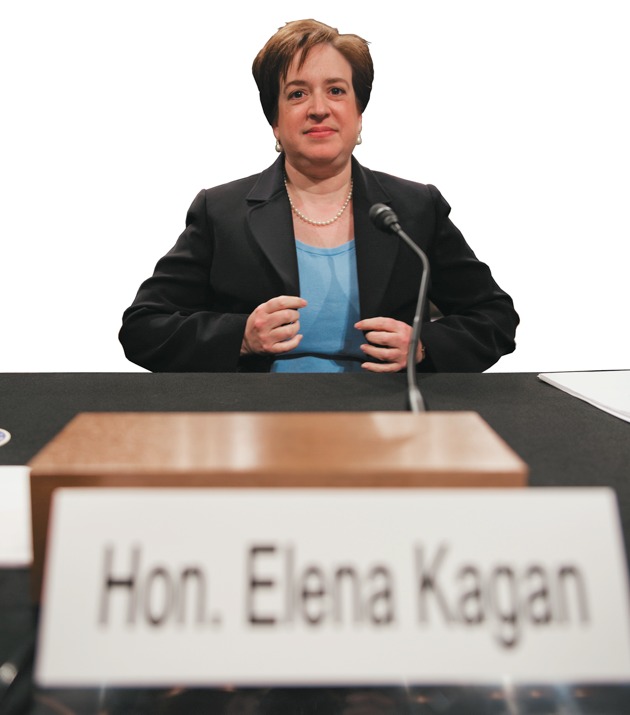
Recent Senate Judiciary Committee hearings on Supreme Court nominees have been a waste of everyone’s time, a parade of missed opportunities. In 1995 Professor Elena Kagan, then of the University of Chicago Law School, explained why:
When the Senate ceases to engage nominees in meaningful discussion of legal issues, the confirmation process takes on an air of vacuity and farce, and the Senate becomes incapable of either properly evaluating nominees or appropriately educating the public…. Such hearings serve little educative function, except perhaps to reinforce lessons of cynicism that citizens often glean from government. Neither can such hearings contribute toward an evaluation of the Court and a determination whether the nominee would make it a better or worse institution.
She offered clear advice. Though nominees should not declare their voting intentions about specific cases on the horizon, she said,
a nominee can say a great, great deal before making a statement that, under this standard, nears the improper. A nominee, as I have indicated before, usually can comment on judicial methodology, on prior case law, on hypothetical cases, on general issues like affirmative action or abortion.
Her own confirmation hearings in late June were a Galilean moment. How much of her 1995 statement would she recant? Almost all of it, it turned out. She said that Senator Orrin Hatch of Utah had persuaded her, in a private meeting before the hearings, that the “balance” of her earlier statement was “a little off.” So, contrary to her own advice, she would not “grade” either the justices of the present court or the Court’s past decisions, she would not speculate about hypothetical cases, and she would certainly not discuss “general issues like affirmative action or abortion.” On the contrary, she vowed to say nothing from which the public might draw even any general assumptions about the political impact she might have on the Supreme Court.
It was predictable that Kagan would follow this now well-trodden path. She knew that if she disclosed nothing she would soon be a Supreme Court justice for life. If, on the contrary, she was even slightly more adventurous, there was a good chance she would not be confirmed. If she showed herself sympathetic to abortion rights or unsympathetic to gun rights, for instance, Republicans and conservative Democrats would feel bound to join a filibuster to sink her.
The committee senators, for their part, had no reason to press her to be more forthcoming. Democrats had no wish to endanger her appointment, which would be a terrible defeat for the President, and Republicans had no wish to contradict their own repeated and ludicrous declarations (cheerfully endorsed by their recent nominees, Chief Justice John Roberts and Justice Samuel Alito) that a judge can always decide what the law requires without calling on any moral or political convictions or any theory of social justice. Most of the senators were content to report their own commitment to gun rights and, depending on party, to announce their contempt or enthusiasm for the Supreme Court’s recent 5–4 ruling, in the Citizens United case, that freed corporations to spend whatever they wish on television electioneering.1
The Republicans labored, somewhat halfheartedly, to paint Kagan as hostile to soldiers because as dean of the Harvard Law School she, like the deans of other prominent law schools, did not allow military recruiters who discriminated against open homosexuals the same recruitment facilities as other employers. It didn’t work because she pointed out that the military had better recruitment access in her administration than under her predecessors.
Some senators tried, for a time, to tempt Kagan out of her defensive crouch. Senator Herb Kohl of Wisconsin said he assumed that she, like any other politically engaged person, has “passions.” Justice Ruth Bader Ginsburg is passionate about women’s rights, for instance, and former Justice Thurgood Marshall, for whom Kagan clerked, was passionate about civil rights. “I’m sure you’re a woman of passion,” Kohl said. “Where are your passions?” Yes, she admitted, she had passions too, but there was no point in discussing them because they would, of course, play no role in her decisions, which would be guided only by law. Senator Chuck Grassley of Iowa asked her to say that gun ownership was not merely a constitutional right under the Second Amendment but a God-given natural right as well. She declined to say whether she believed in natural or moral rights but declared that she would respect the Court’s recent 5–4 decisions recognizing constitutional gun rights as (in one of her favorite phrases) precedents “going forward.”
Senator Jon Kyl of Arizona asked whether she agreed with President Obama, who said, when he nominated Justice Sonia Sotomayor, that law decides 95 percent of a hard case, but that the rest of the decision was a matter of empathy. No, she replied, even a very hard case is “law all the way down.” There is always one right answer to any constitutional question and though judges may disagree about what that right answer is they must do their best to find it. Empathy or sympathy or a sense of social justice has nothing to do with the matter.
Advertisement
Did she stand by the legal and political opinions she had expressed in various roles earlier in her career? No, she was wearing different “hats” in her earlier jobs, and what she said then was no guide to what she would think as a judge. When she clerked for Justice Marshall she only “channeled” his opinions; when she worked in the Clinton White House she promoted what she took to be the President’s views; as solicitor general she has, like a good advocate, acted only in the interests of her client, the United States.
Near the end of the last day of hearings—and near the end of his own political career—Senator Arlen Specter of Pennsylvania expressed his disgust:
Well, Solicitor General Kagan, I think the commentaries in the media are accurate. We started off with a standard that you articulated at the University of Chicago Law School about substantive discussions. And they say we haven’t had them here, and I’m inclined to agree with them. The question is where we go from here…. It would be my hope that we could find someplace between voting no and having some sort of substantive answers.
He was right about the media: the Kagan hearings have been almost universally denounced as pointless and calls for reform have increased. It is important to review the hearings in some detail to consider how far that charge is justified and how confirmation hearings might be improved.
2.
The Supreme Court is a very powerful political institution: justices are appointed for life and five of them can veto any decision, no matter how popular, of Congress or a state legislature. Only the Senate confirmation hearings offer the public a chance to participate in the process of selecting these powerful officials, and that opportunity can be important. It was popular political pressure that led the Senate to reject President Reagan’s nomination of Judge Robert Bork in 1987. But since then nominees have largely stonewalled the hearings and, as Kagan pointed out in 1995, failure of disclosure undermines the public’s power to help choose. So senators would seem to have a democratic duty to press nominees to be more candid. Specter said that perhaps the Senate should “stand up on its hind legs” and reject any nominee who is as unforthcoming as Kagan was.
Some of the arguments that nominees have offered for their silence are very weak. Kagan said that she must not disclose her views about particular issues that might come before the Court because it would be injudicious and unfair to future litigants for her to publish her views in advance. But she is joining a Court on which eight other justices have expressed their opinions on a large variety of constitutional issues through their votes and their majority or dissenting opinions. If these public statements do not compromise their ability to decide fairly in the future, there is no reason why nominees should not make their opinions public as well.
However there is a genuine and important countervailing argument. It is crucial to the role Supreme Court justices play in our constitutional system that they be free and able to reject popular opinion—to overrule the wishes of the majority in order to protect individual rights. The individual rights that need protection are often unpopular; it would compromise that crucial role were the public able to defeat a nominee because he or she proposed to defend such rights. It seems doubtful, for instance, that anyone who declared a concern to protect due process rights of suspected terrorists, or to better protect the rights of women to choose abortion, or to recognize a constitutional right to gay marriage could be nominated now or, if he were, escape a filibuster or outright defeat. So if nominees were as candid as Kagan proposed in 1995, and senators approved only those with very popular opinions, Americans might lose their traditional protection against majority selfishness, intolerance, or prejudice.
True, the right-wing phalanx of the Court has used its power to overrule the will of the majority in what strikes many of us as an indefensible and dangerous way: not to protect a vulnerable minority from majority indifference or hatred but to protect conservative interests and privilege from progressive legislation.2 Richard Posner, himself a conservative judge, recently wrote that four of the five most conservative justices since 1937 are together on the Court now: Chief Justice Roberts and Justices Clarence Thomas, Antonin Scalia, and Samuel Alito. Many lawyers believe it would have been better had Roberts and Alito been forced to disclose their real substantive intentions in their hearings because they would not have been confirmed if they had. Posner said of Roberts: “The tension between what he said at his confirmation hearing and what he is doing as a Justice is a blow to Roberts’s reputation for candor and further debasement of the already debased currency of the testimony of nominees at judicial confirmation hearings.”3
Advertisement
Scholars who approved the power of the Supreme Court to overrule legislation during its more liberal periods may well have second thoughts now that right-wing justices are so firmly in control. But I continue to think that the institution of judicial review has done more good than harm to our country, and still promises more good than harm in the long run. We should not compromise the Court’s role or its independence just because it has now been captured—we do not know for how long—by right-wing zealots who understand neither law nor justice. That would be yet a further grave cost of the right-wing coup.
Kagan was therefore right in 2010: her 1995 statement did indeed get the “balance” wrong. Nominees should not be required to rank other justices or past decisions and they should not be required to discuss their intentions about highly controversial constitutional issues like abortion or the rights of accused terrorists. But they should certainly be pressed to discuss constitutional theory and political principle at a more abstract level, and that interrogation should be much deeper than the entirely superficial level at which such questions were raised in the Kagan hearings.
Kagan said, remember, in reply to Senator Kyl’s question about Obama’s jurisprudence, that though reasonable justices would inevitably disagree about the correct answers to the most challenging constitutional questions, there nevertheless are right answers they must each try to discover. That is what it means to say, as she repeatedly did, that adjudication is “law all the way down.” Her claim is, in my view, correct and important. But it raises an obvious further question: How can justices find those right answers without relying, as Kagan insisted she would not, on controversial moral judgment? True, some clauses of the Constitution are explicit and require no interpretation. As Kagan pointed out, judges may not declare that the Constitution’s requirement that senators be “thirty” years old really means “forty” because people live longer now. But some of the most important constitutional clauses are drafted in abstract moral language, such as the Fourteenth Amendment’s injunction that government must accord everyone the “equal protection” of the law. How can judges decide whether laws against consensual gay sex or gay marriage deny equal protection to homosexuals without deciding, for themselves, what equal citizenship means and requires?
Some conservative lawyers, including Scalia and Thomas, insist that judges can avoid such moral judgment because they can find the right answers in history: they think that the abstract moral clauses should be applied either in the way the “framers” (those who enacted the clauses in question in the eighteenth and nineteenth centuries) intended or in a way that respects practices and traditions embedded in American history. But these suggestions are unhelpful because a judge must rely on moral conviction even to discover what history teaches.
Consider the first suggestion: that justices should look to the framers’ intention. What did the framers intend when they made moral principles such as the equal protection clause part of constitutional law? Kagan offered an excellent and in my view crucial distinction. We must, she said, distinguish between what the framers meant to say and what they themselves expected would be the legal consequences of their saying it. They chose the language of abstract moral principle, not of precise rules:
And in writing the provision that way, I think that the drafters of the Constitution knew exactly what they were doing. They didn’t mean to constitutionalize all of their practices in 1868. They meant to set forth a principle of equality that would be applied over time to new situations and new conditions. And I think that’s exactly what has occurred.
She cited an example. The Supreme Court did not change the Constitution, but only enforced its original meaning, when it declared racial segregation unconstitutional in the Brown case of 1954. But that is not because the framers themselves rejected school segregation. They did not: on the contrary, the Congress that adopted the Fourteenth Amendment itself segregated the schools of the District of Columbia from 1864 onward. The Court enforced the original meaning of the Fourteenth Amendment in 1954 because the framers laid down a principle that required the justices to decide for themselves whether segregation is consistent with equal citizenship and they decided, rightly, that it is not.
Now consider the second supposed historical source: practices and traditions embedded in American history. The first ten amendments to the Constitution—the “Bill of Rights” adopted in 1789—apply only to Congress, so when the Court held 5–4 two years ago, in the *Heller* case, that the Second Amendment guarantees gun rights to individual citizens, that meant only, in itself, that Congress could not ban guns in the District of Columbia. But the Court has long insisted that the Fourteenth Amendment, which applies to the states, “incorporates” certain of the original rights and so made them enforceable against the states as well. For many decades the Court followed the famous test offered by Justice Benjamin Cardozo: the Fourteenth Amendment incorporates only those original rights that are essential to “ordered liberty,” rights, that is, like the right to free speech, without which a society is not free.
In the MacDonald case, decided the day the Kagan hearings began, the Court ruled, again 5–4, that the Fourteenth Amendment does incorporate the Second Amendment, so that states as well as Congress must recognize private gun rights. The conservative justices could hardly claim that private handguns are essential to a free society. They fell back on another traditional formulation of the test: the Fourteenth Amendment incorporates all of the original rights that are “deeply rooted in this Nation’s history and tradition.” They declared that gun rights meet that historical test. But as Justice Stephen Breyer pointed out in his dissenting opinion, history defeats as much as it vindicates that claim. Gun control is popular and accepted in some parts of the country though not others; any judgment that gun freedom is “deeply rooted” in the nation as a whole must be an interpretive value judgment that takes one of these traditions to be more “fundamental” than the other. It must be the kind of interpretive judgment that led the Court once to declare that outlawing homosexual sex is a fundamental American tradition and later to insist that it is not.4
So history is no substitute for political conviction: a judge needs convictions about equal citizenship or fundamental rights to decide how history should be read. Then how could Kagan decide difficult constitutional issues without relying on such conviction? She offered this answer:
I think that what I’ve said is that you look to text. You look to structure. You look to history, very much including and very especially the original understandings. And you look to precedents. And in one or another cases, one of those may be more important than others of them. In some cases, you might look to all of them. And that’s a kind of pragmatic approach, not an approach that takes a sort of grand overarching philosophical view as to, you know, it’s just one thing and it’s got to be that one thing in every case.
This answer is not only guarded but empty: it says nothing at all. In academic law, more than in other disciplines, phrases quickly grow runic: it is now expected of legal theorists that they will abjure “overarching” theories and endorse a “pragmatic” approach. In this context, however, “pragmatic” has no content. In philosophy, pragmatism is a theory of scientific truth; in politics it means doing what is necessary to achieve a stipulated goal—Mideast peace, for instance, or reelection. But in constitutional law the question is not how to achieve a given goal but which goal we should try to achieve. Is it “pragmatic” to protect fetuses from abortion? Or to protect a woman’s power to decide for herself? Justices should of course be “pragmatic” in guarding a right to free speech. But that truism doesn’t help them decide what that right embraces.
Nor is it plain what makes a theory “overarching” or how such theories can be avoided. How might Kagan decide how each of the several factors she listed as pertinent to a decision bears on a particular case and which are more important when they point in different directions? This cannot be a matter of an ineffable intuition provoked mysteriously by one case but not another. She needs a theory and, if that theory is to guide her choice among factors, it must of course be a theory that applies across all cases so that it helps answer that question consistently in each of them. Isn’t that what “overarching” must mean?
Each of the discrete factors Kagan mentioned, as figuring in her decision, raises further problems of interpretation. She talked a great deal about precedent: she said she regarded the conservative 5–4 decisions she might be expected to disapprove, about gun rights or corporate electioneering for example, as “settled” law and “valid” precedents “going forward.” She admitted, however, that
there are various reasons for why you might overturn a precedent. If the precedent has proved—proves unworkable over time or if the doctrinal foundations of the precedent are eroded, or if the factual circumstances that are—were critical to why the precedent—to the original decision, if those change.
She was not pressed to elaborate. Her answer was almost identical to what Roberts and Alito said about precedent and once they were confirmed they joined the other conservative justices in an overruling spree unparalleled in Court history. What makes a precedent “unworkable?” In Citizens United, Roberts, explaining why he was overruling a recent decision, said that that decision “actually impedes the stable and orderly adjudication of future cases.” He cited the fact that the conservative justices who dissented in the earlier case had continued to declare their opposition to it. If that is enough to justify overruling, no important precedent would be safe.
Abortion rights continue to be denounced by Scalia and Thomas and continue to be hated by many millions of Americans. Does that make Roe v. Wade “unworkable”? Many of the Court’s recent abortion decisions—in overruling a recent decision in order to permit a ban on “partial-birth” abortion, for instance—might well be thought to “erode” Roe’s “doctrinal foundations.” Does that make Roe itself ripe for overruling? (Much of the Roberts Court’s jurisprudence might be preparing for the day it does that.) When do the pertinent facts change sufficiently to permit overruling? If television electioneering does prove to intimidate congressmen and corrupt democracy, as Senator Sheldon Whitehouse of Rhode Island predicted, would that mean that “factual circumstances” had changed sufficiently to overrule Citizens United? These are obvious questions that no one asked.
Kagan also spoke repeatedly about another important jurisprudential issue: she vowed to interpret congressional statutes according to what Congress intended.
When a text is ambiguous, which, you know, frequently happens, which frequently happens, then I think that the job of the courts is to use whatever evidence is at hand to understand Congress’s intent, and that includes exploration of Congress’s purpose by way of looking at the structure of the statute, by way of looking at the title of the statute, by way of looking at when the statute was enacted, and in what circumstances, and by way of looking at legislative history.
But what can the idea of Congress’s intention mean? Individual senators and representatives vote for or against a statute laid before them for a variety of reasons and with a variety of expectations, some of them plainly irrelevant, such as a desire to please campaign contributors or party leaders. Judges who appeal to a legislative purpose do not have in mind some psychological amalgam of these different purposes of different legislators: finding the intention of the legislative body as a whole requires an interpretive, not a psychological judgment. It requires a judge to make the best sense of a statute’s language in the political and economic circumstances in which Congress acted, taking everything Kagan mentioned into account.
When a text is unclear or radically abstract—when it speaks, for instance, of “unreasonable” restraints of trade—that interpretive judgment must draw on a judge’s own political sense. Kagan might have been pressed to say not merely what factors count but how they count. She might have been invited to describe the standards she would use, which might well differ from those of other judges, to make the interpretive leap from bare history to substantive interpretation.
3.
On all evidence Elena Kagan—whose nomination was approved by the Senate Judiciary Committee in a 13–6 vote—will be confirmed by the Senate and will be an excellent Supreme Court justice. Her credentials are superb. Some of her former colleagues believe that she will be less liberal on several issues—including treatment of terrorist suspects—than John Paul Stevens has been but that she can be counted on to help resist the careening path of the Court to the right. She has the intellectual power to supply more of what the Court now needs: a reinvigorated theory of what the Constitution means. Her statement that the framers’ intention was to enact principles of political morality, not their own opinions about what those principles require, is an excellent beginning. That she offered little more on this occasion is not her fault. She had every reason not to, and no one pressed her in the ways she might have been pressed.
It would be a mistake, as I said, to force nominees to state their voting intentions on particular concrete cases. But they should be required to discuss the larger issues of constitutional philosophy that I have mentioned: to provide a general account of how they propose to interpret and apply the grand but abstract clauses of the Constitution. This account might include, for instance, stating a general definition of what equal citizenship requires, what they take the purpose of the First Amendment’s free speech protection to be, and whether they are drawn to a majority-rule conception of democracy or a conception closer to that Justice Breyer defended in his recent book, Active Liberty.5 Skillful nominees can answer such questions without forecasting their own future votes in particular cases. In that way they can educate the public in the political complexities of constitutional law without compromising their protection of individual and perhaps unpopular constitutional rights.
One structural change in the Judiciary Committee’s procedures would seem particularly helpful. It should appoint special majority and minority counsel, who might be academic specialists in constitutional law, to conduct a major part of the hearings, as other congressional committees do in other investigations. Senators will not of course deny themselves the opportunity to preen before constituents and to try to demonstrate (sometimes successfully) their own knowledge of constitutional law. But their television time could be reduced to give special counsel opportunity to press nominees in much more depth than senators can. This may not help much. But confirmation hearings remain the best and perhaps only opportunity to make constitutional law a matter of public interest and concern. That is a grand goal—it would improve our democracy in many ways—and we should miss no opportunity to pursue it.
—July 22, 2010
This Issue
August 19, 2010

The Crisis & the Euro
This Issue
August 19, 2010
The Crisis & the Euro
-
1
See my [“The Decision That Threatens Democracy,”](/articles/archives/2010/may/13/decision-threatens-democracy/) *The New York Review*, May 13, 2010. ↩
-
2
See my *The Supreme Court Phalanx: The Court’s New Right-Wing Bloc* (New York Review Books, 2008). ↩
-
3
*How Judges Think* (Harvard University Press, 2008), p. 81. ↩
-
4
Compare *Bowers* v. *Hardwick*, 478 US 186 (1986) and *Lawrence* v. *Texas*, 539 US 558 (2003). ↩
-
5
*Active Liberty: Interpreting a Democratic Constitution* (Oxford University Press, 2008). ↩

