

1.
One evening in June 1914, Osbert Sitwell attended a concert in London at which Richard Strauss performed his Sonata in E-flat for piano and violin, Strauss playing the piano and Lady Speyer the violin—much as John Singer Sargent depicts her with her Stradivarius in the portrait he painted in 1907. Writing afterward about Lady Speyer and her wealthy American-born financier husband, Sir Edgar, Sitwell says that their grand mansion in Grosvenor Street
sheltered the sort of art collection that is seldom seen in England but is more common in America. Many of the items might have been chosen by a magpie who had found himself a millionaire: some were dark in tone, it is true—yet all glittered and were rich in luster. There was something in the atmosphere, too, that recalled the public rooms of an expensive liner. French staircases, German woodcarving, Augsburg plate, crystal vases from China, Persian tiles, and some of the furnishings of Marie Antoinette’s boudoir, all these were united by the taste of the owners for objects of luxury.1
What Sir Osbert apparently means by an American sort of art collection is one that displays paintings and sculpture in a luxurious setting of splendid decorative arts. He could, of course, have found much the same thing nearer home, with the Sassoons at Houghton Hall or in Park Lane, for example, or with the Camondos in Paris on the rue de Monceau. The English prototype of all such collecting is Hertford House in London, where the opulent Wallace Collection has been displayed to the public since 1900. But the American “squillionaires,” as Bernard and Mary Berenson liked to call them, were often richer and not infrequently more ostentatious—and of riveting fascination to English nobility for the heiresses they might provide as spouses. What is interesting is that Sitwell thinks of such comprehensive collections as American rather than as English or European.
Beginning with J.P. Morgan and Isabella Stewart Gardner, a lengthy succession of very wealthy nineteenth-century American “buccaneer collectors,” as Kenneth Clark once termed them—Henry Walters, Henry Clay Frick, Henry Huntington, Charles Lang Freer, Andrew Mellon, Joseph Widener, to name the most eminent—formed large collections of paintings that they then displayed in an ambiance of elegant, expensive decorative arts. There were, of course, other notable collectors—the Havemeyers, the Lewisohns, the Cone sisters, the Clark brothers, Guggenheim, Kress, Phillips, etc.—but they collected paintings almost exclusively. In the twentieth century, fewer comprehensive collections were formed, but one of the largest of all time was that of Robert Lehman, so eminent that it was given a special exhibition at the Orangerie in Paris in 1957, the only American collection ever to be afforded that honor. Lehman was probably the last of the magpie millionaires.
Such comprehensive collections may be seen as reflections of that characteristic nineteenth-century impulse to undertake impossibly large, all-embracing projects. Although there are some notable earlier precursors, such as Bayle’s Dictionnaire (1695) and Diderot’s Encyclopédie (1751), the full force of this obsessive impulse was to be felt in the nineteenth century with innumerable grandiose projects, such as (to give only a few examples) Jacques Paul Migne’s Patrologia Latina in 221 volumes or Theodor Mommsen’s Corpus Inscriptionum Latinarum, begun in 1853, which by now contains almost 200,000 inscriptions and has yet to reach conclusion; James Murray’s Oxford English Dictionary or Leslie Stephen’s Dictionary of National Biography; the Louvre and the British Museum—each attempting to encompass and categorize dauntingly vast areas of human experience and learning. The Wagnerian idea of Gesamtkunstwerk (a synthesis of various arts in one embracing work) is an artistic offshoot of these ambitious attempts to bring everything together.
Although the great American art collectors did not have quite such overweening aspirations, they did desire to create a total ambiance—a Gesamtkunstwerk, if you will—of furnishings, decor, paintings, and sculpture in which to live. In Isabella Gardner’s case, she chose to recreate a Venetian palazzo, but the others were mostly content with something a bit less historic and histrionic. One can still see two of the best of these collections in their original settings at the Morgan Library and the Frick Collection. What Robert Lehman, a member of the Lehman Brothers banking family, managed to assemble may be the last great example of this, and if some of the objects are less than first-rate, that is no doubt because he came late, when the available supply of masterpieces had greatly diminished, and because he apparently had somewhat less money than his great predecessors or even some of his contemporaries. His collection is not at all as formidable and imposing as those of his coevals Albert Barnes, Norton Simon, and Baron Thyssen, and he was fortunate that his collecting interests did not much overlap with those of Paul Mellon or Nelson Rockefeller.
Advertisement
The Lehman Collection was begun by Philip Lehman, Robert Lehman’s father, around 1911, when Bobbie (as he preferred to be called) was only twenty; yet it would appear that much of what Philip bought was influenced by Bobbie’s taste. Like the other major American collectors of the day, the Lehmans were advised on purchases of paintings and drawings by Bernard Berenson, whom Bobbie knew personally and with whom he had a lengthy correspondence. When Philip retired from business in 1925, Bobbie replaced him as head of Lehman Brothers and took over as well the collection, which was kept in the family home at 7 West 54th Street. Bobbie himself lived with a succession of wives in a large apartment on Park Avenue and a house on Long Island, in both of which the post-Renaissance parts of his collection were housed.
A few years before his death in 1969, Lehman began negotiations with the Metropolitan Museum about the possibility of giving them this huge collection of some 2,600 works of art. The house on 54th Street was too small to function effectively as a museum, and several other possibilities were considered but rejected before the Metropolitan was chosen as the recipient of this treasure. Bobbie, concerned to emphasize the integrity and uniqueness of his collection and determined not to let it get lost in the general collection of the museum, specified that the collection should be “exhibited intact and in perpetuity in a manner evoking the ambiance of his ancestral home rather than that of an institutional collection.” He insisted that it should have a wing of its own, distinct from the rest of the museum. The Metropolitan was so covetous of the collection that it not only surrendered to Lehman’s imperative conditions but, as additional enticement, made him chairman of its Board of Trustees. He had wanted for some years to be president of the museum, but that post was held by Arthur Houghton, so the position of chairman was created for him in 1967, and he held it for the last two years of his life.
The circumstances of the collection’s transfer to the Metropolitan were “obscure and controversial,” as Jane Boutwell wrote in a New Yorker piece back in 1975, where she recounted verbatim some of the things Thomas Hoving, the museum’s director, had said describing his recurrent difficulties with Bobbie. Hoving subsequently wrote elsewhere, in his preface to a guide to the collection and in his autobiography, about the trying, complex negotiations involved in the gift, for which the Met built a new, domed wing designed by Kevin Roche. Preservationists objected vehemently to the new wing’s encroachment on Central Park and went to court in a failed attempt to prevent it; and when the wing was finally erected, the late Ada Louise Huxtable wrote a notorious, highly ambivalent review of it in The New York Times, a bittersweet appraisal confected of both admiration and resentful disapproval. Only five years ago, writing in anticipation of the new building in Philadelphia to house the Barnes Collection, she even more forcefully criticized the Lehman Wing as “an exercise in patronizing and self-delusory sophistry that is supposed to lull us into thinking that we are keeping a place, or an ambiance, already irretrievably lost.”
2.
With the publication of a volume devoted to decorative arts, the monumental, fifteen-volume catalog of the Robert Lehman Collection has at last reached completion after almost thirty-five years of labor by a pantheon of eminent scholars, beginning with John Pope-Hennessy, who published the first volume, on Italian paintings, in 1987. By now, four of the volumes are, sadly, already out of print, including the important volume on Italian (mostly Venetian) eighteenth-century drawings, which also appeared in 1987. Few private collections have been honored with a catalog so complete and containing such superb, informative scholarship as this one, which is, as one of its contributors rightly claims, “unique in American museum scholarship in its scope and range.”
It was Michael Thomas, a former curator at the Met and a trustee of the Lehman Foundation, who had the felicitous idea for this undertaking and who proposed a consortium comprised of the Institute of Fine Arts (providing the scholarship), the Metropolitan Museum (providing editorial and publishing supervision), and the Lehman Foundation (providing the funds). An agreement initiating this venture was signed in August 1978, and the triumvirate of scholars who defined and supervised the project in its early years, choosing authors for the various volumes, could not have been more exalted: John Pope-Hennessy from the Metropolitan Museum, Sydney Freedberg from Harvard and the National Gallery of Art, and Egbert Haverkamp-Begemann from the Institute of Fine Arts.
Professor Haverkamp-Begemann, who is unquestionably the hero of this prolonged and laborious endeavor, has continued to serve as coordinating scholar for the entire series almost from its inception, and it is largely because of his lofty standards and scrupulous surveillance that such an impressive level of scholarship has been maintained throughout. Each item has been subjected to intensive scholarly investigation. Each entry provides a detailed description of the object and its provenance as well as a brief essay discussing its qualities and history. Each volume contains an extensive bibliography of the subject involved and a thorough index. The only equally substantial, wide-ranging catalog of this sort I know is that of the Wallace Collection.
Advertisement
The range of what Lehman collected is astonishing. In addition to eight volumes on paintings, drawings, and watercolors, there are also individual volumes for illuminations, majolica, glass, textiles, sculpture and metalwork, and antique frames. The final volume on decorative arts contains entries on ancient bronzes; painted enamels; European snuffboxes and ceramics; European furniture; Chinese ceramics; Islamic pottery; Chinese and Thai cast metal and Chinese stone; carpets; Japanese, Chinese, and Indian textiles; and jewelry and precious objects (including thirty-four acknowledged forgeries). Given the exceptional breadth of his collecting interests, it’s surprising only that Lehman didn’t also collect ivories, porcelain figurines, and silver. But as his curator, George Szabó, once observed, “he bought the strangest things, and he bought only what he liked.”
In an essay describing this collection, the late Theodore Rousseau, curator of paintings at the Metropolitan, wrote in 1963, six years before Bobbie’s death:
The Lehman Collection has been made by a man who does not limit his choice to one kind of object, who does not try to complete a set or to prove or teach anything, but acquires only what appeals to his sense of quality, regardless of what the object is. His collection is therefore unique in its quality as well as in its size. Nothing like it has been brought together in America during the twentieth century…. Each object was chosen because something peculiar or individual about it appealed to the collector. Robert Lehman’s interests in art have no limits.
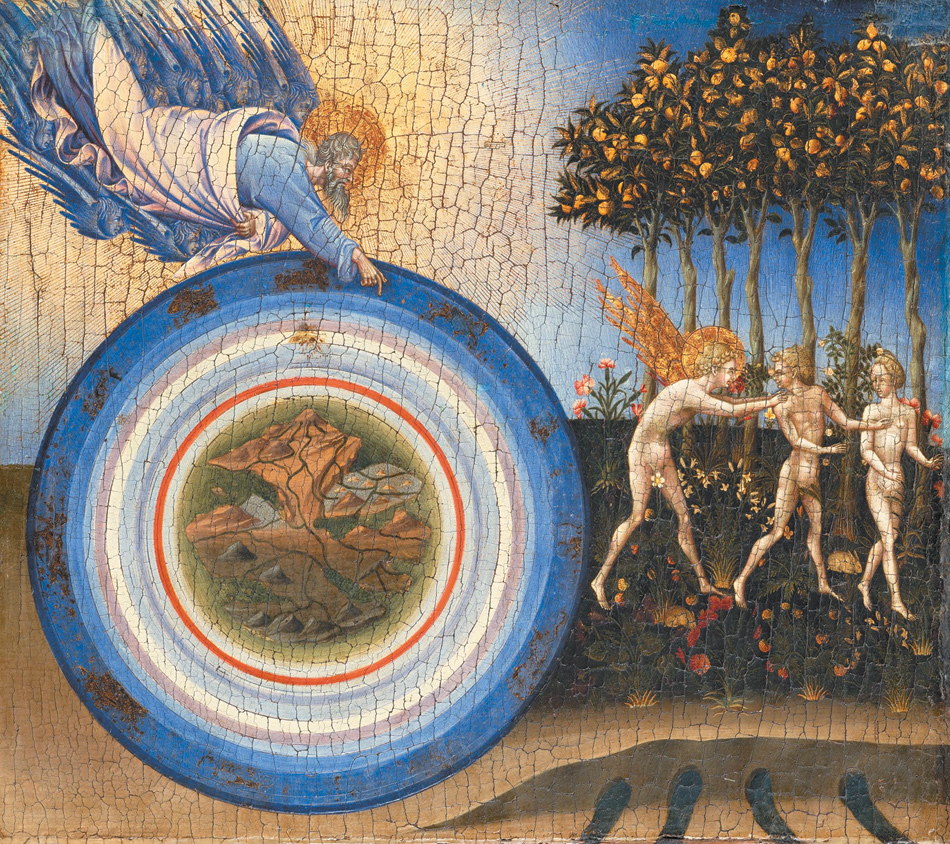
The most distinguished section of the collection is that of Italian paintings and drawings from the fourteenth to the eighteenth centuries. Although most of the very greatest Renaissance artists are unrepresented, there is a ravishing little Annunciation by Botticelli, one of the smallest pictures he ever painted, which Robert Lehman bought for his father’s sixty-fifth birthday, an unforgettable drawing of a walking bear by Leonardo da Vinci, a tranquil, early Madonna and child by Bellini, two fine Simone Martinis, eleven pictures by the incomparable Giovanni di Paolo, including his well-known Creation of the World and the Expulsion from Paradise—see page 33—(which I like to imagine, perhaps fancifully, may have had some influence on Paul Signac’s 1890 portrait of Félix Fénéon), and a marvelous sunset landscape with Saint Anthony Abbot, which was formerly attributed to Sassetta, is given in the catalog to the Osservanza Master, and is now thought perhaps to be by Sano di Pietro.
In addition, there is probably the largest collection of Sienese fondi d’oro (thirteenth- and fourteenth-century paintings with gold backgrounds) outside of Siena. The drawings include, in addition to the Leonardo bear, a superb pencil and ink study for an equestrian statue by Pollaiuolo, two important drawings from the circle of Giovanni Bellini and his brother-in-law, Andrea Mantegna, some memorable drawings by Canaletto and by Francesco and Giacomo Guardi, and a large number of drawings by Giambattista Tiepolo and his son Giandomenico, including an engaging series by Giandomenico depicting the escapades of Punchinello.
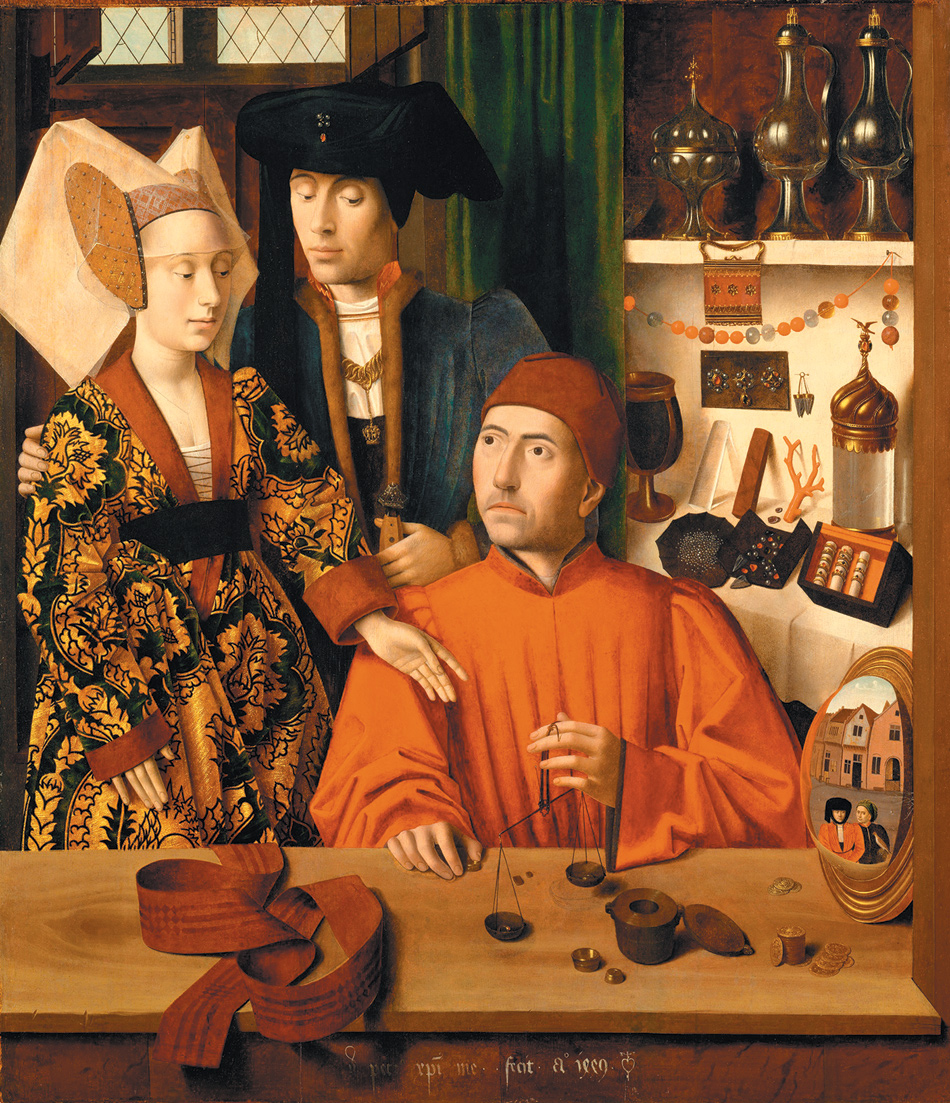
The outstanding paintings from farther north in Europe include an intriguing Petrus Christus of A Goldsmith in His Shop, a tender Goya portrait of the Condesa de Altamira and her daughter, a monumental El Greco of Saint Jerome, a portrait of young Margaret of Austria by the Maître de Moulins, important paintings by Memling, Holbein, and the Cranachs, and a disturbing Rembrandt of a fellow artist and theorist disfigured by hereditary syphilis, which only a very courageous collector would have bought. The greatest painting in the collection is the elegant, classical portrait of the Princesse de Broglie by Ingres, which Bobbie Lehman described in a letter to Berenson as “probably the most beautiful picture we have.” The northern drawings include a Dürer self-portrait, seven Rembrandts, and a large number of Dutch, French, and English items, including a very curious, surrealistic, mid-fifteenth-century drawing from the Netherlands depicting “Men Shoveling Chairs,” which is meant to illustrate a Dutch pun.
There are unanticipated treasures in these fifteen volumes, such as the fascinating account of forgeries of Renaissance jewelry by Charles Truman in Volume XV and Richard Brettell’s extensive introduction to Volume IX, where he explains much about Bobbie Lehman’s taste, his habits of acquisition, his interest in modern art, and his aversion to abstract expressionism.
Unexpectedly, the volume on antique frames (XIII) is one of the most accomplished and most engrossing. Its author, Timothy Newbery, is sufficiently knowledgeable about the early history of this inchoate subject to have perfected its taxonomy,2 and as an accomplished frame-maker himself, he has uncommon insights into the subtle details of this practical art form. He, along with George Bisacca and Laurence Kanter, mounted the groundbreaking exhibition of Italian Renaissance frames at the Metropolitan in 1990.
The Lehman collection of Italian majolica pottery, with its high glazes and rich decoration, has been called the finest and most comprehensive private collection in the United States (the major other collections are in France, Germany, Russia, and, most especially, Italy and England). The catalog (Volume X), by the brilliant young scholar Jörg Rasmussen, who unfortunately died at the age of forty-one just before its publication, is one of the most outstanding of the fifteen volumes, displaying enviable expertise, astuteness, sensitivity, and humane scholarship.
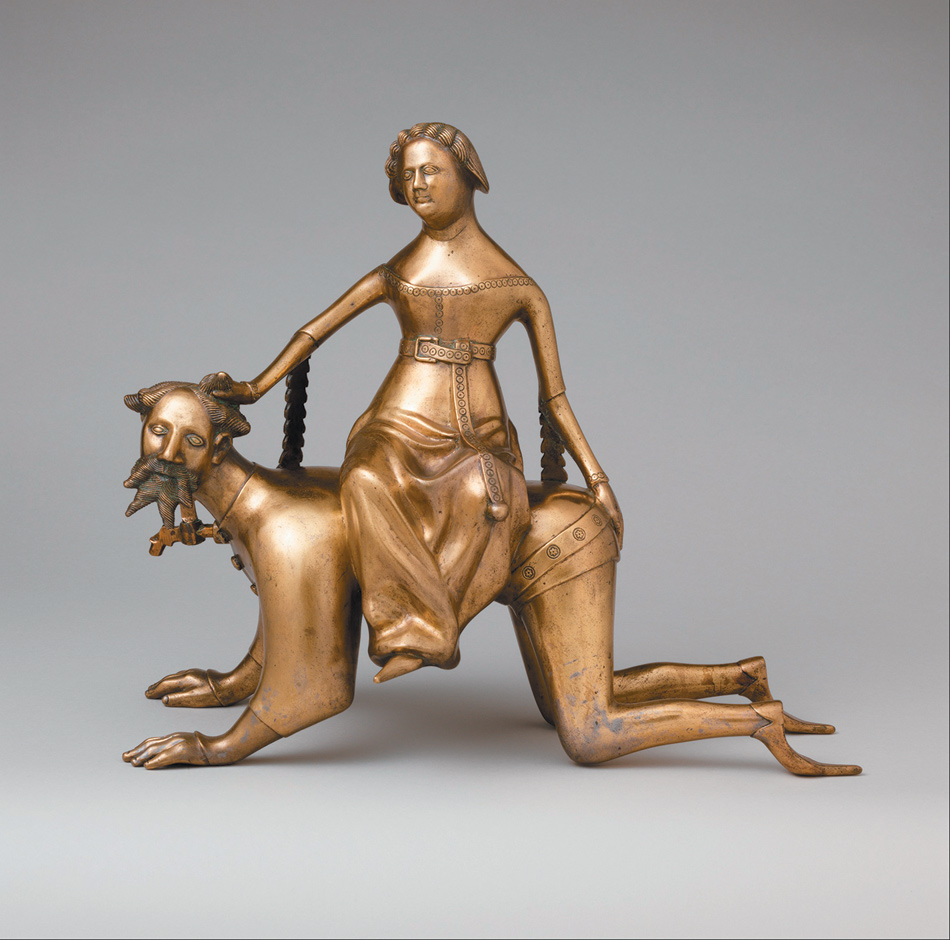
Several of the volumes contain collections that are only rarely displayed in the galleries, most notably Volumes IV and XII. Volume IV, Illuminations, contains, among other rarities, a fascinating depiction of the buildings of medieval Paris by Jean Fouquet in “The Right Hand of God Protecting the Faithful Against the Demons,” an exquisite little “Last Judgment” inside a capital letter C by Lorenzo Monaco, and a memorable portrait of San Bernardino of Siena preaching by Francesco di Giorgio. Volume XII, European Sculpture and Metalwork, contains the various bronzes that are on display throughout the galleries, including two very rare sixteenth-century perfume burners and a celebrated collection of aquamanilia (small ewers with animal or human shapes), among which is the Aristotle and Phyllis that so amuses puzzled tourists. But of equal importance, it also contains more than one hundred medals and plaquettes from Pisanello onward that are usually not exhibited, including one of my favorites—the medallion by Matteo dei Pasti with the lovely portrait of Isotta degli Atti, Sigismondo Malatesta’s wife, “pulchra aspectu,” as Ezra Pound describes her in Canto IX.3
I have to confess little enthusiasm for many of the numerous twentieth-century paintings. They include an admired portrait of two girls at the piano by Renoir, a questionable Gauguin, an austere Cézanne landscape of trees near the Jas de Bouffan, some Crosses and Signacs, and a large Balthus much esteemed by those who like Balthus. But overall, the Impressionist pictures for the most part seem to me pallid, the Nabi pictures by Vuillard and Bonnard charming but slight, and the Fauve pictures not fauve enough. A telling example is Lehman’s Derain of the Thames: it’s very good, but not nearly as spectacular as the Derain with much the same view in David Rockefeller’s collection. There are too many Kees van Dongens for my taste, a bizarre Dalí copy of Vermeer, and some mediocre Matisses. Of all these pictures, my personal favorites are the two little wooden cigar-box tops painted by Seurat, a golden one of a mower and the other, one of the several studies for La Grande Jatte.
3.
The American collection that most resembles the Lehman is no doubt the Frick, which opened forty years earlier, in 1935; both have similarities to the even earlier Poldi Pezzoli Museum in Milan (1881) and the Marquess of Hertford’s Wallace Collection in London (1900). A comparison between the Frick Collection and the Lehman Collection is telling. Unlike the Lehman, the Frick is a collection of almost nothing but masterpieces. There are many fewer objects in toto than in the Lehman Collection, but the paintings, bronzes, and examples of decorative art are all of superlative quality. And they are displayed in their original setting, the house that they were purchased to embellish, rather than in a feigned replica. There is an essential, pervasive elegance at the Frick mansion that is inevitably lacking in the Lehman museum galleries. As Kenneth Clark has observed, “works bought with love and installed in harmonious surroundings retain, in some mysterious way, a touching quality which they inevitably lose in a public gallery.”
Aware of this, Bobbie Lehman and his trustees tried to replicate seven of the rooms of the house on 54th Street in the Metropolitan galleries, hanging the walls with velvets, using some of the house’s sofas, Savonarola chairs, tables, cassoni, sconces, and chandeliers, and even reproducing part of one of the stairways that led up from the ground floor. But the result has been more meretricious than successful, lacking any real sense of a domicile; the stairway to nowhere has fortunately been removed, but the strained effort to reproduce the feeling of a residence rather than a gallery has, among other things, resulted in the most illegible labels I’ve encountered anywhere. I can’t imagine that anyone ever feels he is inside a home, as one does at the Frick or in parts of the Morgan Library, and the works of art would surely be more useful and meaningful if they were displayed, as the Annenberg Collection is, near related works in the museum galleries. But that, of course, would be contrary to Bobbie Lehman’s express intentions, which the Metropolitan accepted.
In comparison with the Frick Collection, the Lehman Collection, larger, more diffuse, and coming at the end of a lengthy tradition of such American collections, seems somehow analogous to those fin-de-race proper Bostonians who were so eloquently skewered by Elizabeth Hardwick years ago.4 Like them, when compared to the Frick, the Lehman Collection seems a bit less robust, somewhat etiolated, slightly feckless, its energies rather dissipated. Yet despite all that, the contents of the galleries remain a remarkable achievement of one man’s taste, dedication, and persistence, and the masterpieces in this collection, as Kenneth Clark noted, “leave one breathless.”
Like the collection itself, its impressive catalog may well be the last of its kind—and there aren’t, as I’ve said, very many of its kind to begin with. In this era of revolutionary technological innovation, online catalogs are bound more and more to replace such endeavors, and one can only wonder about the future of the printed catalog. The great advantage of an online catalog is that attributions, provenance, technical investigations, conservation work, exhibitions, and bibliography can all be regularly updated in perpetuity.
However, perpetual aggiornamento brings with it losses as well. At least for someone of my generation, the handsome volumes of the Lehman Collection have an enduring stability and nobility that any online catalog, essentially mutable and transient, lacks. What is more, these volumes tell you important things about the time in which they were written, the point of view of the author, and the way in which a work of art was perceived at a certain moment in history; an online catalog may or may not give you that information, and authorial voices, which are one of the aspects of the Lehman catalog that make it so special, may well be lost.
The technical gains provided by modern technology are staggering. I’m told that it’s now possible to go to the Metropolitan Museum, stand in front of a painting, point your iPad or iPhone at it, click on it, and the image will be recognized, and you’ll immediately be connected to the museum website with all the pertinent information about the painting, including a note indicating what new contribution the author makes. As catalogs have become increasingly ponderous, in every sense of the word, almost no one walks through an exhibition carrying one: for the museum visitor, they have become as antiquated and burdensome as an ear trumpet. Acoustiguides are far more manageable and convenient, but the information they provide is limited and spotty. This new possibility with an iPad may be promising indeed.5
Meanwhile, as more and more technological innovations are produced, the fifteen volumes of the Robert Lehman Collection in the Metropolitan Museum of Art will continue to occupy a significant space on the shelves of libraries throughout the world, where scholars will continue to consult them for many years to come. The collection, however it may be displayed in the future, will continue to impress visitors as an accomplishment that no doubt will come to seem more and more astonishing as years pass. In its own sphere, this admirable catalog is just as impressive an achievement as the collection itself—paradoxically, perhaps even more so.

-
1
Osbert Sitwell, Great Morning! (Little, Brown, 1947), p. 273. ↩
-
2
Timothy J. Newbery, “Towards an Agreed Nomenclature for Italian Picture Frames,” International Journal of Museum Management and Curatorship, Vol. 4 (1985). ↩
-
3
Pound thought he was quoting a quattrocento chronicle by someone called Alessandro di Rimini, which he found in Charles Yriarte’s late-nineteenth-century book on Sigismondo Malatesta. But the chronicle is, in fact, a seventeenth-century forgery. See Lawrence S. Rainey, Ezra Pound and the Monument of Culture (University of Chicago Press, 1991), pp. 173ff. ↩
-
4
“Boston,” Encounter, November 1959, and “Boston: The Lost Ideal,” Harper’s, December 1959. ↩
-
5
I am much indebted to Keith Christiansen for telling me about this new development in technology and for generously discussing with me various aspects of the Lehman Collection. ↩

