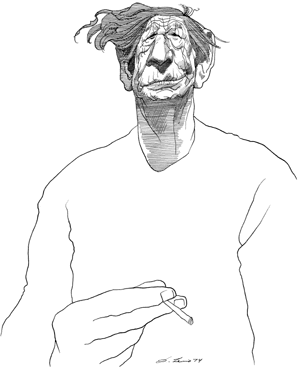
The ceremonious unveiling of Auden’s memorial stone in Poets’ Corner of Westminster Abbey on October 2 mantled the poet in an atmosphere of propriety that befitted his age and reputation at death. It might have been the serene conclusion of a life spent endorsing English culture. But, as Stephen Spender intimated in his tribute on that occasion, Auden had lived rambunctiously enough. In the Abbey itself, some years ago, he delivered a sermon in which he edified the devout, for the first time in ecclesiastical history, by using the word “tightarsed.” Then there had been his pursuit of a lover across the Atlantic just before war broke out, his naturalization as an American citizen, his extraordinary “marriage” to Erika Mann, his sexual wound to which he wrote the famous Letter in The Orators, and in general an array of experience, not discreditable but not suited to press releases, which made him leery of biographers and eager that his friends destroy his letters. I hope that none have.
Apart from such exploits, there was his gamesome irreverence toward pieties if not toward piety, his refusal to allow his shirt or anyone else’s to be stuffed. If in spite of his iconoclasm he was not precisely an iconoclast, that was because of his sharp eye for the ludicrous and the pompous in rebels as in the rebelled against. He thought for a time of shaking the world, and as a young man talked much of its being shaken, but eventually he decided on another mode, to accept with modifications. As this habit grew on him, he increasingly prided himself on it; he was the world’s celebrant, and in case that be thought too limited a role, he argued that no poet could be more. Those who claimed to be, like Yeats or Shelley, were deceivers or themselves deceived.
As Auden lowered his sights as poet, he returned to the High Church sympathies which, as Christopher Isherwood has recounted, he manifested also when a schoolboy. He came by them naturally, as grandson on both sides of Church of England clergymen. But his decision to regard himself as a believer was also a resolution to make do with what was available, and get on with it. Secular diffusion was a danger. He refused to pursue further the passionate but uncertain outlook which for a time he had accepted from “Lawrence, Blake and Homer Lane, once healers in our English land.” Yet he did not abjure them entirely in favor of the later trio whom he salutes in the poem “A Thanksgiving,” in his last book,
Wild Kierkegaard, Williams and
Lewis
guided me back to belief.
His twenty years of unbelief were in fact marked by adherence to a secular psychotherapy which was always calling problematic divinities from the wings, “Sir, no man’s enemy,” “Lords of Limit,” or just “Love.” It was clear to him then, as before and after, that he required objects of affection more lasting than any his eyes could light upon. His poems were evocations of someone or something that might join stability and affection like form and content. He had no specific commandments to relay, but he could identify outrageousness he disliked in conduct as in poetry. Changes that had occurred in both departments made him lament in “New Year Letter,”
Then speech was mannerly, an art, Like learning not to belch or fart,
and made him contend that
Art and life agree in this
That each intends a synthesis.
Although some moving passages in Auden are expressly Christian, such as “O Unicorn among the cedars,” from the same poem, the center of interest in his verse cannot be said to lie in religious experience. Exaltations and rigors attracted him less than aftermaths and loosenings. His Christmas oratorio, For the Time Being, is never more effective than at the close when Christmas is over.
Well, so that is that. Now we must dismantle the tree,
Putting the decorations back into their cardboard boxes—
Some have got broken—and car- rying them up into the attic.
The amused tolerance and homely images suited his conception of the poet as stymied in action but wonderfully expressive in verbal responses.
In his later aesthetic pronouncements, which he uttered with the greatest certainty, Auden assigned all consideration of the Creator to the Church, but allocated Creation to the poet. This division of labor enabled him to recognize a certain backsliding even among Christian poets,
Whatever their personal faith,
All poets, as such,
Are polytheists,
and perhaps in himself specifically,
Poets have learned us their myths,
but just how did They take them?
That’s a stumper.
In the preface to his collection of shorter poems, Auden confesses that, at the age of thirty-seven, he still did not know where his poetic direction was to lie. But in his last thirty years he came to regard himself as singing of life to make it palatable. The Westminster Abbey officials accepted this appraisal and so caused to be inscribed on his stone the last two lines of his elegy, “In Memory of W. B. Yeats,”
Advertisement
In the prison of his days
Teach the free man how to praise.
Auden wrote quite a number of poems of praise, but his most affecting passages are rather those that afford inklings or present forebodings, that connect what seemed unconnectable, that locate wounds and then search and sometimes salve them. As well as being two clergymen’s grandson, he was after all a doctor’s son. Perhaps no other poet has uttered so many warnings as Auden. His concern for spiritual health was like that of his father for public health in the Birmingham area. Sometimes he warned of a personal doom deep and dark as any sea dingle, sometimes—more communally—of a terrible future for the sleeping city.
Auden loved to detect and make sense of seemingly erratic behavior, and he was very rational as well as very moral about it. Yet behind the rationality and morality, or infused into it, was that strange perspective of his, which made him regard humankind from the vantage point of the lower animals, of babies, of the dead, of the prehistoric (here following his father’s interest in Danish prehistory), of the landscape, of the body’s valves or the itemized senses (“Precious Five”) or the mind’s unconscious. Often what was discovered was funny, in a muted way, and Auden’s last books were dotted with what he called “Shorts,” wry disclosures of short circuits between pretension or presupposition and act.
Auden was deeply influenced by Freud—perhaps he was the first great post-Freudian poet, a distinction not without its perils—and even more by Freud’s eccentric followers Groddeck and Layard. Like the latter, Auden extended Freud into psychosomatic medicine and on his own he translated mental states into spectacular language. So he illustrated “crooked love” by the lines,
The glacier knocks in the cup- board, The desert sighs in the bed,
or turned Oedipal feeling into geography,
By landscape reminded once of his mother’s figure,
or reduced a philosophy to its original impulsion,
Deprived of a mother to love him,
Descartes divorced
Mind from matter,
or, more thoughtfully, determined the motive behind Housman’s classical scholarship,
In savage footnotes on unjust editions He timidly attacked the life he led…
He learned from Freud, or confirmed from him, a sympathy for repressed parts of the mind to go with a sympathy for repressed parts of humanity. He also learned the pervasiveness of imperfection.
Auden did not spare himself and wrote often about his loves and friendships and, latterly, his living conditions. His poetry does not, however, seem confessional in the age of Plath and Lowell. He belonged instead to an earlier dispensation, as did Yeats and Eliot, for whom also personal details were admissible only if sufficiently generalized. By this standard failures in love were appropriate enough, but not whether the love was homosexual or not. In his review of Ackerley’s autobiography Auden made his own proclivities clear, but in his verse the gender of the beloved was always undifferentiated. In his sixties, especially, Auden rejoiced in his decorum, which he attributed to form. He was uncertain which was worse, he said, “the Anti-Novel or Free Verse,” and summed it up,
Blessed be all metrical rules that forbid automatic responses, force us to have second thoughts, free from the fetters of Self
In Epistle to a Godson, he declared,
No, Surrealists, no! No, even the wildest of poems must, like prose, have a firm basis in staid common-sense,
and in his new book, in a poem called “No, Plato, No,” he rejects another kind of formlessness, that of being disincarnate,
No, God has placed me exactly where I’d have chosen to be:
the sub-lunar world is such fun, where Man is male or female
and gives Proper Names to all things.
But he was not here just for fun, and Edward Mendelson, his literary executor, informs us that Auden’s last poem indicated that much of the fun was over,
He still loves life
But O O O O how he wishes
The good Lord would take him.
And now we have his last book, shorter than Epistle to a Godson as that was shorter than City Without Walls. It needed a few more poems to complete it. The title, Thank You, Fog, suggests that the volume is to be taken as celebratory, but as usual this strain is much mitigated. The fog makes for good company; it is still fog. If anything, the wryness of the poems is greater; life’s tricks, like tricks of phrase, have been seen through. A pungent example is his last variation on the famous line in “September 1939,” which announced, “We must love one another or die.” Because Auden came to regard this sentiment as fustian, he omitted first the stanza, then ruthlessly expunged the whole poem. But in this last book, the final poem, attributed to Chester Kallman and Auden jointly, contracts the idea to its statable residue:
Advertisement
When you get a little older
You’ll discover like Isolde:
“We must love one another and
die!”
These poems are relaxed and throwaway, almost the opposite of those clamant, heterodox formulations of his experience that he had written at the start. The slow-paced, ruminative, and usually agreeable tone does not keep the perceptions from being unflinching, but it does make them less imperative. For the nouns shorn of articles and the twisted syntax he used as a young man, Auden now substitutes neologisms formed by making nouns verbs and other lexical bizarreries, some more felicitous than others. In his early work the landscape, a mix of industrial smoke and Beowulfian fells, seemed brilliantly invented; the later landscape is deliberately familiar, old-shoeish. Time has brought a concern, even in verse, for bodily comfort. Where once the crosshatch of emotions startled him or appeared to do so, the unsurprisableness of experience now catches his eye.
Sometimes the later manner attenuates an earlier one, as in “A Curse,” which harks back to the alliteration of The Age of Anxiety:
Dark was that day when Diesel
conceived his grim engine that
begot you, vile invention,
more vicious, more criminal
than the camera even,
metallic monstrosity,
bale and bane of our Culture,
chief woe of our Commonweal.
There are too many words, and the archness shows through. But Auden could cut to the bone in “Lullaby,” evidently addressed to his senescing self,
The old Greeks got it all wrong:
Narcissus is an oldie,
tamed by time, released at last
from lust for other bodies,
rational and reconciled.
For many years you envied
the hirsute, the he-man type.
No longer: now you fondle
your almost feminine flesh
with mettled satisfaction,
imagining that you are
sinless and all-sufficient,
snug in the den of yourself,
Madonna and Bambino:
Sing, Big Baby, sing lullay.
So he continues to the last the stripping of illusions which he began in his first book. Vanities change, but vanities remain. The poet bewilders them again as he moves into the shadows.
This Issue
December 12, 1974
This Issue
December 12, 1974