Table of Contents

Volume 49, Number 5 · March 28, 2002

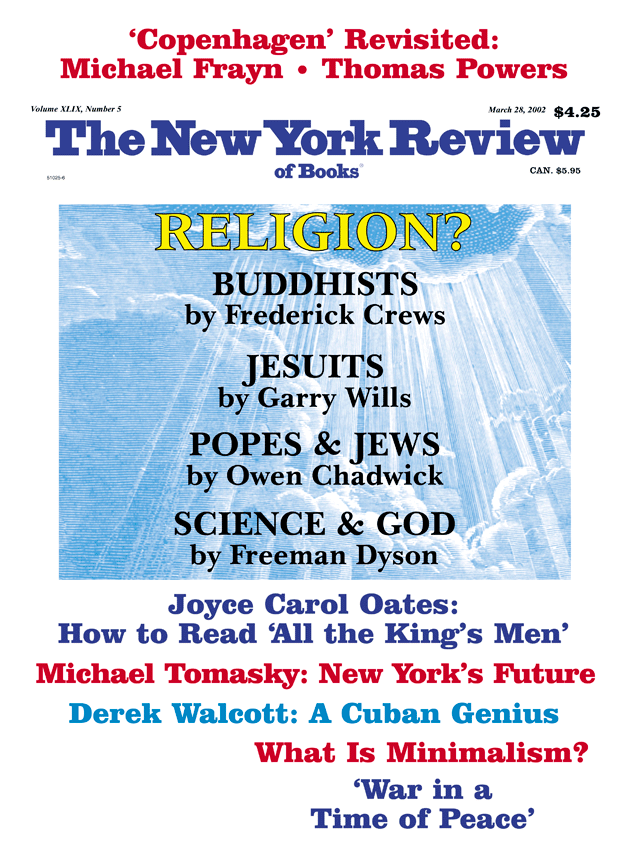
Freeman Dyson, Science & Religion: No Ends in Sight

The God of Hope and the End of the World by John Polkinghorne

Frederick C. Crews, Zen & the Art of Success

Shoes Outside the Door: Desire, Devotion, and Excess at San Francisco Zen Center by Michael Downing

James Fenton, The Vapour Trail (poem)

Garry Wills, Jesuits in Disarray

Passionate Uncertainty: Inside the American Jesuits by Peter McDonough and Eugene C. Bianchi

Owen Chadwick, Bad for the Jews

The Popes Against the Jews: The Vatican's Role in the Rise of Modern Anti-Semitism by David I. Kertzer

W.S. Merwin, Transit (poem)

Michael Tomasky, The World Trade Center: Before, During, & After

Divided We Stand: A Biography of New York's World Trade Center by Eric Darton

Twin Towers: The Life of New York City's World Trade Center by Angus Kress Gillespie

John Russell, In Goreyland

Ascending Peculiarity: Edward Gorey on Edward Gorey interviews selected and edited by Karen Wilkin

The Object-Lesson by Edward Gorey

Michael Frayn, 'Copenhagen' Revisited

Thomas Powers, What Bohr Remembered

Derek Walcott, The Great Exile

Guilty of Dancing the Chachachá by Guillermo Cabrera Infante,translated from the Spanish by the author

James Chace, War Without Risk?

War in a Time of Peace: Bush, Clinton, and the Generals by David Halberstam

Daniel Mendelsohn, When Not in Greece

Iphigeneia at Aulis by Euripides, directed by Shepard Sobel

Oedipus Rex by Sophocles, directed and designed by Tadashi Suzuki

Jack Flam, The Road to Minimalism

The Sculptural Imagination: Figurative, Modernist, Minimalist by Alex Potts

Joyce Carol Oates, 'All the King's Men'—A Case of Misreading?

All the King's Men by Robert Penn Warren, restored edition edited by Noel Polk

Letters

Ruth Hubbard, Mark Wagner, et al. 'The Future of Science'
Michael Hofmann, Translating Joseph Roth
Peter J. Conradi, Iris the Seeker


Contributors

James Chace is the Paul W. Williams Professor of Government and Public Law at Bard College. He is the author of Acheson and, most recently, 1912: The Election That Changed the Country. He is now working on a biography of Lafayette. (October 2004)

Owen Chadwick is the former Regius Professor of Modern History at Cambridge and the author of The Reformation, The Victorian Church, The Secularization of the European Mind in the Nineteenth Century, and The Popes and European Revolution. (March 2002)

Frederick Crews's most recent book is Follies of the Wise: Dissenting Essays. (December 2007)

Freeman Dyson has spent most of his life as a professor of physics at the Institute for Advanced Study in Princeton, taking time off to advise the US government and write books for the general public. He was born in England and worked as a civilian scientist for the Royal Air Force during World War II. He came to Cornell University as a graduate student in 1947 and worked with Hans Bethe and Richard Feynman, producing a user-friendly way to calculate the behavior of atoms and radiation. He also worked on nuclear reactors, solid-state physics, ferromagnetism, astrophysics, and biology, looking for problems where elegant mathematics could be usefully applied.

Dyson's books include Disturbing the Universe (1979), Weapons and Hope (1984), Infinite in All Directions (1988), Origins of Life (1986, second edition 1999), and The Sun, the Genome and the Internet (1999). He is a fellow of the American Physical Society, a member of the National Academy of Sciences, and a fellow of the Royal Society of London. In 2000 he was awarded the Templeton Prize for Progress in Religion.

James Fenton's new book, School of Genius, a history of the Royal Academy in London, will be published in the US in May. (May 2006)

Jack Flam is Distinguished Professor of Art History at Brooklyn College and at the Graduate Center of the City University of New York. His new book, Matisse and Picasso: The Story of Their Rivalry and Friendship, has just been published. (March 2003)

Michael Frayn is a playwright and novelist. His new novel, Spies, will be published in April. (March 2002)

Daniel Mendelsohn, is the author of The Lost: A Search for Six of Six Million, which won the National Book Critics Circle Award and the Prix Médicis Étranger in France. A collection of his essays, How Beautiful It Is and How Easily It Can Be Broken, mostly from these pages, will be published in August. He teaches at Bard. (June 2008)

W.S. Merwin was born in New York City in 1927 and grew up in Union City, New Jersey, and in Scranton, Pennsylvania. From 1949 to 1951 he worked as a tutor in France, Portugal, and Majorca. He has since lived in many parts of the world, most recently on Maui in the Hawaiian Islands. He is the author of many books of poems, prose, and translations and has received both the Pulitzer and the Bollingen Prizes for poetry, among numerous other awards.

Joyce Carol Oates is the Roger S. Berlind Professor of Humanities at Princeton. Her collection of short novellas Wild Nights! Stories About the Last Days of Poe, Dickinson, Twain, James, and Hemingway has just been published, and her novel My Sister, My Love: The Intimate Story of Skyler Rampike will be published this summer. (June 2008)

Thomas Powers is the author of The Man Who Kept the Secrets: Richard Helms and the CIA (1979), Heisenberg's War: The Secret History of the German Bomb (1993), and The Confirmation (2000), a novel. He won a Pulitzer Prize for National Reporting in 1971 and has contributed to The New York Review of Books, The New York Times Book Review, Harper's, The Nation, The Atlantic, and Rolling Stone.

John Russell was formerly Chief Art Critic of The New York Times, to which he continues to be a contributor. He is at work on a short history of the museum since 1800. (March 2003)

Michael Tomasky is Editor of Guardian America, The Guardian’s American Web site. (June 2008)

Derek Walcott won the Nobel Prize in Literature in 1992. His most recent book is Selected Poems. (May 2008)

Garry Wills was born in Atlanta, Georgia. One of our most distinguished historians and critics, he is the author of numerous books, including Saint Augustine, Papal Sin, and the Pulitzer Prize–winning Lincoln at Gettysburg. He has won many other awards, among them two National Book Critics Circle Awards and the 1998 National Medal for the Humanities. He is currently Professor of History Emeritus at Northwestern University. A regular contributor to the New York Review of Books, he lives in Evanston, Illinois.


Search the Review
Advanced search