Contents

April 4, 1996 • Volume 43, Number 6
  • George M. Fredrickson

    Land of Opportunity? e-edition

    Facing Up to the American Dream: Race, Class, and the Soul of the Nation by Jennifer L Hochschild

  • John Banville

    That’s Life! e-edition

    Last Orders by Graham Swift

  • Joseph Brodsky

    At the City Dump in Nantucket (poem) e-edition

  • Stephen Jay Gould

    Why Darwin? e-edition

    Charles Darwin: Voyaging by Janet Browne

  • James Fenton

    The Cherry Orchard Has to Come Down e-edition

  • Gordon S. Wood

    The Writingest Explorers’ e-edition

    Undaunted Courage: Meriwether Lewis, Thomas Jefferson, and the Opening of the American West by Stephen E. Ambrose

  • David Sylvester

    Pure and Not So Simple e-edition

    Constantin Brancusi 1876–1957 31, 1995. an exhibition at the Philadelphia Museum of Art, October 8–December, Catalog by Friedrich Teja Bach, by Margit Rowell, by Ann Temkin

  • Denis Donoghue

    The Myths of Robert Graves e-edition

    Robert Graves and the White Goddess, 1940–1985 by Richard Perceval Graves

    Robert Graves: Life on the Edge by Miranda Seymour

    Robert Graves: His Life and Work revised and extended edition., by Martin Seymour-Smith

  • Francis Haskell

    Ah! Sweet History of Life e-edition

    The Autumn of the Middle Ages by Johan Huizinga, translated by Rodney J. Payton, by Ulrich Mammitzsch

    The Civilization of Europe in the Renaissance by John Hale

  • Theodore H. Draper

    Rise & Fall of a Revolutionary e-edition

    Trotsky: The Eternal Revolutionary by Dmitri Volkogonov, translated and edited by Harold Shukman

  • Andrew Delbanco

    Melville’s Fever e-edition

    Pierre, or the Ambiguities by Herman Melville, edited by Hershel Parker, pictures by Maurice Sendak

    Pierre, or the Ambiguities. Historical Note by Leon Howard and Hershel Parker. by Herman Melville, edited by Harrison Hayford, by Hershel Parker, by G. Thomas Tanselle, Historical Note by Leon Howard, by Hershel Parker

  • Elizabeth Marshall Thomas

    First Fine Careless Raptor e-edition

    Raptor Red by Robert T Bakker

  • Anne Barton

    An Affair to Remember e-edition

    The Clairmont Correspondence: Letters of Claire Clairmont, Charles Clairmont, and Fanny Imlay Godwin, Volume I (1808–1834), Volume II (1835–1879) edited by Marion Kingston Stocking

  • Ingrid D. Rowland

    The Empress of Ice Cream

    Harvest of the Cold Months: The Social History of Ice and Ices by Elizabeth David, edited by Jill Norman

  • Quentin Skinner

    Bringing Back a New Hobbes e-edition

    The Correspondence of Thomas Hobbes edited by Noel Malcolm

    Three Discourses: A Critical Modern Edition of Newly Identified Work of the Young Hobbes by Thomas Hobbes, edited by Noel B Reynolds, edited by Arlene W Saxonhouse

  • Luc Sante

    American Photography’s Golden Age e-edition

    Mathew Brady: American Art Series

    Gardner’s Photographic Sketch Book of the Civil War by Alexander Gardner

    Landscapes of the Civil War: Newly Discovered Photographs from the Medford Historical Society edited by Constance Sullivan

    Jacob A. Riis: Photographer and Citizen by Alexander Alland

    The North American Indians by Edward Curtis

    Genthe’s Photographs of San Francisco’s Old Chinatown by Arnold Genthe, by John K Tchen

    Alfred Stieglitz: An American Seer by Dorothy Norman

    Alfred Stieglitz: A Biography by Richard Whelan

    Alfred Stieglitz at Lake George by John Szarkowski

    Gertrude Käsebier: The Photographer and Her Photographs by Barbara Michaels

    Alvin Langdon Coburn: Symbolist Photographer, 1882–1966 by Mike Weaver

    Women at Work: One Hundred and Fifty-Three Photographs by Lewis W Hine

    Men at Work: Photographic Studies of Modern Men and Machines by Lewis W Hine

    Paul Strand: An American Vision

    Paul Strand (Aperture Masters of Photography Series, No. 1)

    Edward Weston: Forms of Passion edited by Gilles Mora

    Tina Modotti: Photographs by Sarah M Lowe

    Berenice Abbott: Photographs

    Berenice Abbott, Photographer: A Modern Vision

    American Photographs by Walker Evans

    Walker Evans: The Hungry Eye by Gilles Mora

    Walker Evans: The Getty Museum Collection by Judith Keller

    Photography Until Now by John Szarkowski

    Photography and the American Scene by Robert Taft

    The History of Photography from 1839 to the Present (fifth edition, 1982) by Beaumont Newhall
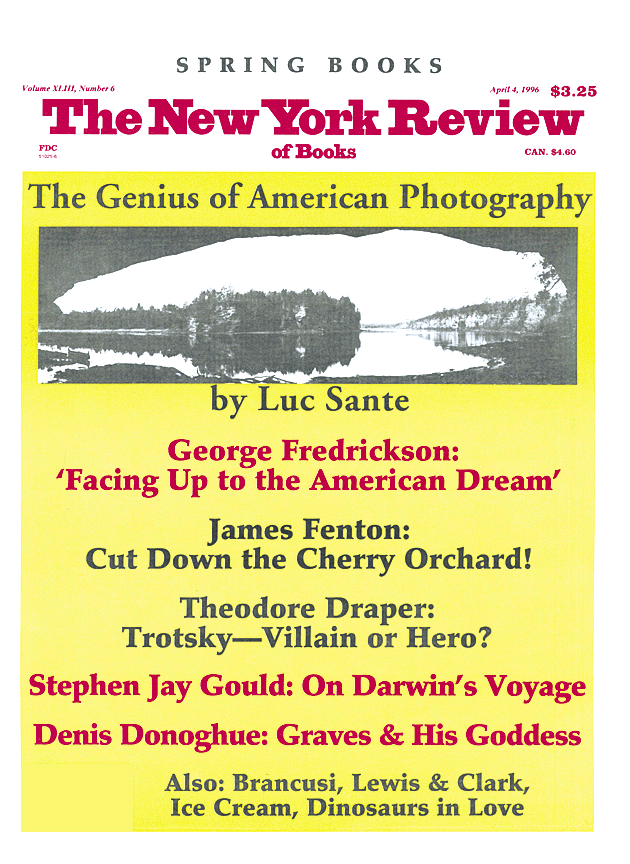
  • Gerald L Geison,
    M.F. Perutz

    Pasteur and the Culture Wars: An Exchange

  • Amos Oz

    A Letter to a Palestinian Friend

LETTERS

Contributors

Timothy Garton Ash is Professor of European Studies and Isaiah Berlin Professorial Fellow at St. Antony’s College, Oxford, and a Senior Fellow at the Hoover Institution, Stanford. He is the author of many books, including The Magic Lantern, an eyewitness account of the velvet revolutions of 1989. His most recent book is Facts Are Subversive: Political Writing from a Decade Without a Name. He is currently leading an Oxford University 
research project for the discussion of global free speech norms (www.freespeechdebate.com) and working on a book about free speech.

John Banville was born in Wexford, Ireland in 1945. He is the author of many novels, including The Book of Evidence, The Untouchable, Eclipse, The Sea (winner of the Man Booker Prize), and Ancient Light. As Benjamin Black he has written six crime novels, including Vengeance.

Anne Barton is a Fellow of Trinity College, Cambridge. She is the author of Essays, Mainly Shakespearean.

Andrew Delbanco is Mendelson Family Chair of American Studies at Columbia. His new books, College: What It Was, Is, and Should Be and The Abolitionist Imagination, will be published in April.
 (February 2012)

Theodore H. Draper (1912–2006) was an American historian. Educated at City College, he wrote influential studies of the American Communist Party, the Cuban Revolution and the Iran-Contra Affair. Draper was a fellow of the American Academy of Arts and Sciences and the 1990 recipient of the Herbert Feis Award from the American Historical Association.

Roger Shattuck (1923–2005) was an American writer and scholar of French culture. He taught at Harvard, the University of Texas at Austin, the University of Virginia, and Boston University, where he was named University Professor. His books includeForbidden Knowledge: From Prometheus to Pornography.

James Fenton is a British poet and literary critic. From 1994 until 1999, Fenton was Oxford Professor of Poetry; in 2007 he was awarded the Queen’s Gold Medal for Poetry.

Joseph Brodsky (1940–1996) was a Russian poet and essayist. Born in Leningrad, Brodsky moved to the United States when he was exiled from Russia in 1972. His poetry collections include A Part of Speech andTo Urania; his essay collections include Less Than One, which won the National Book Critics Circle Award, and Watermark. In 1987, he was awarded the Nobel Prize for Literature. He served as US Poet Laureate from 1991 to 1992.

Denis Donoghue is University Professor at New York University, where he holds the Henry James Chair of English and American Letters. His works include The Practice of Reading, Words Alone: The Poet T.S. Eliot, and The American Classics.

George M. Fredrickson is Edgar E. Robinson Professor of US History Emeritus at Stanford. His recent books include Racism: A Short History and Not Just Black and White, a collection co-edited with Nancy Foner.

M. F. Perutz (1914–2002) was an Austrian molecular biologist. He was awarded the Nobel Prize for Chemistry in 1962. He is the author of Is Science Necessary?, Protein Structure, and I Wish I’d Made You Angry Earlier.

Stephen Jay Gould (1941–2002) was an American geologist, biologist and historian of science. He taught at Harvard, where he was named Alexander Agassiz Professor of Zoology, and at NYU. His last book was Punctuated Equilibrium.

Amos Oz teaches literature at Ben Gurion University. He is the author of A Tale of Love and Darkness and, most recently, Rhyming Life and Death. (November 2010)

Ingrid D. Rowland is a professor, based in Rome, at the University of Notre Dame School of Architecture. A frequent contributor to The New York Review of Books, she is the author of The Culture of the High Renaissance: Ancients and Moderns in Sixteenth-Century Rome and The Scarith of Scornello: A Tale of Renaissance Forgery. She has also published a translation of Vitruvius’ Ten Books of Architecture and a history of Villa Taverna, the US ambassador’s residence in Rome.

Luc Sante is the author of Low Life, Evidence, The Factory of Facts, Kill All Your Darlings, and Folk Photography. He has translated Félix Fénéon’s Novels in Three Lines and written the introduction to George Simenon’s The Man Who Watched Trains Go By (both available as NYRB Classics). He is a frequent contributor to The New York Review of Books and teaches writing and the history of photography at Bard College.

Quentin Skinner is Regius Professor of History at Cambridge University. His most recent books are Reason and Rhetoric in the Philosophy of Hobbes and Liberty Before Liberalism. (November 2000)

Elizabeth Marshall Thomas’s most recent books are The Hidden Life of Dogs, Certain Poor Shepherds, and The Tribe of Tiger: Cats and Their Culture.

Czesław Miłosz (1911–2004) was born in Szetejnie, Lithuania. Over the course of his long and prolific career he published works in many genres, including criticism (The Captive Mind), fiction (The Issa Valley), memoir (Native Realm), and poetry (New and Collected Poems, 1931-2001). He was a member of the American Academy and Institute of Arts and Letters and was awarded the Nobel Prize for Literature in 1980.

Francis Haskell (1928-2000) was an English art historian. His works include Patrons and Painters: Art and Society in Baroque Italyand History and its Images: Art and the Interpretation of the Past. Haskell taught at Oxford.

Gordon Wood is the Alva O. Way University Professor and Professor of History Emeritus at Brown. His latest book is The Idea of America: Reflections on the Birth of the United States.