Contents

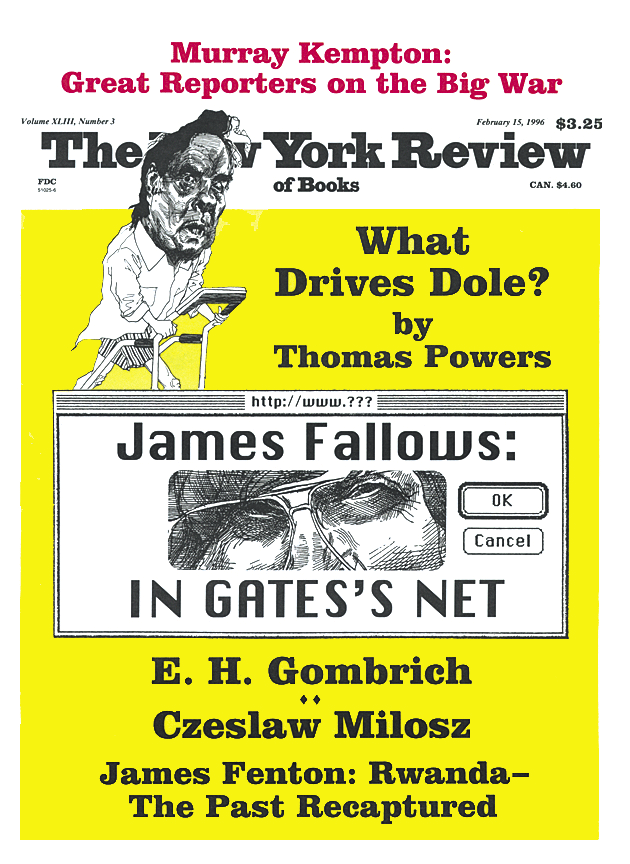
February 15, 1996 • Volume 43, Number 3
  • Thomas Powers

    The Last Hurrah e-edition

    Bob Dole by Richard Ben Cramer

    Senator for Sale: An Unauthorized Biography of Senator Bob Dole by Stanely G. Hilton

    Bob Dole: The Republicans’ Man For All Seasons by Jake H. Thompson

  • James Fenton

    A Short History of Anti-Hamitism e-edition

    The Rwanda Crisis: History of a Genocide by Gérard Prunier

  • J. F.

    On Rwanda e-edition

  • John Bayley

    Alice, or The Art of Survival e-edition

    Lewis Carroll: A Biography by Morton N. Cohen

    The Complete Sylvie and Bruno by Lewis Carroll, iillustrated by Renée Flower

  • James Fallows

    Caught in the Web e-edition

    The Road Ahead by Bill Gates, with Nathan Myhrvold, by Peter Rinearson

    Microserfs by Douglas Coupland

    Silicon Snake Oil: Second Thoughts on the Information Highway by Clifford Stoll

    The Trouble with Computers: Usefulness, Usability, and Productivity by Thomas K. Landauer

    I Sing the Body Electronic: A Year with Microsoft on the Multimedia Frontier by Fred Moody

    Startup: A Silicon Valley Adventure Story by Jerry Kaplan

    Microsoft Secrets: How the World’s Most Powerful Software Company Creates Technology, Shapes Markets, and Manages People by Michael A. Cusumano, by Richard W. Selby

    Road Warriors: Dreams and Nightmares Along the Information Highway by Daniel Burstein, by David Kline

    Gates: How Microsoft’s Mogul Reinvented an Industry—and Made Himself the Richest Man in America by Stephen Manes, by Paul Andrews

  • Rosemary Dinnage

    Death’s Gray Land e-edition

    The Ghost Road by Pat Barker

    Regeneration by Pat Barker

    The Eye in the Door by Pat Barker

  • Tony Judt

    Austria & the Ghost of the New Europe e-edition

  • Czesław Miłosz

    Bringing a Great Poet Back to Life e-edition

    Laments by Jan Kochanowski, translated by Stanislaw Baranczak, by Seamus Heaney

  • Ernst Gombrich

    Icon e-edition

    Three Essays on Style by Erwin Panofsky, edited by Irving Lavin, with a memoir by William S. Heckscher

    Perspective as Symbolic Form by Erwin Panofsky, translated by Christopher S. Wood

  • Brad Leithauser

    Notions of Freedom e-edition

    The Collected Poetry of Malcolm Lowry edited by Kathleen Scherf

    Pursued by Furies: A Life of Malcolm Lowry by Gordon Bowker

  • Murray Kempton

    The Beat of War e-edition

    Reporting World War II, Part One:1 American Journalism 1938-1944 Part Two: American Journalism 1944-1946
  • William Pfaff

    On the Death of Mitterrand e-edition

  • Susan Sontag

    On Wei Jingsheng e-edition

LETTERS

Contributors

John Bayley is a critic and novelist. His books include Elegy for Iris and The Power of Delight: A Lifetime in Literature.

William Styron (1925–2006) was the author of several novels, including Sophie’s Choice and The Confessions of Nat Turner.

Robert Stone was born in Brooklyn in 1937. He is the author of seven novels: A Hall of Mirrors, the National Book Award–winning Dog Soldiers, A Flag for Sunrise, Children of Light, Outerbridge Reach, Damascus Gate, and Bay of Souls. He has also written short stories, essays, and screenplays, and published a short story collection, Bear and His Daughter, which was nominated for the Pulitzer Prize. He lives in New York City and in Key West, Florida.

Norman Mailer (1923-2007) was born in Long Branch, New Jersey, and grew up in Brooklyn, New York. In 1955 he co-founded The Village Voice. He is the author of more than thirty books, including The Naked and the Dead; The Armies of the Night, for which he won a National Book Award and the Pulitzer Prize; The Executioner’s Song, for which he won his second Pulitzer Prize; Harlot’s Ghost; Oswald’s Tale; The Gospel According to the Son; and The Castle in the Forest.

Anne Hollander’s books include Seeing Through Clothes, Sex and Suits, and Feeding the Eye. Fabric of Vision: Dress and Drapery in Painting, a companion book for the upcoming exhibition at the National Gallery in London, will be published this spring. (February 2002)

Günter Grass, a recipient of the Nobel Prize for Literature, is a novelist, poet, playwright, sculptor, and artist. (April 2012)

Susan Sontag (1933–2004) was a novelist, playwright, filmmaker, and one of the most influential critics of her generation. Her books include Against Interpretation, On Photography, Illness as Metaphor, and The Volcano Lover.

Margaret Atwood is the author of The Handmaid’s Tale, Oryx and Crake, and The Blind Assassin, among other novels. Her most recent work of fiction is I’m Starved for You, a long short story available as an e-book.


(May 2012)

Michael Ondaatje’s novels are Coming Through Slaughter, In the Skin of a Lion, The English Patient, and Anil’s Ghost. His books of poetry include The Cinnamon Peeler and Handwriting. His most recent book is The Conversations: Walter Murch and the Art of Editing Film. He lives in Toronto, Canada.

Arthur Miller (1915–2005) was an American playwright and essayist. His 1949 play, Death of A Salesman, received a Tony Award for Best Author, The New York Drama Circle Critics’ Award, and the Pulitzer Prize for Drama.

A. S. Byatt’s book of essays On Histories and Stories will be published in the US next year. Her new novel, The Biographer’s Tale, will be published here in January. (November 2000)

Rosemary Dinnage’s books include The Ruffian on the Stair, One to One: Experiences of Psychotherapy, and Annie Besant.

Murray Kempton (1917-1997) was a columnist for Newsday, as well as a regular contributor to The New York Review of Books. His books include Rebellions, Perversities, and Main Events and The Briar Patch, as well as Part of Our Time. He won the Pulitzer Prize in 1985.

Brad Leithauser is a novelist, poet, and essayist. He lives in Massachusetts.

Czesław Miłosz (1911–2004) was born in Szetejnie, Lithuania. Over the course of his long and prolific career he published works in many genres, including criticism (The Captive Mind), fiction (The Issa Valley), memoir (Native Realm), and poetry (New and Collected Poems, 1931-2001). He was a member of the American Academy and Institute of Arts and Letters and was awarded the Nobel Prize for Literature in 1980.

William Pfaff was an editor of the lay-Catholic Commonweal magazine from 1949 to 1955, and remains a contributor. His latest book is The Irony of Manifest Destiny: The Tragedy of America’s Foreign Policy. (May 2013)

Thomas Powers is the author of The Man Who Kept the Secrets: Richard Helms and the CIA (1979), Heisenberg’s War: The Secret History of the German Bomb (1993), Intelligence Wars: American Secret History from Hitler to al-Qaeda (2002; revised and expanded edition, 2004), and The Confirmation (2000), a novel. He won a Pulitzer Prize for National Reporting in 1971 and has contributed to The New York Review of Books, The New York Times Book Review, Harper’s, The Nation, The Atlantic, and Rolling Stone. His latest book, The Killing of Crazy Horse, won the 2011 Los Angeles Times Book Prize for History. He is currently writing a memoir of his father, who once told him that the last time he met Clare Boothe Luce was in the office of Allen Dulles.


James Fallows is National Correspondent for The Atlantic.His books include Free Flight: Inventing the Future of Travel, Blind into Baghdad: America’s War in Iraq, and China Airborne.

Ernst Gombrich (1909–2001) was an Austrian art historian. Born in Vienna, Gombrich studied at the Theresianum and then at the University of Vienna under Julius von Schlosser. After graduating, he worked as a Research Assistant and collaborator with the museum curator and Freudian analyst Ernst Kris. He joined the Warburg Institute in London as a Research Assistant in 1936 and was named Director in 1959. His major works include The Story of Art, Art and Illusion: A Study in the Psychology of Pictorial Representation, Aby Warburg: An Intellectual Biography, The Sense of Order: A Study in the Psychology of Decorative Art.

James Fenton is a British poet and literary critic. From 1994 until 1999, Fenton was Oxford Professor of Poetry; in 2007 he was awarded the Queen’s Gold Medal for Poetry.

Tony Judt (1948–2010) was the founder and director of the Remarque Institute at NYU and the author of Postwar: A History of Europe Since 1945, Ill Fares the Land, and The Burden of Responsibility: Blum, Camus, Aron, and the French Twentieth Century, among other books.