
1.
On October 12 the president of the Federal Republic of Germany, Richard von Weizsäcker, addressed the 37th Congress of German Historians at Bamberg. Boldly seizing upon one of the central issues of the so-called Historikerstreit that has divided the profession for the past two years (see The New York Review, January 15, 1987), he rejected the idea that National Socialist crimes could be palliated by comparisons with atrocities committed by the Soviet Union and other regimes and cultures. He declared that Auschwitz remained unique and the responsibility for it undiminished by time, and suggested that openness to history was a prerequisite and a pillar of West German democracy. He admonished his audience to be aware of the needs of young people:
They want to know and have to know who they are, where they come from, and who the others are with whom they are to share and shape this world.
To them it is vitally important to know how the moral and political disaster came about in the days of their grandparents. Did their nation leave the civilized community of nations only temporarily and has it now returned to its natural position, albeit encumbered by that terrible aberration?
…For their own lives they need an answer to the question of where we [their parents and grandparents] were, what we did, what responsibility we assumed, and what responsibility we very much failed to live up to.1
A frivolous member of the president’s audience might have been reminded by these remarks of a passage in Günter Grass’s novel of 1963, Dog Years, in which there mysteriously comes upon a postwar market a kind of miracle glasses that enable young people, when they use them, to see what their elders were up to during the Nazi regime. Grass writes that the glasses show
…varied images of their parents’ past, often, though it takes a little patience, in chronological sequence. Episodes which are kept from the younger generation for one reason or another are made palpably clear…. All indications are that, surprisingly enough, no staggering quantities of erotic secrets are aired—little beyond the customary escapades. The scenes that recur over and over again in the twin spheres of the father-recognition glasses are acts of violence performed tolerated instigated eleven twelve thirteen years ago: murders, often by the hundreds. Aiding and abetting. Smoking cigarettes and looking on while. Certified decorated applauded murderers. Murder motives become leitmotives. With murderers at one table, in the same boat, bed, and officers’ club. Toasts, emergency directives. Record entries. Blowing on rubber stamps. Sometimes mere signatures and wastebaskets. Many roads lead to. Silence as well as words can. Every father has at least one to hide.2
The glasses soon disappear, confiscated by the parents or by local government authorities.
Just about a month after the Bamberg meeting of historians, Philipp Jenninger, the president of the West German Bundestag, undertook to perform the function of the miracle glasses. In a special memorial service in the parliament on the fiftieth anniversary of Reichskrystallnacht, the nationwide pogrom against the Jews in 1938, Jenninger sought to describe for his colleagues where their elders were and what they were doing in 1938 and, more particularly, why so many of them had admired and supported Adolf Hitler. This time the children seemed not to relish what the glasses revealed, for the result was a disaster; some of Jenninger’s colleagues interrupted the speech with cries of protest and large numbers left the chamber in anger. The international press, apparently on the basis of what the early departees told the parliamentary reporters, burst out in a rash of angry headlines, Ma’ariv of Israel accusing Jenninger of defending Hitler, the Amsterdam Telegraaf reporting a “tumult in Parliament over Hitler-veneration,” Il Messaggero of Rome announcing that the president of parliament had “ripped open once more the historic wound between Germany and the Jewish people.” The uproar was so great that Jenninger concluded that his position was insupportable and announced his resignation.
And yet, in the cold gray dawn of the morning after, things began to look a little different. Once the text of the speech became available, it was clear that none of the sensational charges against it had any substance. There was no trace in it of any sympathy for National Socialism, whose crimes and brutalities Jenninger described in perhaps excessive detail (oddly enough the Greens, the liberals, and some of the Socialists left the chamber while he was talking about “the factories of death”). Jenninger was as explicit as the Bundespräsident had been in Bamberg in stating that Auschwitz was a German crime and an ineradicable part of German history, and, indeed, insisted that the frequently heard demand that Germans should finally make a definitive settlement with the past (“endlich Schluss machen“) so that they could forget it was nonsense. Nor was it as clear as the first press reports had made it seem to be that the Jewish people were outraged by Jenninger’s address. Simon Wiesenthal, for one, defended Jenninger and said publicly that he had been misunderstood, and Michael Fürst, the vice-president of the Central Council of Jews in Germany, actually praised the speech for showing “with such clarity what the situation was like in Germany between 1933 and 1938” and for demonstrating “that everything Hitler did was supported by the whole German people.”
Advertisement
Why then the uproar? The German press showed great fertility in explanations. Jenninger was a bad speaker because Chancellor Kohl, a notoriously clumsy orator, would not allow anyone to become president of the Bundestag who was more eloquent than he, and therefore the speech was “a trampling through history in army boots,” unaccented, monotonous, soporific (Der Spiegel). The speech may not have been written by Jenninger at all, but by his personal aide Thomas Gundelach, who delivered the twenty-six-page manuscript on Thursday morning, too late for Jenninger to master it (Süddeutsche Zeitung). Jenninger made the mistake of forgetting that he was a politician and not a historian. He wrote an essay that might have served as the basis of an interesting discussion rather than an address for the occasion (Günther Nonnenmacher in the Frankfurter Allgemeine Zeitung). Jenninger made the mistake of being too literary. In his attempts to convey the thoughts and desires of Germans in the Thirties, he relied too heavily upon the Flaubertian device of “free indirect discourse,” so that his auditors became confused and attributed to Jenninger sentiments (“Did the Jews not assume a role that was inappropriate for them? Did they not perhaps deserve to be put in their place?”) that he meant to be understood as representing the thinking of people in that earlier time (Paul Geyer in the feuilleton of the Frankfurter Allgemeine Zeitung). And so forth.
That such factors may have contributed to the debacle is doubtless true, but it is possible to look beyond them. David Schoenbaum of the University of Iowa, who is currently a visiting professor at the Free University of Berlin, was quoted in the press as saying that there was nothing in Jenninger’s speech that made his resignation necessary; the root of the trouble was to be found partly in the text and the speaker, but perhaps more in those people in the audience who either couldn’t or wouldn’t listen to it. This is suggestive. It is quite possible that the reaction to Jenninger’s speech was a sign that some at least of the parliamentarians are becoming fed up with being lectured about their country’s past. After all, this was the same body that gave a distinctly chilly reception to Professor Fritz Stern of Columbia University when he was invited to address it last year on the occasion of a commemoration of the East German rising of June 17, 1953, and told his audience that that revolt had not been a demonstration in favor of reunification, as West German politicians were fond of saying, but rather a courageous demand for freedom and reform, and reminded them that “undivided Germany brought unspeakable misfortune to other peoples and to itself,” a fact that no German could afford to forget.3
2.
What must, to the ears of Jenninger’s auditors, have been one of the most painful passages in his speech came early, when he talked of the attitude of the broad public toward the atrocities of Reichskrystallnacht. He said:
The public for the most part behaved passively: that corresponded to their attitude with respect to anti-Jewish attitudes and measures in the years that had gone before. Only a few collaborated in these excesses, but there was also no rejection of them, no resistance worth the name. The reports speak of embarrassment and shame, of pity, yes, of disgust and horror. But only in isolated cases was there active sympathy or solidarity. Everybody saw what was going on, but the great majority looked away and kept their silence. Even the churches were silent.
The question of why this was so Jenninger did not treat very systematically, but it now forms the main theme of Michael Balfour’s new book, which, in his own words, “concentrates on explaining why more Germans did not stand up to Hitler and why those who did failed to get rid of him.”
Mr. Balfour is no stranger to his subject. A longtime student of German history and the author of an admirable study of William II and his times, he had during the last years of the Second World War access to virtually all of the information reaching Britain about German civilian conditions and attitudes and had a particular interest in oppositional activities because he had been a close friend before the war of Helmuth James von Moltke, one of the leaders of the Widerstand—the word Balfour uses to describe the anti-Nazi groups—whose biography he later wrote. His present book is the fruit of years of reflection on the practical and moral aspects of obedience and dissent, which he compresses into six general questions that he poses for his readers, with some tentative answers of his own, in his final pages. These include dilemmas that must have agonized the minds of many Germans during the Nazi period, such as in what circumstances, if at all, an individual has a right—or even a duty—to seek to overthrow by violence the government of his country and the equally troubling question whether anyone who lives under an evil regime inevitably acquires some share of guilt for its misdeeds.
Advertisement
The bulk of Balfour’s book, however, consists of a concise analysis of the circumstances of Hitler’s coming to power, the reaction of various classes of society to this event, and the development, modes, difficulties, and aims of the Widerstand, followed by a “portrait gallery” of twenty-four leading members of the Widerstand, including the “loner” Georg Elser, a skilled cabinetmaker and sometime Communist who came very close to blowing Hitler up in the Bürgerbräukeller in Munich in November 1939; representatives of the Goerdeler and Kreisau circles and of the military opposition; the group of students who, under the name “The White Rose,” distributed anti-Nazi leaflets in Munich in the fall of 1942 and the early spring of 1943 until they were caught and executed; labor leaders like Julius Leber and Wilhelm Leuschner, and—here the biographies are among the most original and informative—churchmen like Martin Niemöller, Bernhard Lichtenberg, and Bishop Konrad Graf von Preysing.
Balfour says at the outset that he has used the word Widerstand throughout his book rather than words like “resistance” and “opposition” “because one of the first steps to understanding what did or did not happen is to realise that the activities associated with those English nouns in many countries were not practicable in Germany after 1933.” This was because the German people had handed themselves over in 1933 to a party that was as efficient in the techniques of control as it was ruthless and unconstrained by constitutional or moral considerations in its use of force against opponents. Why this happened Balfour answers in general terms by saying that
the German nation found itself in a crisis in which its accumulated possessions and inherited values seemed at risk. The causes and nature of the crisis were imperfectly understood and, in an atmosphere of panic, the Germans resorted to such solutions as were in their own power to apply. In the apparent urgency for drastic action, they allowed their norms of judgment and humanity to be swept aside. The forms which action took were largely determined by Germany’s past history and the society resulting from it (which is not to say that everything was inevitable).
More specifically, Balfour points, as Jenninger did in his speech, to the hardships, frustrations, diminished personal expectations, and national humiliations of the Weimar years as causes for both the triumph of Nazism in 1933 and its success in consolidating its power. Lots of people who later said, “I was never a Nazi,” thought in 1933 that a Hitler regime “would further some cause or interest which they considered important, and they were therefore prepared at least to acquiesce in its happening.” Others were drawn to Nazism by the movement’s emphasis upon the nation rather than the individual; or by the very fact that it was, unlike the bureaucratized and inert Weimar parties, a Bewegung, active, dynamic, and apparently irresistible; or because of the magnetic force and confidence of its leader, who promised to give direction to a people that had lost its way.
The movement had a natural appeal to the lower middle class, which was the most vulnerable and most resentful class in the country, but civil servants, teachers, members of the professions, and the Protestant clergy constituted a disproportionately high percentage of its membership. “From the days of the romantic rejection of the Enlightenment,” Balfour says tartly,
there has always been a strong anti-rational element in German thought…. It is an unfortunate fact that by no means all who earn their living by applying reason to some specific subject extend the practice to life as a whole. Wissenschaft is not automatically linked to Menschlichkeit; the fallacy that it should be apolitical was widespread. No natural scientists were prominent in the Widerstand…. By 1938 there were 3000 lawyers and 3000 doctors in the SS.
The early foreign policy triumphs of the Nazis and the intensity of their own convictions made it possible for Germans to overlook the excesses and brutalities of the regime. Long after the good days had passed and war had come and the shadow of defeat loomed before them, the majority of the people remained loyal to the regime and discountenanced disobedience or opposition. On the day after the execution of the leaders of the White Rose movement, a meeting of three thousand Munich students condemned their action and cheered the university porter who had informed on them. Loyalty to Hitler persisted to the bitter end. On the day after the Attentat on Hitler’s life in July 1944, 50,000 people gathered in Freiburg im Breisgau to show their relief at the leader’s escape, and 70 percent of the population of Schaumburg did the same. This was perhaps not surprising. Balfour says:
To lose faith in Hitler…meant admitting that one had been wrong, wrong about the goals which had been held out for the German Volk, wrong about the whole German nationalist interpretation of the world and its history. That could not be acknowledged overnight…. The process of disillusionment and reorientation was bound to be lengthy. There are still a few Germans who have not completed it.
Meanwhile the difficulties confronting the Widerstand were formidable. In March 1943 Helmuth von Moltke wrote to an English friend:
Can you imagine what it is like if you
a. cannot use the telephone
b. cannot use the post
c. cannot send a messenger, because you probably have no one to send and, if you have, you cannot give him a written message as the police sometimes search people in trains etc. for documents.
d. cannot even speak with those with whom you are completely d’accord, because the secret police have methods of questioning where they first break the will but leave the intelligence awake…
e. cannot even rely on a rumour or a whispering campaign to spread information as there is so effective a ban on communications of all kinds that a whispering campaign started in Munich may never reach Augsburg. There is only one way of communicating news and that is the London wireless.
In these circumstances, there could be no organized resistance on a mass basis but only a congeries of small groups, sometimes connected and sometimes working at cross purposes, always open to penetration, always dependent for effective action on foreign assistance, which was unreliable, or on the German military, for which willingness to act was impeded by the oath to Hitler, the fear of creating another stab-in-the-back myth, and the reluctance, on the part of many, to resort to murder. Balfour’s exposition of these difficulties makes the fortitude and persistence shown by the people in his “portrait gallery” seem doubly remarkable.
The diaries of Ulrich von Hassell and the letters of Helmuth von Moltke to his wife admirably complement the story told in Balfour’s book. Hassell, as Hans Mommsen points out in his foreword to the diaries, was in some respects a victim of the illusions of Hitler’s conservative allies. Like others among them, he had imagined that he could manage the Nazi leader and, in particular, keep him on a sound course in foreign policy, but his opposition to Ribbentrop’s Anti-Comintern Pact, which he felt would alienate the Western powers, made him persona non grata in both Berlin and Rome, where he was German ambassador, and in February 1938, when Ribbentrop succeeded Neurath as foreign minister, he lost his post. He was drawn into oppositional activity by his conviction that Hitler’s foreign policy would be disastrous for his country and by the revulsion caused in him by Nazi racial policy. (On the day after Reichskrystallnacht he wrote of the horror aroused in him by this event and his concern about the inner life of his country, “which is held, ever more comprehensively and with an ever more iron grasp, by a system that is capable of such things.”) He obtained a position in the directorship of the Mitteleuropäische Wirtschaftstag, which gave him an office in Berlin and the right to travel extensively, and through this means he was able to maintain contact with like-minded people. He was closest to the Goerdeler-Beck circle, although he thought Goerdeler a bit of a reactionary and regarded himself as a kind of mediator between it and the younger Kreisau circle whose leading spirit was Helmuth von Moltke. In the wake of the failed attempt on Hitler’s life, he was arrested and executed.
Hassell’s personal diaries, however, survived and were published in part under the title Vom anderen Deutschland in 1946 and later in English translation.4 The present edition is greatly expanded, representing about 87 percent of the total text (everything but family matters, illnesses, visits to the theater, and the like) as opposed to the 54 percent that appeared in the 1946 edition, and it has been supplied with 150 pages of notes. The text supplies a fascinating and highly readable day-to-day account of life in wartime Germany, ruminations on the direction of German policy, and illuminating glimpses of Widerstand activity.
It would be difficult to find a better portrait of the mixture of arrogance, mendacity, braggadocio, technical incompetence, corruption, and overestimation of its own capacities that characterized the Nazi regime at the zenith of its power than in these diaries (Hassell somehow found time even to record gossip about the indiscretions of Party leaders and the latest examples of Flüsterwitz in the capital), or a more depressing revelation of the craven self-interest and servility of the old establishment and the higher levels of society. The pages are strewn with expressions of deepening pessimism concerning the possibility that the generals—the “Josephs,” as Hassell called them—would ever stand up to Hitler, and the chances of effective resistance without them were, in his view, negligible, given Nazism’s success in effecting “a fearful devastation of German character, which in any case has often enough given evidence of a tendency toward slavish behavior.”
It was an unfortunate circumstance that the Widerstand, with so many other difficulties to contend with, was by no means united in its aims or its tactics. The group around Goerdeler and General Beck wanted to get rid of Hitler, if necessary by killing him, but they were by no means eager to give up all of his territorial gains or to institute a democratic government. Their model of the future was a Germany like that of William II, with the boundaries of 1938. Hassell’s own political thinking, while not as primitive as that of some of his associates, had not progressed much beyond the ideas of Baron vom Stein and Bismarck.
The views of Helmuth James von Moltke, whom George Kennan has described as “the greatest person morally, and the largest and most enlightened in his concepts, that I met on either side of the battle-lines in the Second World War,”5 were fundamentally different, and the splendid volume of letters to his wife, beautifully edited by Beate Ruhm von Oppen, makes this abundantly clear, while at the same time detailing, in affectionate letters that are often partly devoted to the husbandry and financial state of their author’s estate at Kreisau, the wearying but ceaseless efforts of this remarkable man to build contacts between representatives of every segment of German society and out of them to forge plans for a new Germany. The plans of the Goerdeler circle—the Honoratioren as he called them—he rejected as a “Kerenski solution” to Germany’s problems. The idea of killing Hitler in the hope of making a deal with the Allies and getting out of the war was repugnant to him on both political and religious grounds. He was a profoundly Christian man who could not stifle his conscience and accept, as other Christians including Dietrich Bonhoeffer accepted, the necessity of resorting to the ultimate weapon of armed resistance. “It is better,” he wrote to his wife in January 1943, when he had stood firm against friends who urged him to change his mind, “that they dance this Extratour without me.”
In his last letter to his sons before his execution, Moltke wrote that he had “never wished for or contributed to acts of violence like that of 20 July…because I…believed that the fundamental spiritual evil would not be got rid of in that way.” In order to eradicate the basic ill, the Antichrist, which Moltke saw in the thoughtless gaiety in Berlin during the Olympics of 1936, in the collaboration of people he had once respected who were undeterred by any concern over the repulsive and degrading nature of their behavior, in the greediness of German tourists and profiteers in the countries occupied by German troops—“Schieber, Schieber und wieder Schieber!” he wrote from Paris in June 1943—and most of all in the inhumanities practiced in conquered areas against the local populations and the Jews, Germany must be defeated in the war and a new society built on the ruins.
Moltke sought to promote that end by bringing churchmen and laity and soldiers together at Kreisau for secret conferences, and for the rest used his position as adviser on international law in the foreign department of the Abwehr to do what he could to moderate the regime’s contempt for moral and legal restraints by arguing for the rights of the captured and the interned and by traveling constantly for the purpose of alleviating, when possible, the treatment of captive peoples and establishing contacts with other resistance movements. It was almost inevitable that sooner or later he would fall prey to the Gestapo, and in January 1944 he did. He was accused of discussing matters that were not his concern but that of the state and of failing to report a conspiracy of which he was well aware, and he was condemned to death. “The beautiful thing about this verdict,” Moltke wrote in one of the last letters to his wife, “is the following: we had no desire to use force—that is clear;…we only thought…. We shall be hanged because we thought together.” The Nazi judge Freisler gave a somewhat different reason when he said to Moltke during his hearing, “In only one respect are Christianity and we alike: we demand the whole man.”
The German Widerstand was always in a sense a movement of officers without troops, for it found no way of making effective contact with what had once been the best organized and most militant working class in Europe. Ronald Smelser’s book on the leader of the Labor Front Robert Ley helps to explain why this was so. Ley was not the least colorful of Hitler’s satraps: a man whose consumption of alcohol produced legends and won him the title Reichtrunkenbold (or Reich Drunkard), a street brawler and anti-Semite of the most primitive kind who nevertheless had a doctorate in food chemistry, an intensely ambitious politician whose enemies tried to balk his rise by claiming that he was a half-Jew, and, when they sang the Heine song about the Lore-Ley, ending it, as my landlady in Munich in 1935 used to do, with the words:
Und das hat mit ihrem Singen
Die Lore-Levy getan.
But he was also idealistic in his belief in National Socialism’s mission and its potential for social integration. Called by Hitler in May 1933 to establish a Labor Front after the organized working-class movement had been smashed, the trade unions abolished, and their leaders sent into exile or isolation, Ley responded with enthusiasm. The purpose of the new organization had been defined as that of “educating all Germans engaged in the life of labor in National Socialist conviction.” A person who, as Smelser points out, always suffered from social angst from which his membership in the party to some extent relieved him, Ley was prone to fears for the security of the movement, which took the form of brooding over the possibility of another 1918 revolution if ever the working class should become discontented or feel excluded from party activity. Under his direction, the Labor Front became an instrument not only for indoctrinating the working class in party loyalty but for penetrating their private lives and organizing their leisure activities and providing them with inexpensive vacations (the famous Kraft durch Freude—Strength through Happiness—program) and preventing other agencies from imposing regulations on working hours and conditions that might estrange them.
The empire building and bureaucratic infighting and the harmful effects of all this on wartime economic mobilization Smelser describes with authority, while at the same time advancing the thesis that Ley’s political career and his leadership of the Labor Front throw new light upon the millenarian aspects of the Nazi movement. Here it need only be noted that Ley’s policy was highly successful in keeping the mass of the working class reasonably content with their condition and stifling any inclination to participate in Widerstand activities.
3.
On December 20, 1938, Ulrich von Hassell wrote in his diary that one of the saddest aspects of the November pogrom was that
Hermann Göring, who criticized the action against the Jews sharply and openly before all the ministers and all the Gauleiter, didn’t take the opportunity to refuse to collaborate and, arm in arm with Brauchitsch [the commander in chief of the army], to demand a fundamental halt [to the atrocities].
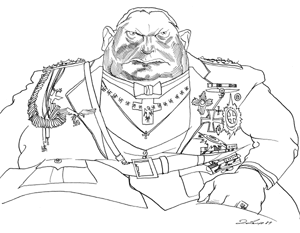
Hassell’s information may have been faulty. After Reichskrystallnacht, Göring is reported to have said (Herr Jenninger quoted this in his Bundestag speech): “I wish you’d done in two hundred Jews and not destroyed such assets!” In any event, Hassell soon discovered that it would be bootless to attempt to recruit Göring for the Widerstand. “He is more façade than wall, expires before Hitler, and is afraid of Himmler and Heydrich.” He might have noted also that Göring was self-indulgent to the extreme and considered nothing as important as the gratification of his own whims and desires. In 1934, after a visit to Göring’s bison enclosure on the Schorfheide, where his host kept dashing off in fast motorcars and then reappearing in ever more bizarre costumes, punctuating these changes of scene with harangues on a variety of Germanic themes, the British ambassador, Sir Eric Phipps, wrote in a dispatch that was soon being privately circulated in London.6
The chief impression was that of the almost pathetic naiveté of General Göring, who showed us his toys like a big, fat, spoiled child: his primeval woods, his bison and birds, his shooting box and lake and bathing beach, his blonde private secretary [the actress Emmy Sonnemann, who became Göring’s second wife], his wife’s mausoleum and swans and sarsen stones, all mere toys to satisfy his varying moods, and all, or so nearly all, as he was careful to explain, German. And then I remembered that there were other toys, less innocent, though winged, and that these might some day be launched on their murderous mission in the same childlike spirit, and with the same childlike glee.
The opinions of Hassell and Phipps would not offend David Irving, who in his new biography of Göring supplies much evidence to support them. Irving’s principle seems to be to show his subject at his worst and best—as pilot and paladin, drug addict and diplomat, megalomaniac and clown, sybarite and warrior, Gestapo chief and economic czar, man of peace and bomber of cities, lover of nature and despoiler of other people’s art treasures—in fact, the compleat Renaissance man and, to quote the book’s publicity text, “one of the most fascinating, outrageous and consequential [sic] villains who ever lived.” The result is a sprawling, excessively long, but very readable book, for Irving has always written with verve and energy, and if it is occasionally marred by the author’s contempt for received opinion and his penchant for taking sideswipes at people he doesn’t like, it tells us a great deal that we did not know about Göring’s direction of the Luftwaffe in the Second World War (indeed, everything Irving has to say about the Luftwaffe is highly interesting). The book also includes marvelous stuff on his art collecting and plundering, and provides an absorbing account of Göring’s varying relationship with Adolf Hitler.
Göring’s diplomatic activities in behalf of peace in 1939–1940 are perhaps less significant than Irving would have us believe, and his attitude toward the Jews far less disinterested. Irving admits Göring’s leading part in the campaign to drive Jews out of German business, but takes the line that “he had no time at all for pogroms,” and that his anti-Semitism was a “dutiful” one, not deeply felt. Above all, having always maintained that Hitler had no direct connection with the Final Solution, Irving now absolves Göring as well. The famous directive to Heydrich of July 31, 1941, in which Göring, as plenipotentiary of the Four Year Plan, commissioned the head of the secret police “to carry out all necessary preparations with regard to organizational, substantive, and financial viewpoints for a total solution of the Jewish question in the German sphere of influence in Europe,”7 Irving describes as “a relatively innocuous Auftrag,” which Göring must have regarded as “a routine administrative directive expanding Heydrich’s existing powers to the more recently occupied eastern territories.” There is no proof, he holds, that he ever knew of the “biological extermination” of the Jews, and he can be faulted only for not probing into Himmler’s methods. This is hardly persuasive.
Irving is interesting in his description of the operation of Göring’s Forschungsamt or research office, established in April 1933, whose “research results” consisted largely of intercepted telephone conversations and deciphered signals—an agency that was an important instrument of surveillance and thought control, and whose efficiency is attested to by Helmuth von Moltke’s complaint, quoted above, about the difficulty of confidential communication. But perhaps the most intriguing passages in the book—and here we come back to the question of dissent and Widerstand in Nazi Germany—are those that show how Göring’s popularity with the masses held up even when the land he had promised to protect with his Luftwaffe was being bombed at will by the Allies. In happier days Claire Waldoff used to sing about him:
Rechts Lametta! Links Lametta!
Und der Bauch wird imma fetta.
In der Luft ist er der Meesta!
Hermann heesta!(Glittering medals, left and right!
And his belly gets ever bigger.
In the skies he’s the master!
Hermann’s the name!)
In the fifth year of the war, when he visited bombed-out areas of Germany’s cities, people still streamed to see him, and it was still, as he said, “Hermann, Hermann, never anything but Hermann!” There could hardly be a more telling illustration of Balfour’s point that effective resistance or opposition was not practicable in Nazi Germany.
4.
In the wake of the Jenninger affair, Günther Nonnenmacher wrote in the Frankfurter Allgemeine Zeitung that “writing and speaking about National Socialism and its crimes continues to be for Germans a risky business.” It remains, however, an unavoidable necessity, unless one can somehow do away with anniversaries. We have now had the fiftieth anniversaries of Hitler’s assumption of power in January 1933, of the Anschluss of March 1938, and of Reichskrystallnacht in November 1938, and the fortieth of the bomb plot of July 1944 and of the German surrender of May 1945, and already there looms before us the fiftieth anniversary of the beginning of the war in September 1939, with scholarly conferences planned in Berlin and Pforzheim, and, doubtless, other hazardous public commemorations. These occasions tend to stimulate memory and cause controversy. Hence the long and acrimonious Historikerstreit and the row over Jenninger’s speech. And for Germans they pose the question, over and over again, of how they are to work through those memories.
Charles S. Maier has just written what is the best book available on the tangled and acrimonious debate among the German historians. It is incisive in its analysis of the arguments on all sides of the debate and admirably objective in its assessment of them. His book deserves lengthier and more circumstantial treatment than it can be given here, but three of his points are worth touching on, since they bear on the question just raised.
The first has to do with the political dimension of the historical dispute, for this was never a mere debate over historical facts or values. When the Berlin historian Ernst Nolte made the argument that began the controversy, insisting that the Holocaust was comparable to, and no more reprehensible than, the Gulag, he was seeking to free historical consciousness from the tyranny of collective thought, to lift the burden of guilt from the German past, and to open the door for a conservative nationalism and a new kind of political discourse that would tolerate anti-Western criticism. The philosopher Jürgen Habermas attacked Nolte and his supporters precisely because they were, in his view, trying to diminish national responsibility for the Nazi past, while at the same time weakening, at least potentially, the Federal Republic’s ties with the West. These should, he insisted, be based on community of values rather than mere membership in the same military alliance, which might after all be temporary. While recognizing that Habermas’s position is not without its inconsistencies, Maier, “as a historian contemplating Germany” and “as an American liberal thinking of analogous debates in our own public life,” finds it congenial. Indeed, he says that he fears the “tortured reasoning” of the Nolte revisionists, and their insistence on the necessity of a new historical consensus, could lead to
some form of ugly politics, some infringement of dissent or attack on diversity: the political fantasies of the Bildzeitung rationalized in the language of Existenzphilosophie. Even if no practical consequences followed from the revisionist view, if West Germany remained as robust a democracy as it has been, its civic culture would be degraded by the distortions of historical memory involved.
The second point concerns the revisionists’ argument that the Federal Republic needs a new kind of history that, in the words of Michael Stürmer, “promises direction signs to identity, anchorages in the cataracts of progress…. History holds for the Germans in Europe the chance to recognize themselves again.” Maier is deeply skeptical about this. It may be, as Karl Dietrich Bracher has written, that historians should not be in the identity business at all. It is certainly true that to believe that history alone is enough to establish identity is to expect too much of it. Maier writes:
The point is that the observer of a national culture must presuppose some initial or underlying characteristics. Any meaningful concept of a national identity must posit a subsisting component, which requires description in terms of nonhistorical variables. We need to know history, therefore, to understand identity; but history will not suffice. If it did, countries would move in worn grooves, and trajectories of development would be predictable. German history, above all, teaches that national behavior has scope for unexpected veerings and craziness, atrocious (and corrective) possibilities beyond what historical knowledge can prepare us for.
In short, Stürmer and his followers were perhaps taking themselves too seriously.
Finally, there remains the question of the Holocaust and how it is to be treated by German historians. The argument made by Nolte and others that there is danger in a national obsession with the Holocaust is not an idle one, and Maier faces up to it by asking why this particular past, which will not, after all, go away, should be any more obsessive than other pasts. Is this not perhaps due less to the horrors themselves than to the failure, because of complicity and shame, to confront them? It has, of course, been suggested that this failure has had its positive side and in the early years of the Federal Republic enabled it to establish a consensus without agonizing debates over responsibility. Maier will have none of this and refuses to believe that one can build the future by forgetting the past. In his epilogue, he writes:
The answer to obsession is not forgetting, but overcoming: the basis for consensus is not obscuring but repairing so far as is possible…. Thereafter let the historian insist that Auschwitz was not the end of history; it was not the entelechy of the twentieth century. It alone does not characterize our era; the movements toward emancipation that can be ranged alongside the monstrous repressions—the role of women, of racial minorities, the spread of democratic regimes—are also part of the twentieth-century record. It is possible to make a fetish of Auschwitz. Granted, the distinction between mourning, honoring, analyzing—all legitimate ends for the historian—and fetishizing is a hard one: Not the method, but the use of history establishes it. History should contribute to reconstructive effort, efforts by, as well as on behalf of, earlier victims.
This Issue
February 2, 1989
This Issue
February 2, 1989
-
1
German Information Center, Statements and Speeches, Vol. XI, No. 19 (October 14, 1988). ↩
-
2
Günter Grass, Dog Years, translated from the German by Ralph Manheim (Harcourt Brace Jovanovich, 1965; Fawcett Crest, 1966), p. 464. ↩
-
3
The New York Review, October 8 and December 3, 1987. ↩
-
4
The Von Hassell Diaries: The Story of the Forces Against Hitler in Germany, translated from the German with an introduction by Alan Welsh Dulles (Doubleday, 1947). ↩
-
5
George F. Kennan, Memoirs, 1935–1950 (Little Brown, 1967; reprinted by Pantheon, 1983), p. 120. ↩
-
6
Documents on British Foreign Policy, 1919–1939, edited by E.L. Woodward and Rohan Butler (London, 1949 ff.), 2nd series, Vol. VI, pp. 749–751. ↩
-
7
International Military Tribunal, Trial of the Major War Criminals (Nuremberg, 1947 ff.), Vol XXVI, pp. 266–267. ↩
