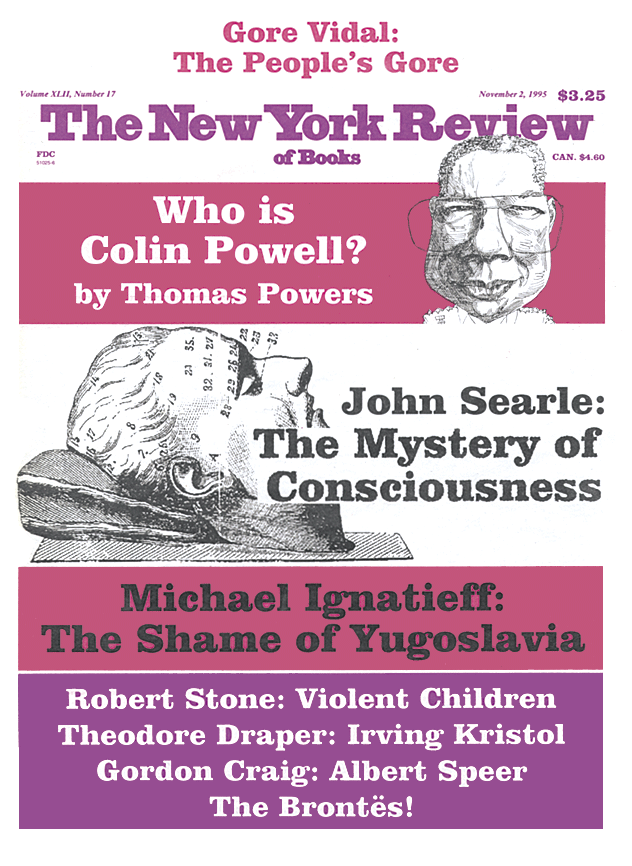
Tito and the Rise and Fall of Yugoslavia
by Richard West
The Death of Yugoslavia
by Laura Silber and Allan Little
Genocide in Bosnia: The Policy of "Ethnic Cleansing"
by Norman Cigar
All God's Children: The Bosket Family and the American Tradition of Violence
by Fox Butterfield
The Brontës
by Juliet Barker
Charlotte Brontë: A Passionate Life
by Lyndall Gordon
The Letters of Charlotte Brontë
edited by Margaret Smith
Neoconservatism: The Autobiography of an Idea
by Irving Kristol
Twilight of the Habsburgs: The Life and Times of Emperor Francis Joseph
by Alan Palmer
Landscapes of France: Impressionism and its Rivals 1995
an exhibition at the Hayward Gallery, London, May 18 to August 28,
Impressions of France: Monet, Renoir, Pissarro, and their Rivals October 4, 1995 to January 14, 1996.
the same exhibition, retitled, at the Museum of Fine Arts, Boston,, Catalog of the exhibitions by John House, with contributions from Ann Dumas and Jane Mayo Roos and James F. McMillan
Claude Monet 1840––1926
an exhibition at the Art Institute of Chicago, July 22 to November 26, 1995, Catalog of the exhibition by Charles F. Stuckey, with the assistance of Sophia Shaw
Monet to Matisse: Landscape Painting in France 1874––1914
an exhibition held in 1994 at the National Gallery of Scotland, Edinburgh, Catalog of the exhibition by Richard Thomson, with an essay by Michael Clarke
On Human Rights: The Oxford Amnesty Lectures 1993
edited by Stephen Shute, edited by Susan Hurley
Women Musicians of Venice: Musical Foundations, 1525––1855
by Jane L. Baldauf-Berdes
Vivaldi: Voice of the Baroque
by H. C. Robbins Landon
The Astonishing Hypothesis: The Scientific Search for the Soul
by Francis Crick
Consciousness Explained
by Daniel C. Dennett
The Remembered Present: A Biological Theory of Consciousness
by Gerald Edelman
Bright Air, Brilliant Fire: On the Matter of the Mind
by Gerald Edelman
Shadows of the Mind: A Search for the Missing Science of Consciousness
by Roger Penrose
The Strange, Familiar, and Forgotten: An Anatomy of Consciousness
by Israel Rosenfield
Subscribe and save 50%!
Read the latest issue as soon as it’s available, and browse our rich archives. You'll have immediate subscriber-only access to over 1,200 issues and 25,000 articles published since 1963.
Subscribe now
Subscribe and save 50%!
Get immediate access to the current issue and over 25,000 articles from the archives, plus the NYR App.
Already a subscriber? Sign in