Contents

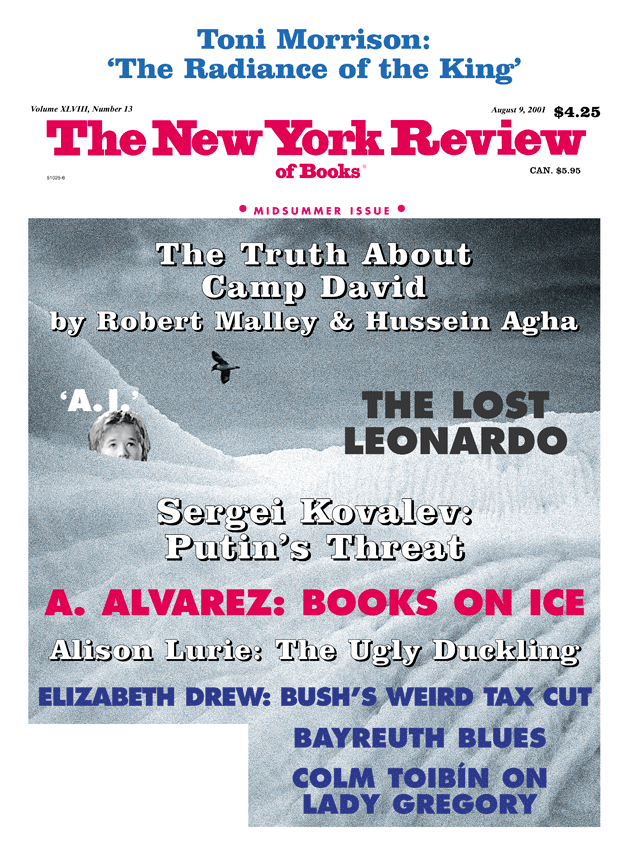
August 9, 2001 • Volume 48, Number 13

LETTERS

Contributors

Robert Malley is Middle East and North Africa Program Director at the International Crisis Group. He is writing here in his personal capacity. (November 2012)

Hussein Agha is Senior Associate Member of St. Antony’s College, Oxford, and coauthor of A Framework for a Palestinian National Security Doctrine. (November 2012)

Elizabeth Drew is a regular contributor to The New York Review and the former Washington correspondent of The Atlantic and The New Yorker. She is the author of fourteen books.
 (March 2013)

Colm Tóibín is the author of seven novels and two collections of stories. His play, The Testament of Mary, is now being staged at the Walter Kerr Theatre in New York City. He has been a visiting writer at Stanford, the University of Texas at Austin, and Princeton, and is now the Irene and Sidney B. Silverman Professor of the Humanities at Columbia.

Sylvie Kauffmann is the US correspondent for the French newspaper Le Monde. (August 2001)

Toni Morrison, Robert F. Goheen Professor at Princeton, is the author of seven novels. She received the Nobel Prize in Literature in 1993. (August 2001)

Geoffrey O’Brien is Editor in Chief of the Library of America. His recent works include Early Autumn and The Fall of the House of Walworth. His new book Stolen Glimpses, Captive Shadows: Writing on Film 2002–2012 will be published in 2013.


James Traub is a contributing writer for The New York Times Magazine. He is currently writing a book about Times Square. (February 2002)

Alison Lurie is a former Professor of English at Cornell. She is the author of two collections of essays on children’s literature, Don’t Tell the Grownups and Boys and Girls Forever, and the editor of The Oxford Book of Fairy Tales. Her most recent novel is Truth and Consequences.


Charles Hope was Director of the Warburg Institute, London, from 2001 to 2010. He is the author of Titian.


Al Alvarez is the author of Risky Business, a selection of essays, many of which first appeared in The New York Review of Books.

James Fenton is a British poet and literary critic. From 1994 until 1999, Fenton was Oxford Professor of Poetry; in 2007 he was awarded the Queen’s Gold Medal for Poetry.

John Lanchester is the author of five books including, most recently, I.O.U.: Why Everyone Owes Everyone and No One Can Pay. In 2008 he received the E.M. Forster Award from the American Academy of Arts and Letters.
 (December 2011)

Sergei Kovalev, a biologist and former political prisoner, is a leading candidate on the Yabloko Party list for the December election to the Russian State Duma. He is President of the Institute for Human Rights and Chairman of the Andrei Sakharov Foundation in Moscow. (November 2007)

Robert Skidelsky is Emeritus Professor of Political Economy at Warwick University, England. His latest book is Keynes: The Return of the Master. Felix Martin, an economist at Thames River Capital LLP, worked at the World Bank for two stretches between 1998 and 2008. He was formerly an executive board member and analyst at the European Stability Initiative.
 www.skidelskyr.com. (April 2011)

John Updike (1932–2009) was born in Shillington, Pennsylvania. In 1954 he began to publish in The New Yorker, where he continued to contribute short stories, poems, and criticism until his death. His major work was the set of four novels chronicling the life of Harry “Rabbit: Angstrom, he two of which, Rabbit is Richand Rabbit at Rest, won the Pulitzer Prize for Fiction. His last books were the novel The Widows of Eastwick and Due Considerations, a collection of his essays and criticism.

Richard Horton is a physician. He edits The Lancet, a weekly medical journal based in London and New York. He is also a visiting professor at the London School of Hygiene and Tropical Medicine.

Larry McMurtry lives in Archer City, Texas. His novels include The Last Picture Show, Terms of Endearment, Lonesome Dove (winner of the 1986 Pulitzer Prize for Fiction), Folly and Gloryand Rhino Ranch. His nonfiction works include a biography of Crazy Horse, Walter Benjamin at the Dairy Queen, Paradise, Sacagawea’s Nickname: Essays on the American West and, most recently, Custer.

Joseph Kerman is emeritus professor of music at the University of California, Berkeley. He began writing music criticism for The Hudson Review in the 1950s, and is a longtime contributor to The New York Review of Books and many other journals. His books include Opera as Drama (1956; new and revised edition 1988), The Beethoven Quartets (1967), Contemplating Music (1986), Concerto Conversations (1999), and The Art of Fugue (2005).