Contents

January 13, 2005 • Volume 52, Number 1

LETTERS

Contributors

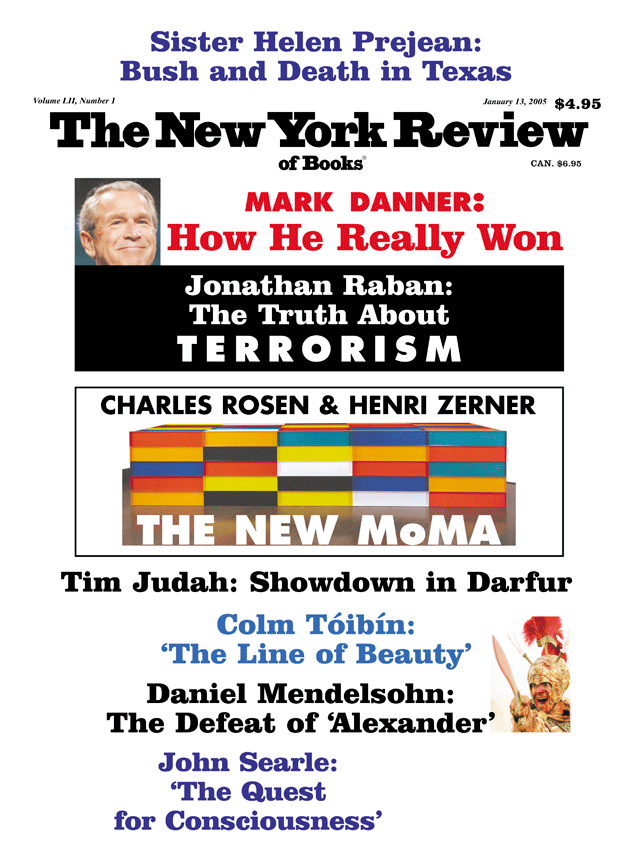
Sister Helen Prejean is a member of the Sisters of St. Joseph of Medaille and lives in Louisiana. She gives on average 140 lectures a year nationwide, seeking to encourage discussion of the death penalty. She is the author of Dead Man Walking. The article in this issue is adapted from her new book, The Death of Innocents: An Eyewitness Account of Wrongful Executions, to be published by Random House this month. (January 2005)

Colm Tóibín is the author of six novels, including The Master (a novel based on the life of Henry James) and Brooklyn, and two collections of stories, Mothers and Sons and The Empty Family. He has been a visiting writer at Stanford, the University of Texas at Austin, and Princeton, and is now the Irene and Sidney B. Silverman Professor of the Humanities at Columbia.

Tim Judah is the Balkans Correspondent of TheEconomist. He is the author of The Serbs: History, Myth and the Destruction of Yugoslavia, a new edition of which has just been published. He is also the author of two books on Kosovo and one on the Ethiopian marathon runner Abebe Bikila. He has reported on the Balkans, Afghanistan, Kurdistan, Iraq, and Sudan for The New York Review.
 (March 2010)

Jennifer Schuessler is an editor at The New York Times Book Review. (March 2011)

W.S. Merwin was born in New York City in 1927 and grew up in Union City, New Jersey, and in Scranton, Pennsylvania. From 1949 to 1951 he worked as a tutor in France, Portugal, and Majorca. He has since lived in many parts of the world, most recently on Maui in the Hawaiian Islands. He is the author of many books of poems, prose, and translations and has received both the Pulitzer and the Bollingen Prizes for poetry, among numerous other awards.

Charles Rosen’s recording The Romantic Generation, which contains a performance of Franz Liszt’s Reminiscences of Don Juan, was recently reissued. (February 2012)

Henri Zerner, Professor of History of Art and Architecture at Harvard, is the author, most recently, of Renaissance Art in France: The Invention of Classicism and Écrire l’histoire de l’art: Figures d’une discipline. (January 2005)

Pico Iyer’s most recent book is The Open Road: The Global Journey of the Fourteenth Dalai Lama. His next book, The Man Within My Head, on hauntedness, Graham Greene, and fathers, will be out next March.
 (May 2011)

Jonathan Raban’s books include Surveillance, My Holy War, Arabia, Old Glory, Hunting Mister Heartbreak, Bad Land, Passage to Juneau, and Waxwings. He is the recipient of the National Book Critics Circle Award, the Heinemann Award of the Royal Society of Literature, the PEN/West Creative Nonfiction Award, the Pacific Northwest Booksellers’ Award, and the Governor’s Award of the State of Washington. He is a frequent contributor to The New York Review of Books, The Guardian, and The Independent. He lives in Seattle.

Aryeh Neier, former Executive Director of Human Rights Watch, is President of the Open Society Institute. His most recent book is Taking Liberties: Four Decades in the Struggle for Rights. (November 2007)

James Fenton is a visiting fellow at the Cullman Center of the New York Public Library.
 (March 2012)

John R. Searle is Slusser Professor of Philosophy at the University of California, Berkeley. His most recent book is Making the Social World. (June 2011)

Robert Gottlieb has been Editor in Chief of Simon and Schuster, Knopf, and The New Yorker. His most recent book is Lives and Letters. (September 2011)

Daniel Mendelsohn is the author of six books, including How Beautiful It Is and How Easily It Can Be Broken, a collection of critical essays mostly from The New York Review of Books. He is the Charles Ranlett Flint Professor of Humanities at Bard.

Joyce Carol Oates is Roger S. Berlind Professor of Humanities and the Arts at Princeton. Her most recent books are A Widow’s Story: A Memoir and the forthcoming The Corn Maiden: Novellas and Stories. (September 2011)

Stephen Kotkin directs Russian studies at Princeton. He received a Ph.D. from the University of California, Berkeley, in 1988 under Martin Malia and Reginald Zelnik, both of whom died this year. (January 2005)

Mark Danner is the author, most recently, of Stripping Bare the Body: Politics Violence War. He is Chancellor’s Professor of English, Journalism and Politics at the University of California at Berkeley and James Clarke Chace Professor of Foreign Affairs, Politics and the Humanities at Bard College and is currently teaching at Al Quds University in East Jerusalem. Parts of his essay in the Review‘s October 13, 2011 issue were drawn from his Tanner Lectures on Human Value at Stanford University, which will be published next year as Torture and the Forever War. His work can be found at markdanner.com.