Table of Contents

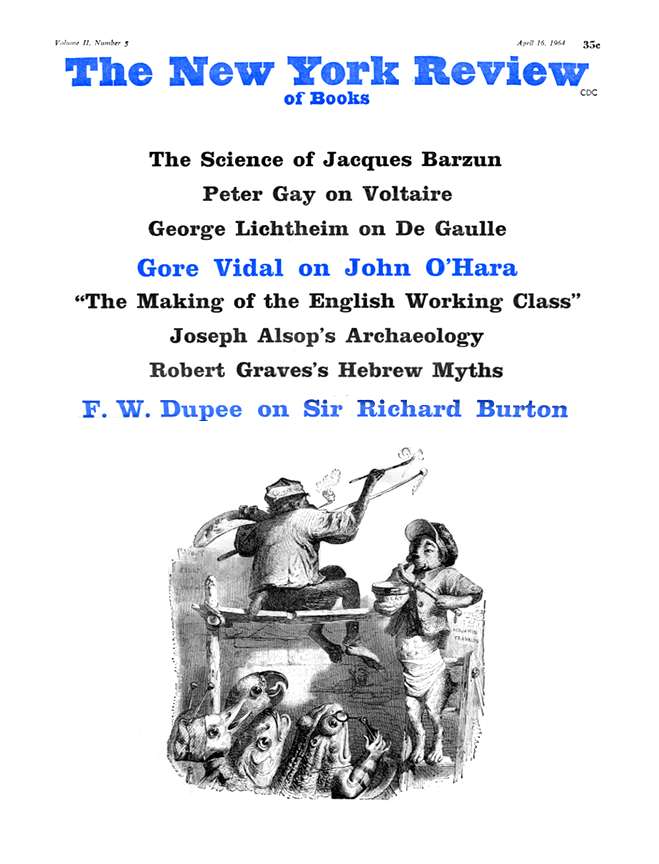
Volume 2, Number 5 · April 16, 1964

F.W. Dupee, Sir Richard and Ruffian Dick

Burton: A Biography of Sir Richard Francis Burton by Byron Farwell

George Lichtheim, The Enigma of De Gaulle

De Gaulle and the French Army: A Crisis in Civil-Military Relations by Edgar S. Furniss Jr.

De Gaulle Entre Deux Mondes by Paul-Marie de la Gorce

Gore Vidal, Appointment with O'Hara

The Hat On The Bed by John O'Hara

Elizabeth Appleton by John O'Hara

M.I. Finley, Alsop's Archaeology

From the Silent Earth by Joseph Alsop

John Gross, Hard Times

The Making of the English Working Class by E.P. Thompson

Peter Gay, Voltaire

Select Letters of Voltaire translated and edited by Theodore Besterman

Henry David Aiken, The Science of Jacques Barzun

Science: The Glorious Entertainment by Jacques Barzun

Irving Kristol, Murder in New Jersey

Doe Day: The Antlerless Deer Controversy in New Jersey by Paul Tillett

D.A.N. Jones, Amis's English Usage

One Fat Englishman by Kingsley Amis

Wylie Sypher, A Late Romantic

Selected Writings Poetry and Criticism by Herbert Read, with a Forward by Allen Tate

H.H. Rowley, Graves's Mythology

Hebrew Myths: The Book of Genesis by Robert Graves, by Raphael Patai

Robert M. Adams, Two Philosophical Critics

Three Philosophilcal Novelists by Joseph Brennan

Wait Without Idols by Gabriel Vahanian
Stanley Edgar Hyman, Upper West-Side Story

Claremont Essays by Diana Trilling


Letters

Glauco Cambon, William Arrowsmith, Svevo in Italy
G. S Fraser, The Dial
William Wasserstrom, The Dial


Contributors

M. I. Finley (1912-1986), the son of Nathan Finkelstein and Anna Katzellenbogen, was born in New York City. He graduated from Syracuse University at the age of fifteen and received an MA in public law from Columbia, before turning to the study of ancient history. During the Thirties Finley taught at Columbia and City College and developed an interest in the sociology of the ancient world that was shaped in part by his association with members of the Frankfurt School who were working in exile in America. In 1952, when he was teaching at Rutgers, Finley was summoned before the Senate Internal Security Subcommittee and asked whether he had ever been a member of the Communist Party. He refused to answer, invoking the Fifth Amendment; by the end of the year he had been fired from the university by a unanimous vote of its trustees. Unable to find work in the US, Finley moved to England, where he taught for many years at Cambridge, helping to redirect the focus of classical education from a narrow emphasis on philology to a wider concern with culture, economics, and society. He became a British subject in 1962 and was knighted in 1979. Among Finley's best-known works are The Ancient Economy, Ancient Slavery and Modern Ideology, and The World of Odysseus.

Peter Gay is Director of the Center for Scholars and Writers at the New York Public Library. He wrote Schnitzler's Century: The Making of Middle-Class Culture, 1815–1914.

John Gross's most recent book is A Double Thread, a memoir. He is the editor of The New Oxford Book of Literary Anecdotes, which was published in paperback last September. (May 2009)

Gore Vidal's most recent novel is The Golden Age. (February 2002)


Search the Review
Advanced search


Subscribe to our podcasts

Find us on Facebook

Follow us on Twitter