Table of Contents
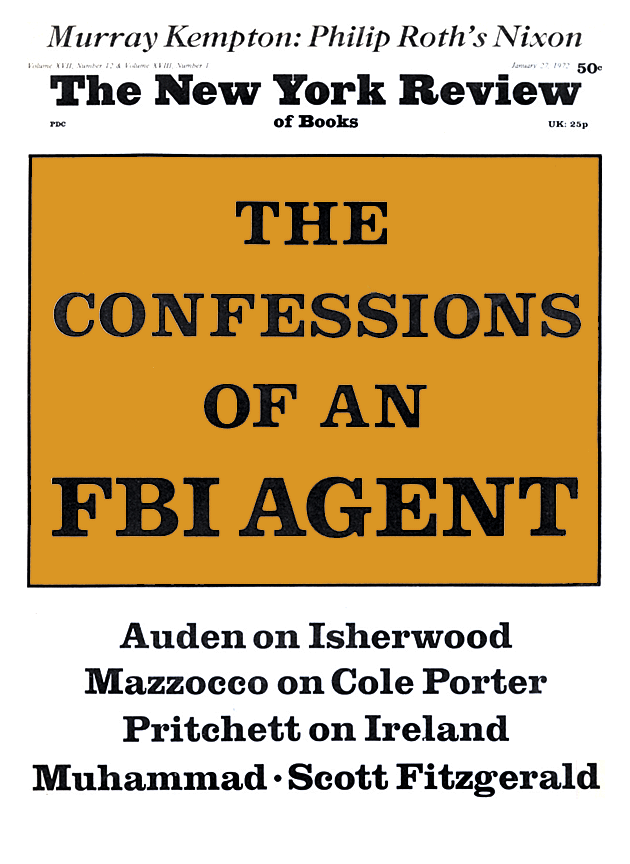
Volume 17 & 18, Number 12 & 1 · January 27, 1972
Robert Mazzocco, A Kick Out of Cole
Cole edited by Robert Kimball, with a biographical essay by Brendan Gill
V.S. Pritchett, Among the Irish
Robert Wall, Special Agent for the FBI
W.H. Auden, The Diary of a Diary
Kathleen and Frank by Christopher Isherwood
Murray Kempton, Nixon Wins!
Our Gang by Philip Roth
L.P. Elwell-Sutton, Muhammad Muckraked
Mohammed by Maxime Rodinson, translated by Anne Carter
Leonard Ross, A Case of Inflation
The New Industrial State by John Kenneth Galbraith
Robert M. Adams, Attis Adonis Osiris Fitzgerald & Co.
Exiles from Paradise: Zelda and Scott Fitzgerald by Sara Mayfield
Dear Scott/Dear Max: the Fitzgerald-Perkins Correspondence edited by John Kuehl, edited by Jackson Bryer
The Golden Moment: The Novels of F. Scott Fitzgerald by Milton R. Stern
Living Well Is the Best Revenge by Calvin Tomkins
Crazy Sundays: F. Scott Fitzgerald in Hollywood by Aaron Latham
F. Scott Fitzgerald in His Own Time, a Miscellany edited by Matthew Bruccoli, edited by Jackson Bryer
C.B.A. Behrens, Counter Revolutionaries
The Counter-Revolution, Doctrine and Action, 1789-1804 by Jacques Godechot, translated by Salvator Attanasio
Power, Property and History by Joseph Barnave, translated and edited by Emanuel Chill
History in Geographic Perspective: The Other France by E.W. Fox
Martin Malia, Mandelstam's Power
Hope against Hope: A Memoir by Nadezhda Mandelstam, translated by Max Hayward, Introduction by Clarence Brown
Clarence Brown, Osip Mandelstam, 3 Poems by Osip Mandelstam
(poem)
The Editors, Short Reviews
The Devil in the Fire: American Literature and Culture 1951-1971 by John W. Aldridge
Massacre of the Brazilian Indians by Lucien Bodard, translated by Jennifer Monaghan
Janis by David Dalton
Letters
Morton H. Halperin, The Quagmire Papers, Cont.
Contributors
W. H. Auden (1907–1973) was born in North Yorkshire, England, the son of a doctor. He studied at Oxford and published his first book, Poems, in 1930, immediately establishing himself as one of the outstanding voices of his generation. Auden emigrated to New York in 1939, where he became a US citizen and converted to Anglicanism. He wrote essays, critical studies, plays, and opera librettos for such composers as Benjamin Britten, Igor Stravinsky, and Hans Werner Henze, as well as the poems for which he is most famous.
Clarence Brown is the author of a prize-winning biography of Mandelstam
and is Professor Emeritus of Comparative Literature at Princeton.
Murray Kempton (1917-1997) was a columnist
for Newsday, as well as a regular contributor to The New York Review of
Books. His books include Rebellions, Perversities, and Main Events
and The Briar Patch, as well as Part of Our Time. He won the Pulitzer
Prize in 1985.
Martin Malia is Professor of History Emeritus at the University of California, Berkeley. He is the author, most recently, of Russia Under Western Eyes, from the Bronze Horseman to the Lenin Mausoleum. (November 2001)
Osip Mandelstam (1891–1938) was born and raised in St. Petersburg, where he attended the prestigious Tenishev School, before studying at the universities of St. Petersburg and Heidelberg and at the Sorbonne. Mandelstam first published his poems in Apollyon, an avant-garde magazine, in 1910, then banded together with Anna Akhmatova and Nicholas Gumilev to form the Acmeist group, which advocated an aesthetic of exact description and chiseled form, as suggested by the title of Mandelstam's first book, Stone (1913). During the Russian Revolution, Mandelstam left Leningrad for the Crimea and Georgia, and he settled in Moscow in 1922, where his second collection of poems, Tristia, appeared. Unpopular with the Soviet authorities, Mandelstam found it increasingly difficult to publish his poetry, though an edition of collected poems did come out in 1928. In 1934, after reading an epigram denouncing Stalin to friends, Mandelstam was arrested and sent into exile. He wrote furiously during these years, and his wife, Nadezhda, memorized his work in case his notebooks were destroyed or lost. (Nadezhda Mandelstam's extraordinary memoirs of life with her husband, Hope Against Hope and Hope Abandoned, published in the 1970s, later helped to bring Mandelstam a worldwide audience.)