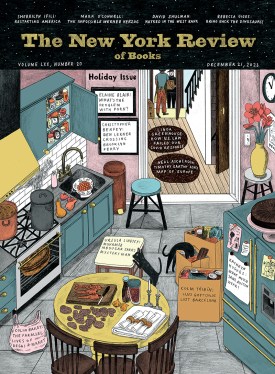
Table of Contents
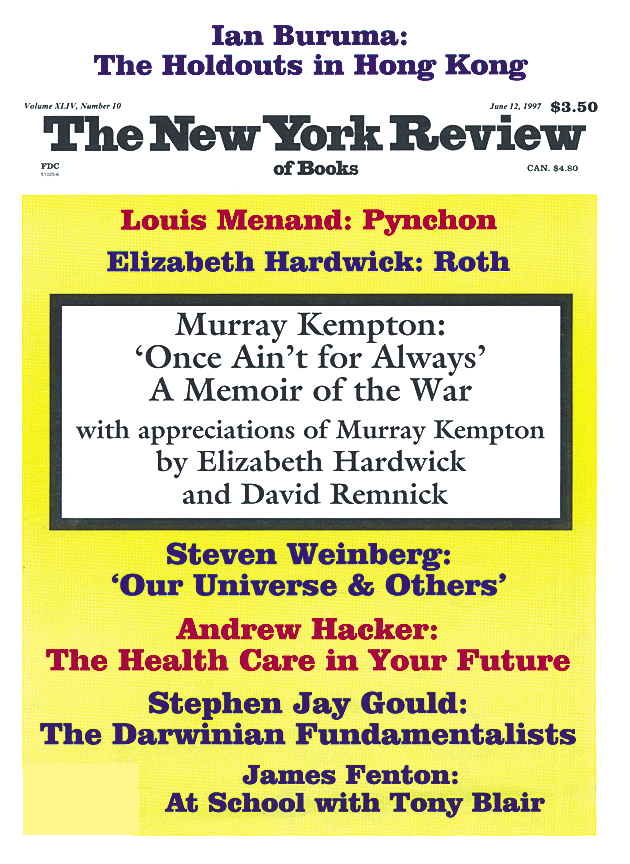
Volume 44, Number 10 · June 12, 1997
Elizabeth Hardwick, On Murray Kempton (1917–1997)
David Remnick, On Murray Kempton (1917–1997)
Murray Kempton, Once Ain't for Always
James Fenton, The Self-Made Man
Elizabeth Hardwick, Paradise Lost
American Pastoral by Philip Roth
Steven Weinberg, Before the Big Bang
The Whole Shebang: A State-of-the Universe(s) Report by Timothy Ferris
Before the Beginning: Our Universe and Others by Martin Rees. (to be published in the US by Addison-Wesley in fall 1997)
The Inflationary Universe: The Quest for a New Theory of Cosmic Origins by Alan H. Guth
Louis Menand, Entropology
Mason & Dixon by Thomas Pynchon
Andrew Hacker, The Medicine in Our Future
Health Against Wealth: HMOs and the Breakdown of Medical Trust by George Anders
Beginnings Count: The Technological Imperative in American Health Care by David J. Rothman
Mortal Peril: Our Inalienable Right to Health Care? by Richard A. Epstein
Boomerang: Clinton's Health Security Effort and the Turn Against Government in U.S. Politics by Theda Skocpol
Market-Driven Health Care: Who Wins, Who Loses in the Transformation of America's Largest Service Industry by Regina E. Herzlinger
The Price of Life: The Future of American Health Care by Robert H. Blank
The Road to Nowhere: The Genesis of President Clinton's Plan for Health Security by Jacob S. Hacker
Michael Ignatieff, In the Center of the Earthquake
Tangled Loyalties: The Life and Times of Ilya Ehrenburg by Joshua Rubenstein
Les Surprises de la Loubianka: nouvelles découvertes dans les archives littéraires du KGB by Vitaly Shentalinsky, French translation by Galia Ackerman, by Pierre Lorrain
Stephen Jay Gould, Darwinian Fundamentalism
John Banville, The European Irishman
Independent Spirit by Hubert Butler
Richard Murphy, The Afterlife
(poem)
Edmund S. Morgan, America's First Great Man
The Journal of John Winthrop, 1630-1649 edited by Richard S. Dunn, edited by James Savage, edited by Laetitia Yeandle
The Journal of John Winthrop, 1630-1649 Abridged Edition edited by Richard S. Dunn, edited by Laetitia Yeandle
Jeremy Bernstein, The Road to Lhasa
Younghusband: The Last Great Imperial Adventurer by Patrick French
Jonathan Mirsky, Peking's Choice
Peter Holland, Maid, Man, and Jew
Impersonations: The Performance of Gender in Shakespeare's England by Steven Orgel
Shakespeare and the Jews by James Shapiro
Ian Buruma, Holding Out in Hong Kong
Kowloon Tong by Paul Theroux
Hong Kong Remembers by Sally Blyth and Ian Wotherspoon, Introduction by the Rt. Honorable the Baroness Thatcher
The Fall of Hong Kong: China's Triumph and Britain's Betrayal by Mark Roberti
Red Flag over Hong Kong by Bruce Bueno de Mesquita, by David Newman, by Alvin Rabushka
The Hong Kong Advantage by Michael J. Enright, by Edith E. Scott, by David Dodwell
Letters
Mark Lilla, A Bone for the Nazis
Barbara Chase-Riboud, Gordon S. Wood, The Sally Hemings Case
Contributors
John Banville was born in Wexford, Ireland, in 1945. He is the author of many novels, including The Book of Evidence, The Untouchable, and Eclipse. Banville's novel The Sea was awarded the 2005 Man Booker Prize. On occasion he writes under the pen name Benjamin Black.
Jeremy Bernstein is a physicist who worked at Los Alamos. His Plutonium: A History of the World's Most Dangerous Element was published in paperback in March. (April 2009)
Ian Buruma is the Henry R. Luce Professor at Bard. He received the 2008 Erasmus Prize. His novel The China Lover was published in September 2008.
James Fenton iis the editor of The New Faber Book of Love Poems and D.H. Lawrence's Selected Poems. (July 2009)
Stephen Jay Gould teaches Geology, Biology, and the History of Science at Harvard and is the Vincent Astor Visiting Professor of Biology at NYU. His latest book is The Lying Stones of Marrakech. (October 2001)
Andrew Hacker teaches political science at Queens College. He is currently writing a book on higher education in collaboration with Claudia Dreifus. (April 2009)
Elizabeth Hardwick (1916-2007) was a frequent contributor to Partisan Review, The New Yorker, and The New York Review of Books, which she helped found in 1963. Her books include the novels The Simple Truth, The Ghostly Lover, and Sleepless Nights (NYRB Classics); the essay collections A View of My Own and Seduction and Betrayal (NYRB Classics).
Peter Holland holds the McMeel Family Chair in Shakespeare Studies in the Department of Film, Television, and Theatre at the University of Notre Dame. He wrote the entry on Shakespeare in the Oxford Dictionary of National Biography. (December 2004)
Michael Ignatieff is the Carr Professor and Director of the Carr Center for Human Rights Policy at the Kennedy School of Government at Harvard. His latest book is Human Rights as Politics and Idolatry. (April 2003)
Murray Kempton (1917-1997) was a columnist
for Newsday, as well as a regular contributor to The New York Review of
Books. His books include Rebellions, Perversities, and Main Events
and The Briar Patch, as well as Part of Our Time. He won the Pulitzer
Prize in 1985.
Louis Menand is the Robert M. and Anne T. Bass Professor of English and American Literature and Language at Harvard University, and a staff writer at The New Yorker. He is the author of The Metaphysical Club—which won the Pulitzer Prize for History and the Francis Parkman Prize in 2002—and of American Studies, a collection of essays.
Jonathan Mirsky is a historian and journalist specializing in Chinese affairs. In 2002 he was the first I.F. Stone Teaching Fellow at the University of California, Berkeley, Journalism School.
(August 2009)
Edmund S. Morgan is Sterling Professor of History Emeritus at Yale. His most recent book, The Genuine Article: A Historian Looks at Early America, was published in 2004. (October 2008)
Richard Murphy's most recent books are Collected Poems and The Kick: A Life Among Writers. (February 2004)
David Remnick is the Pulitzer Prize-winning author of Lenin's Tomb, The Devil Problem and Other True Stories, and Resurrection. He is the editor of The New Yorker.
Steven Weinberg holds the Josey Regental Chair in Science at the University of Texas at Austin. He has been awarded the Nobel Prize in physics and the National Medal of Science.