Contents

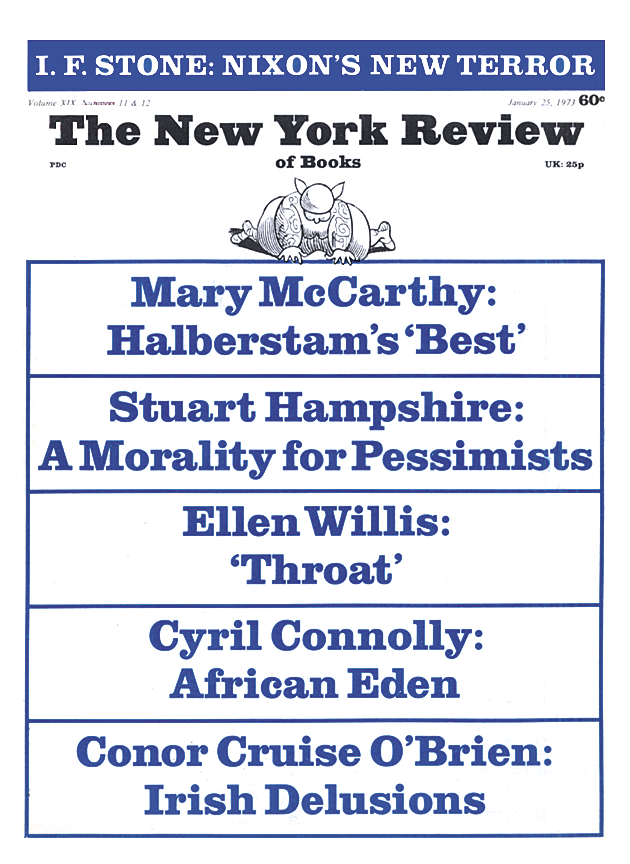
January 25, 1973 • Volume 19, Number 11 & 12

LETTERS

Contributors

Stuart Hampshire (1914–2004) was an English philosopher. He taught at University College London, Princeton, Stanford and Oxford, where he was named Warden of Wadham College. His books include Thought and Action, Spinoza and Justice Is Conflict.

Hugh Honour is the author, with John Fleming, of The Visual Arts: A History, which has recently been published in its sixth expanded edition. (November 2002)

Osip Mandelstam (1891–1938) was born and raised in St. Petersburg, where he attended the prestigious Tenishev School, before studying at the universities of St. Petersburg and Heidelberg and at the Sorbonne. Mandelstam first published his poems in Apollyon, an avant-garde magazine, in 1910, then banded together with Anna Akhmatova and Nicholas Gumilev to form the Acmeist group, which advocated an aesthetic of exact description and chiseled form, as suggested by the title of Mandelstam’s first book, Stone (1913). During the Russian Revolution, Mandelstam left Leningrad for the Crimea and Georgia, and he settled in Moscow in 1922, where his second collection of poems, Tristia, appeared. Unpopular with the Soviet authorities, Mandelstam found it increasingly difficult to publish his poetry, though an edition of collected poems did come out in 1928. In 1934, after reading an epigram denouncing Stalin to friends, Mandelstam was arrested and sent into exile. He wrote furiously during these years, and his wife, Nadezhda, memorized his work in case his notebooks were destroyed or lost. (Nadezhda Mandelstam’s extraordinary memoirs of life with her husband, Hope Against Hope and Hope Abandoned, published in the 1970s, later helped to bring Mandelstam a worldwide audience.)

W.S. Merwin was born in New York City in 1927 and grew up in Union City, New Jersey, and in Scranton, Pennsylvania. From 1949 to 1951 he worked as a tutor in France, Portugal, and Majorca. He has since lived in many parts of the world, most recently on Maui in the Hawaiian Islands. He is the author of many books of poems, prose, and translations and has received both the Pulitzer and the Bollingen Prizes for poetry, among numerous other awards.

Clarence Brown is the author of a prize-winning biography of Mandelstam and is Professor Emeritus of Comparative Literature at Princeton.

Mary McCarthy (1912-1989) was a novelist, essayist, and critic. Her political and social commentary, literary essays, and drama criticism appeared in magazines such as Partisan Review, The New Yorker, Harper’s, and The New York Review of Books, and were collected in On the Contrary (1961), Mary McCarthy’s Theatre Chronicles 1937-1962 (1963), The Writing on the Wall (1970), Ideas and the Novel (1980), and Occasional Prose (1985). Her novels include The Company She Keeps (1942), The Oasis (1949), The Groves of Academe (1952), A Charmed Life (1955), The Group (1963), Birds of America (1971), and Cannibals and Missionaries (1979). She was the author of three works of autobiography, Memories of a Catholic Girlhood (1957), How I Grew (1987), and the unfinished Intellectual Memoirs (1992), and two travel books about Italy, Venice Observed (1956) and The Stones of Florence (1959). Her essays on the Vietnam War were collected in The Seventeenth Degree (1974); her essays on Watergate were collected in The Mask of State (1974).

Conor Cruise O’Brien (1917–2009) was an Irish historian and politician. He was elected to the Irish parliament in 1969 and served as a Minister from 1973 until 1977. His works include States of Ireland, The Great Melody and Memoir: My Life and Themes.

V.S. Pritchett (1900–1997) was a British essayist, novelist and short story writer. He worked as a foreign correspondent for the The Christian Science Monitorand as a literary critic forNew Statesman. In 1968 Pritchett was made a Commander of the Order of the British Empire; he was knighted in 1975. His body of work includes many collections of short stories, in addition to travelogues, reviews, literary biographies and novels.

Roger Sale is a critic and journalist. Until 1999, he was Professor of English at the University of Washington. His books include Modern Heroism: Essays on D. H. Lawrence, William Empson and J.R.R. Tolkien and On Not Being Good Enough: Writings of a Working Critic.

Frances A. Yates (1899–1981) was an English historian. She taught for many years at The Warburg Institute, where she studied the history of esotericism in the West.

Hannah Arendt (1906–1975) was a German political theorist who, over the course of many books, explored themes such as violence, revolution, and evil. Her major works include The Origins of Totalitarianism, The Human Condition, and the controversial Eichmann in Jerusalem, in which she coined the phrase “the banality of evil.”

Peter Brooks is the author of Henry James Goes to Paris, Realist Vision, Troubling Confessions, Reading for the Plot, The Melodramatic Imagination, and a number of other books, including the historical novel World Elsewhere. He taught for many years at Yale, where he was the Sterling Professor of Comparative Literature, and currently is the Andrew W. Mellon Foundation Scholar at Princeton.

Robert Brustein is a playwright, director, critic, teacher, and founder of the Yale Repertory and American Repertory Theatres. His play The Last Will opens in New York in April at Abingdon’s June Havoc Theater, and then goes to the Wuzhen Festival in China. In 2010 he was awarded the National Medal of Arts. (April 2013)

Thomas R. Edwards (1928–2005) was Professor of English at Rutgers and editor of Raritan. His last book was Over Here: Criticizing America.

Barbara Epstein (1928–2006) worked in publishing and at The Partisan Review before becoming editor of The New York Review of Books in 1963. She began her publishing career at Doubleday & Co., where she served as junior editor after graduating from Radcliffe College in 1949. She was born Barbara Zimmerman in Boston, Massachusetts.

Frances FitzGerald’s books include Way Out There in the Blue: Reagan, Star Wars, and the End of the Cold War. (November 2008)

William H. Gass is an American writer, critic and philosopher. He is the David May Distinguished University Professor in the Humanities at the Washington University in St. Louis.

Allen Ginsberg (1926–1997) was a poet and one of most prominent figures of the Beat Generation. His epic poem “Howl,” which denounced bourgeois conformity and capitalistic greed, became the subject of a landmark obscenity trial in San Francisco. Known for his celebration of the marginalized and the downtrodden and his opposition to American militarism, Ginsberg drew inspiration from the long lines and anaphoric rhythms of Walt Whitman. His 1981 collection Plutonium Ode won the National Book Award; in 1993 Ginsberg was awarded the medal of Chevalier Des Arts et des Lettres by the French government.

Robert L. Heilbroner (1919–2005) was an American economist. He taught economic history at the New School, where he was appointed Norman Thomas Professor of Economics in 1971.

John Hollander is Sterling Professor Emeritus of English at Yale.

Richard Howard received a National Book Award for his translation of Les Fleurs du mal and a Pulitzer Prize for Untitled Subjects, his third volume of poems. He is the translator of the NYRB Classics Alien Hearts and The Unknown Masterpiece.

Alfred Kazin (1915–1998) was a writer and teacher. Among his books are On Native Grounds, a study of American literature from Howells to Faulkner, and the memoirs A Walker in the Cityand New York Jew. In 1996, he received the first Lifetime Award in Literary Criticism from the Truman Capote Literary Trust.

Frank Kermode (1919–2010) was a British critic and literary theorist. Born on the Isle of Man, he taught at University College London, Cambridge, Columbia and Harvard. Adapted from a series of lectures given at Bryn Mawr College, Kermode’s Sense of An Ending: Studies in the Theory of Fiction remains one of the most influential works of twentieth-century literary criticism.

Christopher Lasch (1932–1994) was an American historian.

Dwight Macdonald (1906–1982) was born in New York City and educated at Exeter and Yale. On graduating from college, he enrolled in Macy’s executive training program, but soon left to work for Henry Luce at Time and Fortune, quitting in 1936 because of cuts that had been made to an article he had written criticizing U.S. Steel. From 1937 to 1943, Macdonald was an editor of Partisan Review and in 1944, he started a journal of his own, Politics, whose contributors included Albert Camus, Victor Serge, Simone Weil, Bruno Bettelheim, James Agee, John Berryman, Meyer Schapiro, and Mary McCarthy. In later years, Macdonald reviewed books for The New Yorker, movies for Esquire, and wrote frequently for The New York Review of Books.

Norman Mailer (1923-2007) was born in Long Branch, New Jersey, and grew up in Brooklyn, New York. In 1955 he co-founded The Village Voice. He is the author of more than thirty books, including The Naked and the Dead; The Armies of the Night, for which he won a National Book Award and the Pulitzer Prize; The Executioner’s Song, for which he won his second Pulitzer Prize; Harlot’s Ghost; Oswald’s Tale; The Gospel According to the Son; and The Castle in the Forest.

Arthur Miller (1915–2005) was an American playwright and essayist. His 1949 play, Death of A Salesman, received a Tony Award for Best Author, The New York Drama Circle Critics’ Award, and the Pulitzer Prize for Drama.

Julian Moynahan is Professor of English Emeritus at Rutgers University. His most recent book is Anglo-Irish: The Literary Imagination in a Hyphenated Culture. (May 2000)

Robert B. Silvers is editor of The New York Review of Books. Prior to joining the Review, Mr. Silvers was, from 1959 to 1963, associate editor of Harper’s magazine, editor of the book Writing in America and translator of La Gangrène. Before that, Mr. Silvers lived in Paris for six years (1952 to 1958), where he served with the U.S. Army at SHAPE Headquarters and attended the Sorbonne and École des Sciences Politiques. He joined the editorial board of The Paris Review in 1954 and became Paris editor in 1956. He also worked as press secretary to Governor Chester Bowles in 1950. Mr. Silvers, who graduated from the University of Chicago in 1947, was born in Mineola, New York.

Susan Sontag (1933–2004) was a novelist, playwright, filmmaker, and one of the most influential critics of her generation. Her books include Against Interpretation, On Photography, Illness as Metaphor, and The Volcano Lover.

Stephen Spender (1909–1995) was an English poet and essayist. As a young man, he became friends with W.H. Auden, Louis MacNeice, Cecil Day-Lewis, and Christopher Isherwood, a loose collection often referred to as “the Auden Group” or “MacSpaunday.” He published many collections of poems, including The Still Centre and Ruins and Visions, and numerous volumes of nonfiction and other works, including Learning Laughterand Love-Hate Relations.

William Styron (1925–2006) was the author of several novels, including Sophie’s Choice and The Confessions of Nat Turner.

Richard Wilbur’s book Mayflies: New Poems and Translations will be published in April. (November 2000)

I.F. Stone (1907–1989) was an American journalist and publisher whose self-published newsletter, I.F. Stone’s Weekly, challenged the conservatism of American journalism in the midcentury. A Noncomformist History of Our Times (1989) is a six-volume anthology of Stone’s writings.