Contents

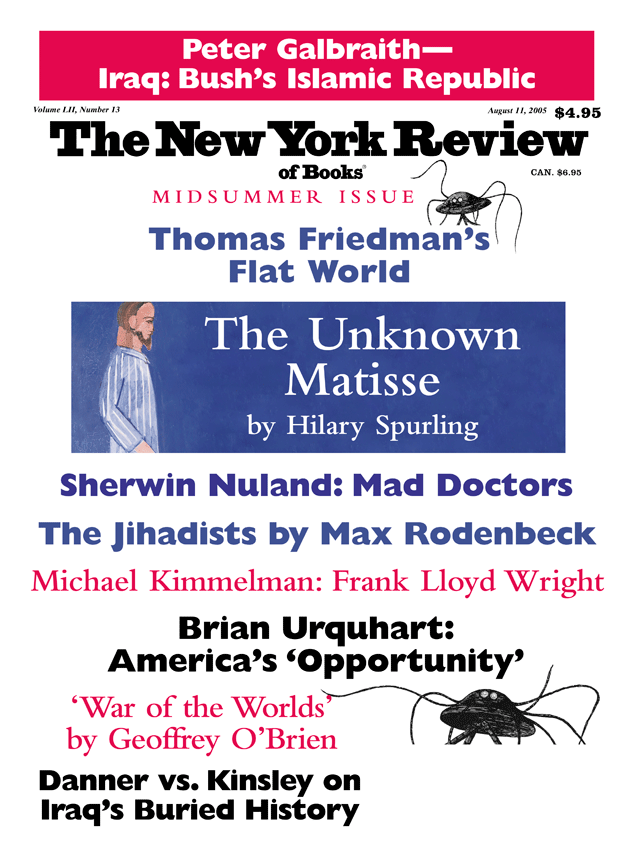
August 11, 2005 • Volume 52, Number 13

LETTERS

Contributors

Peter W. Galbraith, a former US Ambassador to Croatia, is Senior Diplomatic Fellow at the Center for Arms Control and a principal at the Windham Resources Group, which has worked in Iraq. His new book, Unintended Consequences: How War in Iraq Strengthened Americaå?s Enemies, has just been released. (October 2008)

James Fenton is a visiting fellow at the Cullman Center of the New York Public Library.
 (March 2012)

Geoffrey O’Brien is Editor in Chief of the Library of America. His latest books are The Fall of the House of Walworth and Early Autumn. 
(September 2011)

John Gray is Emeritus Professor of European Thought at the London School of Economics. Among his most recent books are Straw Dogs: Thoughts on Humans and Other Animals, False Dawn: The Delusions of Global Capitalism, Heresies: Against Progress and Other Illusions, and The Immortalization Commission: Science and the Strange Quest to Cheat Death.

Alan Hollinghurst was born in 1954 in Gloucestershire, England, and attended Magdalen College, Oxford. He is the author of the novels The Swimming-Pool Library, The Folding Star (shortlisted for the Booker Prize), The Spell, The Line of Beauty, as well as of a translation of the play Bajazet by Racine. A former staff member at The Times Literary Supplement, Hollinghurst is a frequent contributor to that and other publications, including The Guardian. Hollinghurst’s fourth novel, The Line of Beauty, won the Man Booker Prize in 2004. He lives in London.

Christopher de Bellaigue was born in London in 1971 and has worked as a journalist in the Middle East and South Asia since 1994. His first book, In the Rose Garden of the Martyrs: A Memoir of Iran, was shortlisted for the Royal Society of Literature’s Ondaatje Prize. He lives in Tehran with his wife and two children.

Sherwin B. Nuland is Clinical Professor of Surgery and a Fellow of the Institution for Social and Policy Studies at Yale. He is the author of How We Die, which won the National Book Award in 1994, and Lost in America. (December 2005)

Charles Simic is a poet, essayist, and translator. He has published some twenty collections of poetry, six books of essays, a memoir, and numerous translations. He is the recipient of many awards, including the Pulitzer Prize, the Griffin Prize, and a MacArthur Fellowship. Simic’s most recent works are Voice at 3 a.m., a selection of later and new poems; Master of Disguises, new poems; and Confessions of a Poet Laureate, a collection of short essays that was published by New York Review Books as an e-book original. In 2007 Simic was appointed the fifteenth Poet Laureate Consultant in Poetry to the Library of Congress.

Tim Flannery is Panasonic Professor of Environmental Sustainability at Macquarie University in Sydney. His latest book is Here on Earth: A Natural History of the Planet.
 (February 2012)

Hilary Spurling second volume of her two-volume life of Matisse will be published in the US in September. She is also the author of Ivy: The Life of I. Compton-Burnett and The Girl from the Fiction Department: A Portrait of Sonia Orwell. The article in this issue is based on a lecture at the National Gallery, London. (August 2005)

Lorrie Moore teaches at the University of Wisconsin in Madison. She has won the Rea Award and the PEN/Malamud Award for Short Fiction. Her most recent book is A Gate at the Stairs.
 (December 2011)

Brian Urquhart is a former Undersecretary-General of the United Nations. His books include Hammarskjöld, A Life in Peace and War, and Ralph Bunche: An American Life. (April 2011)

Tim Judah is the Balkans Correspondent of TheEconomist. He is the author of The Serbs: History, Myth and the Destruction of Yugoslavia, a new edition of which has just been published. He is also the author of two books on Kosovo and one on the Ethiopian marathon runner Abebe Bikila. He has reported on the Balkans, Afghanistan, Kurdistan, Iraq, and Sudan for The New York Review.
 (March 2010)

Norman Rush was raised in Oakland, California, and graduated from Swarthmore College in 1956. He has been an antiquarian book dealer, a college instructor, and, with his wife Elsa, he lived and worked in Africa from 1978 to 1983. They now reside in Rockland County, New York. His stories have appeared in The New Yorker, The Paris Review, and Best American Short Stories. Whites, a collection of stories, was published in 1986, and his first novel, Mating, the recipient of the National Book Award, was published in 1991. Mortals is his second novel.

Michael Kimmelman is chief art critic of The New York Times. He is based in Berlin, writing the Abroad column for the Times on culture and society across Europe.
 (January 2011)

Max Rodenbeck is The Economist‘s Mideast Correspondent. He lives in Cairo. (October 2011)

Caroline Moorehead’s new book, A Train in Winter: An Extraordinary Story of Women, Friendship, and Resistance in Occupied France, will be published in November. (October 2011)

Ahdaf Soueif is a novelist and a writer on political and cultural affairs. Her latest novel, The Map of Love, was shortlisted for the Booker Prize in 1999. She was born in Egypt and lives in Cairo and London.

Norman Mailer (1923-2007) was born in Long Branch, New Jersey, and grew up in Brooklyn, New York. In 1955 he co-founded The Village Voice. He is the author of more than thirty books, including The Naked and the Dead; The Armies of the Night, for which he won a National Book Award and the Pulitzer Prize; The Executioner’s Song, for which he won his second Pulitzer Prize; Harlot’s Ghost; Oswald’s Tale; The Gospel According to the Son; and The Castle in the Forest.

David Kaiser is Chair of the Board of Just Detention International, a human rights organization that seeks to end sexual abuse in detention. (March 2011)

Mark Danner is the author, most recently, of Stripping Bare the Body: Politics Violence War. He is Chancellor’s Professor of English, Journalism and Politics at the University of California at Berkeley and James Clarke Chace Professor of Foreign Affairs, Politics and the Humanities at Bard College and is currently teaching at Al Quds University in East Jerusalem. Parts of his essay in the Review‘s October 13, 2011 issue were drawn from his Tanner Lectures on Human Value at Stanford University, which will be published next year as Torture and the Forever War. His work can be found at markdanner.com.

Joan Didion is the author of The Year of Magical Thinking and We Tell Ourselves Stories in Order to Live: Collected Nonfiction.

Thomas Frank is editor of The Baffler magazine and author of One Market Under God and The Conquest of Cool. His essay in this issue is based on the afterword to the paperback edition of his most recent book, What’s the Matter with Kansas? , which will be published in May. (May 2005)