Table of Contents

Volume 46, Number 13 · August 12, 1999

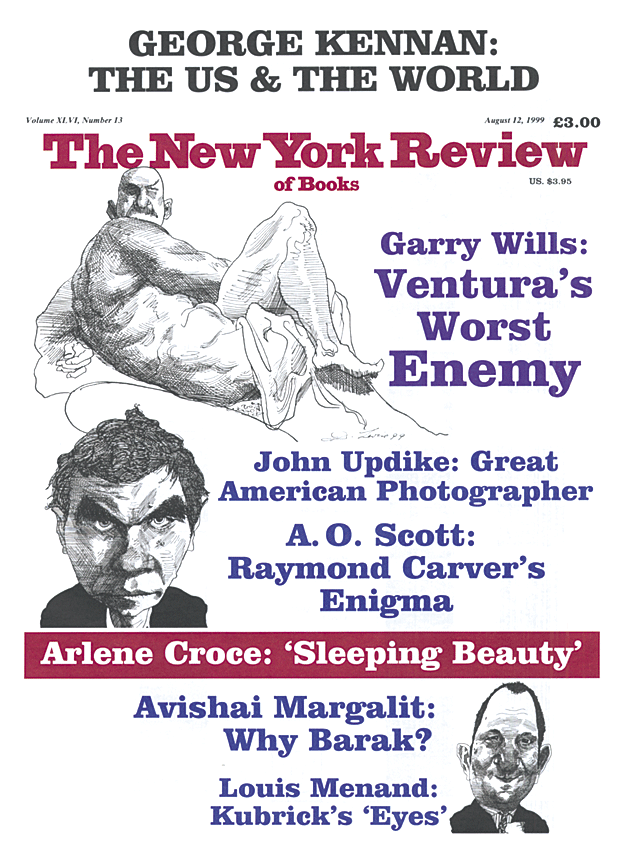
Richard Ullman, The US and the World: An Interview with George Kennan

Louis Menand, Kubrick's Strange Love

Eyes Wide Shut a film by Stanley Kubrick

Lars-Erik Nelson, Undemocratic Vistas

The Corruption of American Politics: What Went Wrong and Why by Elizabeth Drew

Shadow: Five Presidents and the Legacy of Watergate by Bob Woodward

Arlene Croce, On 'Beauty' Bare

The Sleeping Beauty performed by the Kirov Ballet at the Metropolitan Opera, New York, June 28-30, 1999 a ballet choreographed by Marius Petipa, with music by Tchaikovsky,

Robert Stone, Ellison's Promised Land

Juneteenth by Ralph Ellison

John Updike, Evangel of the Lens

Alfred Stieglitz: Photographs & Writings second edition, edited by Sarah Greenough, by Juan Hamilton, with an introduction by Sarah Greenough

Stieglitz, O'Keeffe & American Modernism Connecticut, April 16-July 11, 1999. by Elizabeth Mankin Kornhauser, by Amy Ellis, with Maura Lyons. Catalog of an exhibition at the Wadsworth Atheneum, Hartford,

Lorrie Moore, Made in the USA

Broke Heart Blues by Joyce Carol Oates

Tim Judah, Kosovo: Peace Now?

Julian Barnes, Always True to France

Paris and Elsewhere by Richard Cobb, edited and introduced by David Gilmour, by (Distributed in the US by Trafalgar Square)

The French and Their Revolution by Richard Cobb, edited and introduced by David Gilmour

Brian Urquhart, The Making of a Scapegoat

Unvanquished: A US-UN Saga by Boutros Boutros-Ghali

Paul Kennedy, In the Shadow of the Great War

The First World War by John Keegan

The Pity of War by Niall Ferguson

Garry Wills, The People's Choice

I Ain't Got Time to Bleed: Reworking the Body Politic from the Bottom Up by Jesse Ventura

Body Slam: The Jesse Ventura Story by Jake Tapper

Me, by Jimmy (Big Boy) Valente, Governor of Minnesota as told to Garrison Keillor

Bill McKibben, Nature Without People?

Requiem for Nature by John Terborgh

The Condor's Shadow: The Loss and Recovery of Wildlife in America by David S. Wilcove

Continental Conservation: Scientific Foundations of Regional Reserve Networks edited by Michael E. Soulé, by John Terborgh

Avishai Margalit, Israel: Why Barak Won

Julian Moynahan, Trouble on the Mountain

The Deposition of Father McGreevy by Brian O'Doherty

A.O. Scott, Looking for Raymond Carver

All of Us: The Collected Poems by Raymond Carver

Cathedral by Raymond Carver

Fires: Essays, Poems, Stories by Raymond Carver

A New Path to the Waterfall by Raymond Carver

No Heroics, Please: Uncollected Writings by Raymond Carver

Where I'm Calling From: New and Selected Stories by Raymond Carver. tenth-anniversary edition

What We Talk About When We Talk About Love by Raymond Carver

Will You Please Be Quiet, Please? by Raymond Carver
David Western, John Terborgh, 'Trouble in Paradise': An Exchange


Letters

Myriam Anissimov, Tony Judt, Justice to Primo Levi
Ed Timperlake, Lars-Erik Nelson, Chinese Checkers
Bruce Fetter, Apartheid's Fall
Larry McMurtry, Custer Fixation?


Contributors

Julian Barnes has written nine novels, a book of short stories, and two collections of essays. His most recent book is Something to Declare: Essays on France.

Arlene Croce will publish a collection of her dance reviews from The New Yorker next year. She is currently working on a book about the ballets of George Balanchine. (August 1999)

Tim Judah is the author of Kosovo: War and Revenge and The Serbs: History, Myth and the Destruction of Yugoslavia. He has reported on the Balkans, Afghanistan, Kurdistan, Iraq, and Sudan for The New York Review. (October 2006)

Paul Kennedy, the J. Richardson Dilworth Professor of History and Director of International Security Studies at Yale, is the author and editor of fifteen books, including The Rise and Fall of the Great Powers. His latest book is The Parliament of Man: The Past, Present, and Future of the United Nations. (November 2006)

Avishai Margalit is Professor Emeritus of Philosophy at the Hebrew University of Jerusalem. He is currently the George Kennan Professor at the Institute for Advanced Study in Princeton. He has just been awarded the 2007 Emet Prize by Israeli Prime Minister Ehud Olmert for his work in political thought, ethics, and philosophy. (December 2007)

Bill Mckibben is scholar in residence at Middlebury College, and the author of The End of Nature and Deep Economy: The Wealth of Communities and the Durable Future.

Louis Menand is the Robert M. and Anne T. Bass Professor of English and American Literature and Language at Harvard University, and a staff writer at The New Yorker. He is the author of The Metaphysical Club—which won the Pulitzer Prize for History and the Francis Parkman Prize in 2002—and of American Studies, a collection of essays.

Lorrie Moore teaches at the University of Wisconsin in Madison. Her most recent book is the story collection Birds of America. She has won the Rea Award and the PEN/Malamud Award for Short Fiction. (September 2007)

Julian Moynahan is Professor of English Emeritus at Rutgers University. His most recent book is Anglo-Irish: The Literary Imagination in a Hyphenated Culture. (May 2000)

Lars-Erik Nelson (1941-2000) was the Washington columnist for the New York Daily News, and a frequent contributor to the Review.

A. O. Scott is a film critic at The New York Times and the former Sunday book critic for Newsday. His writing has appeared in The New York Review of Books, Slate, and many other publications.

Robert Stone was born in Brooklyn in 1937. He is the author of seven novels: A Hall of Mirrors, the National Book Award–winning Dog Soldiers, A Flag for Sunrise, Children of Light, Outerbridge Reach, Damascus Gate, and Bay of Souls. He has also written short stories, essays, and screenplays, and published a short story collection, Bear and His Daughter, which was nominated for the Pulitzer Prize. He lives in New York City and in Key West, Florida.

Richard Ullman is the David K.E. Bruce Professor of International Affairs at Princeton University. (August 1999)

John Updike was born in 1932 in Shillington, Pennsylvania. In 1954 he began to publish in The New Yorker, where he continues to contribute short stories, poems, and criticism. His novels have won the Pulitzer Prize, among other awards. His most recent books are the novel Terrorist and Due Considerations, a collection of his essays and criticism.

Brian Urquhart is a former Undersecretary-General of the United Nations. His books include Hammarskjöld, A Life in Peace and War, and Ralph Bunche: An American Odyssey. (March 2008)

Garry Wills was born in Atlanta, Georgia. One of our most distinguished historians and critics, he is the author of numerous books, including Saint Augustine, Papal Sin, and the Pulitzer Prize–winning Lincoln at Gettysburg. He has won many other awards, among them two National Book Critics Circle Awards and the 1998 National Medal for the Humanities. He is currently Professor of History Emeritus at Northwestern University. A regular contributor to the New York Review of Books, he lives in Evanston, Illinois.


Search the Review
Advanced search