Contents

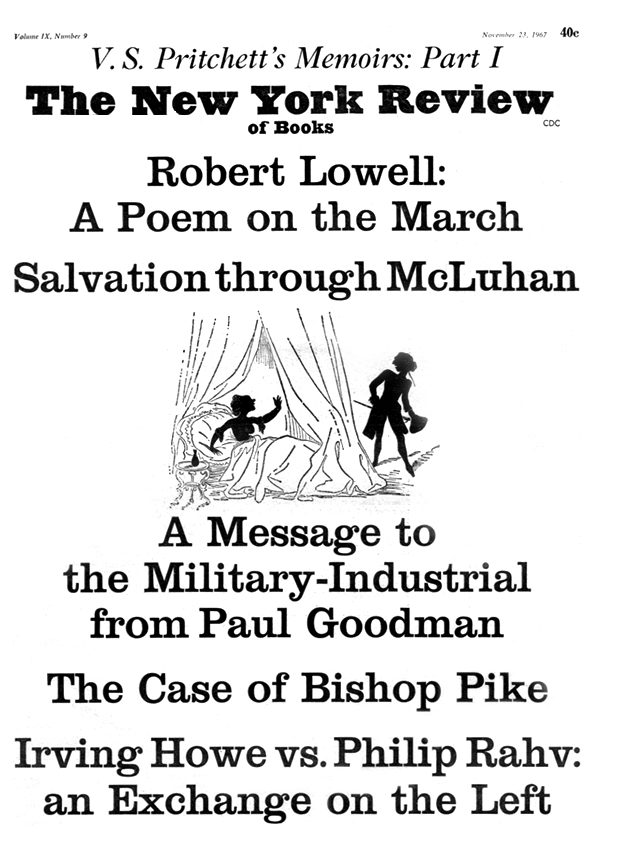
November 23, 1967 • Volume 9, Number 9

LETTERS

Contributors

M. I. Finley (1912-1986), the son of Nathan Finkelstein and Anna Katzellenbogen, was born in New York City. He graduated from Syracuse University at the age of fifteen and received an MA in public law from Columbia, before turning to the study of ancient history. During the Thirties Finley taught at Columbia and City College and developed an interest in the sociology of the ancient world that was shaped in part by his association with members of the Frankfurt School who were working in exile in America. In 1952, when he was teaching at Rutgers, Finley was summoned before the Senate Internal Security Subcommittee and asked whether he had ever been a member of the Communist Party. He refused to answer, invoking the Fifth Amendment; by the end of the year he had been fired from the university by a unanimous vote of its trustees. Unable to find work in the US, Finley moved to England, where he taught for many years at Cambridge, helping to redirect the focus of classical education from a narrow emphasis on philology to a wider concern with culture, economics, and society. He became a British subject in 1962 and was knighted in 1979. Among Finley’s best-known works are The Ancient Economy, Ancient Slavery and Modern Ideology, and The World of Odysseus.

Paul Goodman (1911–1972) was an American social critic, psychologist, poet, novelist, and anarchist. His writings appeared in Politics, Partisan Review, The New Republic, Commentary, The New Leader, Dissent, and The New York Review of Books. He published several well-regarded books in a variety of fields—including city planning, Gestalt therapy, literary criticism, and politics—before Growing Up Absurd, cancelled by its original publisher and turned down by a number of other presses, was brought out by Random House in 1960.

Irving Howe (1920–1993) was an American literary and social critic. His history of Eastern-European Jews in America, World of Our Fathers, won the 1977 National Book Award in History.

Philip Rahv (1908–1973) was an American literary critic. Rahv was a founding editor of Partisan Review. His works include Image and Idea and Literature and the Sixth Sense.