Contents

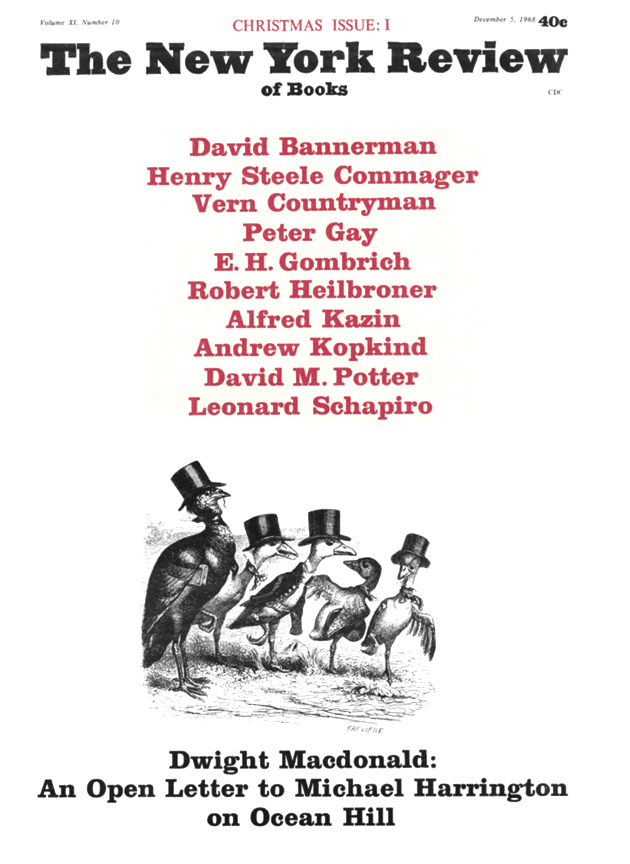
December 5, 1968 • Volume 11, Number 10
  • Henry Steele Commager

    Common Sense e-edition

    In a Time of Torment by I.F. Stone

  • Ernst Gombrich

    In Search of Leonardo e-edition

    Leonardo da Vinci by V.P. Zubov, translated by David H. Kraus, with a Foreword by Myron P. Gilmore

  • Robert L. Heilbroner

    Putting Marx to Work e-edition

    A Reappraisal of Marxian Economics by Murray Wolfson

    Marx’s Economic Predictions by Fred M. Gottheil

    Marx and Modern Economics edited by David Horowitz

  • Alfred Kazin

    Stephen Crane, Inc. e-edition

    Stephen Crane: A Biography by R.W. Stallman

  • Vern Countryman

    Clear and Present Danger e-edition

    The Committee by Walter Goodman

  • Leonard Schapiro

    A Lost Politics e-edition

    The Russian Empire 1801-1917 by Hugh Seton-Watson

    Russian Intellectual History: An Anthology edited by Marc Raeff, with an Introduction by Isaiah Berlin

    Russian Philosophy edited by James M. Edie, edited by James P. Scanlan, edited by Mary Barbara Zeldin, with the collaboration of George L. Kline

    Historical Letters by Peter Lavrov, translated with an Introduction and Notes by James P. Scanlan

    The Russian Anarchists by Paul Avrich

    Danilevsky: A Russian Totalitarian by Robert E. MacMaster

    Russian Political Thought: An Introduction by Thornton Anderson

    The Icon and the Axe: An Interpretive History of Russian Culture by James H. Billington

  • David A. Bannerman

    Birds at the Pole e-edition

    The Birds of Chile and Adjacent Regions of Argentina, Bolivia and Peru by A.W. Johnson, illustrated by J.D. Goodall

    Birds of the Antarctic by Edward Wilson, edited by Brian Roberts. with Wilson's original illustrations

  • Peter Gay

    The Old New Man e-edition

    The Political Philosophy of Rousseau by Roger D. Masters

    Rousseau and the Spirit of Revolt by William H. Blanchard

    La nouvelle Héloïse: Julie or the New Heloise by Jean-Jacques Rousseau, translated and abridged by Judith H. McDowell

    The Social Contract by Jean-Jacques Rousseau, translated and introduced by Maurice Cranston

  • Andrew Kopkind

    A Document of the Sixties e-edition

  • David M. Potter

    The Art of Comity e-edition

    The Progressive Historians: Turner, Beard, Parrington by Richard Hofstadter
  • Dwight Macdonald

    An Open Letter to Michael Harrington e-edition

LETTERS

Contributors

Peter Gay is Director of the Center for Scholars and Writers at the New York Public Library. He wrote Schnitzler’s Century: The Making of Middle-Class Culture, 1815–1914.

Ernst Gombrich (1909–2001) was an Austrian art historian. Born in Vienna, Gombrich studied at the Theresianum and then at the University of Vienna under Julius von Schlosser. After graduating, he worked as a Research Assistant and collaborator with the museum curator and Freudian analyst Ernst Kris. He joined the Warburg Institute in London as a Research Assistant in 1936 and was named Director in 1959. His major works include The Story of Art, Art and Illusion: A Study in the Psychology of Pictorial Representation, Aby Warburg: An Intellectual Biography, The Sense of Order: A Study in the Psychology of Decorative Art.

Andrew Kopkind (1935–1994) was a journalist and editor. Kopkind’s work chronicled the turbulence of the American sixties and seventies; he wrote on the civil rights movement, the Vietnam War era, and the rise of Ronald Regan in Time Magazine, The Nation, and The New Republic, where he served as associate editor. An anthology of his work, The Thirty Years’ Wars: Dispatches and Diversions of a Radical Journalist, 1965-1994, was published in 1995.

Dwight Macdonald (1906–1982) was born in New York City and educated at Exeter and Yale. On graduating from college, he enrolled in Macy’s executive training program, but soon left to work for Henry Luce at Time and Fortune, quitting in 1936 because of cuts that had been made to an article he had written criticizing U.S. Steel. From 1937 to 1943, Macdonald was an editor of Partisan Review and in 1944, he started a journal of his own, Politics, whose contributors included Albert Camus, Victor Serge, Simone Weil, Bruno Bettelheim, James Agee, John Berryman, Meyer Schapiro, and Mary McCarthy. In later years, Macdonald reviewed books for The New Yorker, movies for Esquire, and wrote frequently for The New York Review of Books.