Contents

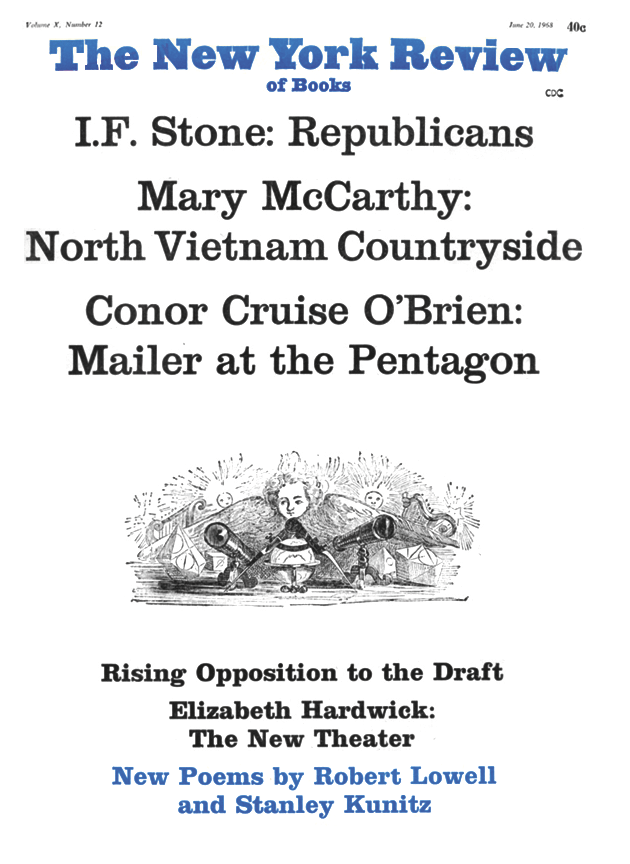
June 20, 1968 • Volume 10, Number 12

LETTERS

Contributors

Robert Lowell died in 1977. His Collected Poems was published this summer. The letters in this issue will be included in The Letters of Robert Lowell, edited by Saskia Hamilton, to be published next year by Farrar, Straus and Giroux, LLC. (November 2003)

Mary McCarthy (1912-1989) was a novelist, essayist, and critic. Her political and social commentary, literary essays, and drama criticism appeared in magazines such as Partisan Review, The New Yorker, Harper’s, and The New York Review of Books, and were collected in On the Contrary (1961), Mary McCarthy’s Theatre Chronicles 1937-1962 (1963), The Writing on the Wall (1970), Ideas and the Novel (1980), and Occasional Prose (1985). Her novels include The Company She Keeps (1942), The Oasis (1949), The Groves of Academe (1952), A Charmed Life (1955), The Group (1963), Birds of America (1971), and Cannibals and Missionaries (1979). She was the author of three works of autobiography, Memories of a Catholic Girlhood (1957), How I Grew (1987), and the unfinished Intellectual Memoirs (1992), and two travel books about Italy, Venice Observed (1956) and The Stones of Florence (1959). Her essays on the Vietnam War were collected in The Seventeenth Degree (1974); her essays on Watergate were collected in The Mask of State (1974).

Isaiah Berlin was born in Riga in 1909. In 1916 his family moved to Petrograd, where he witnessed the Russian Revolution, and in 1921 he emigrated to England. He was educated at Corpus Christi College, Oxford, and became a Fellow of All Souls College, Oxford, where he was later appointed Professor of Social and Political Theory. He served as the first president of Wolfson College, Oxford, and as president of the British Academy. He died in 1997. For more information, see the Isaiah Berlin Virtual Library.

Conor Cruise O’Brien’s many books include God Land: Reflections on Religion and Nationalism and The Long Affair: Thomas Jefferson and the French Revolution. His Memoir: My Life and Themes will be published in the US in May. (December 2000)

M. I. Finley (1912-1986), the son of Nathan Finkelstein and Anna Katzellenbogen, was born in New York City. He graduated from Syracuse University at the age of fifteen and received an MA in public law from Columbia, before turning to the study of ancient history. During the Thirties Finley taught at Columbia and City College and developed an interest in the sociology of the ancient world that was shaped in part by his association with members of the Frankfurt School who were working in exile in America. In 1952, when he was teaching at Rutgers, Finley was summoned before the Senate Internal Security Subcommittee and asked whether he had ever been a member of the Communist Party. He refused to answer, invoking the Fifth Amendment; by the end of the year he had been fired from the university by a unanimous vote of its trustees. Unable to find work in the US, Finley moved to England, where he taught for many years at Cambridge, helping to redirect the focus of classical education from a narrow emphasis on philology to a wider concern with culture, economics, and society. He became a British subject in 1962 and was knighted in 1979. Among Finley’s best-known works are The Ancient Economy, Ancient Slavery and Modern Ideology, and The World of Odysseus.

I.F. Stone was an American journalist, publisher of I.F. Stone’s Weekly, and a regular contributor to the Review. For more about him please visit www.ifstone.org.

Dwight Macdonald (1906–1982) was born in New York City and educated at Exeter and Yale. On graduating from college, he enrolled in Macy’s executive training program, but soon left to work for Henry Luce at Time and Fortune, quitting in 1936 because of cuts that had been made to an article he had written criticizing U.S. Steel. From 1937 to 1943, Macdonald was an editor of Partisan Review and in 1944, he started a journal of his own, Politics, whose contributors included Albert Camus, Victor Serge, Simone Weil, Bruno Bettelheim, James Agee, John Berryman, Meyer Schapiro, and Mary McCarthy. In later years, Macdonald reviewed books for The New Yorker, movies for Esquire, and wrote frequently for The New York Review of Books.

Professor Sir Ernst Gombrich OM was born in Vienna in 1909 and died in London on November 3, 2001, aged 92. He studied at the Theresianum and then at the Second Institute of Art History at the University of Vienna under Julius von Schlosser (1928-33). He then worked as a Research Assistant and collaborator with the museum curator and Freudian analyst Ernst Kris. He joined the Warburg Institute in London as a Research Assistant in 1936. During World War 2 he was employed by the BBC as a Radio Monitor. After the war he rejoined the Warburg Institute eventually becoming its Director in 1959. His major publications include The Story of Art (1950), Art and Illusion: A Study in the Psychology of Pictorial Representation (1960), Aby Warburg: An Intellectual Biography (1970), The Sense of Order: A Study in the Psychology of Decorative Art. (Also see: www.gombrich.co.uk.)

Elizabeth Hardwick (1916-2007) was born in Lexington, Kentucky, and educated at the University of Kentucky and Columbia University. A recipient of a Gold Medal from the American Academy of Arts and Letters, she is the author of three novels, a biography of Herman Melville, and four collections of essays. She was a co-founder and advisory editor of The New York Review of Books and contributed more than one hundred reviews, articles, reflections, and letters to the magazine. NYRB Classics publishes Sleepless Nights, a novel, and Seduction and Betrayal, a study of women in literature.