Contents

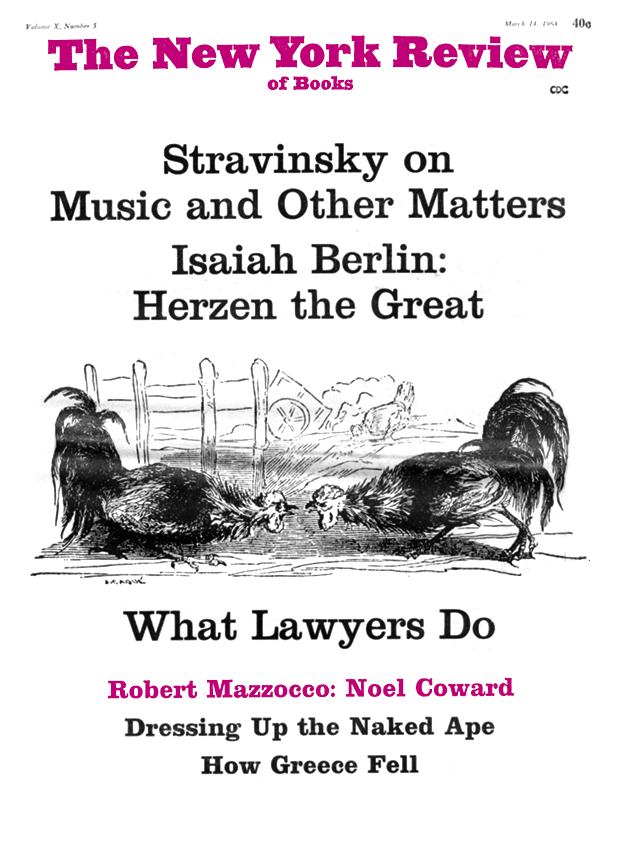
March 14, 1968 • Volume 10, Number 5

LETTERS

Contributors

Geoffrey Barraclough (1908–1984) was a British historian.

Isaiah Berlin (1909–1997) was a political philosopher and historian of ideas. Born in Riga, he moved in 1917 with his family to Petrograd, where he witnessed the Russian Revolution. In 1921 he emigrated to England. He was educated at Corpus Christi College, Oxford, and became a Fellow of All Souls College, Oxford, where he was later appointed Professor of Social and Political Theory. He served as the first president of Wolfson College, Oxford, and as president of the British Academy.

Ronald Dworkin (1931–2013) was Professor of Philosophy and Frank Henry Sommer Professor of Law at NYU. His books include Is Democracy Possible Here?, Justice in Robes, Freedom’s Law, and Justice for Hedgehogs. He was the 2007 winner of the Ludvig Holberg International Memorial Prize for “his pioneering scholarly work” of “worldwide impact” and he was recently awarded the Balzan Prize for his “fundamental contributions to Jurisprudence.”


Frank Kermode (1919–2010) was a British critic and literary theorist. Born on the Isle of Man, he taught at University College London, Cambridge, Columbia and Harvard. Adapted from a series of lectures given at Bryn Mawr College, Kermode’s Sense of An Ending: Studies in the Theory of Fiction remains one of the most influential works of twentieth-century literary criticism.

Robert Mazzocco is an American poet and critic.

Christopher Ricks teaches at Boston University and is a former president of the Association of Literary Scholars, Critics, and Writers. From 2004 to 2009 he was Professor of Poetry at the University of Oxford. His recent books include True Friendship: Geoffrey Hill, Anthony Hecht, and Robert Lowell Under the Sign of Eliot and Pound and Decisions and Revisions in T.S. Eliot.

John Ashbery is the author of several books of poetry, including Self-Portrait in a Convex Mirror (1975), which received the Pulitzer Prize for Poetry, the National Book Critics Circle Award, and the National Book Award. His first collection, Some Trees (1956), was selected by W. H. Auden for the Yale Younger Poets Series. He has also published art criticism, plays, and a novel. From 1990 until 2008 Ashbery was the Charles P. Stevenson, Jr. Professor of Languages and Literature at Bard College.

Robert Brustein is a playwright, director, critic, teacher, and founder of the Yale Repertory and American Repertory Theatres. His play The Last Will opens in New York in April at Abingdon’s June Havoc Theater, and then goes to the Wuzhen Festival in China. In 2010 he was awarded the National Medal of Arts. (April 2013)

Noam Chomsky is an Institute Professor and Professor Emeritus in the Department of Linguistics at MIT.

Allen Ginsberg (1926–1997) was a poet and one of most prominent figures of the Beat Generation. His epic poem “Howl,” which denounced bourgeois conformity and capitalistic greed, became the subject of a landmark obscenity trial in San Francisco. Known for his celebration of the marginalized and the downtrodden and his opposition to American militarism, Ginsberg drew inspiration from the long lines and anaphoric rhythms of Walt Whitman. His 1981 collection Plutonium Ode won the National Book Award; in 1993 Ginsberg was awarded the medal of Chevalier Des Arts et des Lettres by the French government.

Paul Goodman (1911–1972) was an American social critic, psychologist, poet, novelist, and anarchist. His writings appeared in Politics, Partisan Review, The New Republic, Commentary, The New Leader, Dissent, and The New York Review of Books. He published several well-regarded books in a variety of fields—including city planning, Gestalt therapy, literary criticism, and politics—before Growing Up Absurd, cancelled by its original publisher and turned down by a number of other presses, was brought out by Random House in 1960.

Jane Jacobs’s most recent book is The Nature of Economies. Her essay in this issue is the introduction to the Modern Library edition of Hard Times, which is being published later this month. (July 2001)

Robert Lowell (1917–1977) was twice awarded the Pulitzer Prize for Poetry. Life Studies, For the Union Dead, and The Dolphin are among his many volumes of verse. He was confounder of and contributor to The New York Review of Books.

Dwight Macdonald (1906–1982) was born in New York City and educated at Exeter and Yale. On graduating from college, he enrolled in Macy’s executive training program, but soon left to work for Henry Luce at Time and Fortune, quitting in 1936 because of cuts that had been made to an article he had written criticizing U.S. Steel. From 1937 to 1943, Macdonald was an editor of Partisan Review and in 1944, he started a journal of his own, Politics, whose contributors included Albert Camus, Victor Serge, Simone Weil, Bruno Bettelheim, James Agee, John Berryman, Meyer Schapiro, and Mary McCarthy. In later years, Macdonald reviewed books for The New Yorker, movies for Esquire, and wrote frequently for The New York Review of Books.

Norman Mailer (1923-2007) was born in Long Branch, New Jersey, and grew up in Brooklyn, New York. In 1955 he co-founded The Village Voice. He is the author of more than thirty books, including The Naked and the Dead; The Armies of the Night, for which he won a National Book Award and the Pulitzer Prize; The Executioner’s Song, for which he won his second Pulitzer Prize; Harlot’s Ghost; Oswald’s Tale; The Gospel According to the Son; and The Castle in the Forest.

Conor Cruise O’Brien (1917–2009) was an Irish historian and politician. He was elected to the Irish parliament in 1969 and served as a Minister from 1973 until 1977. His works include States of Ireland, The Great Melody and Memoir: My Life and Themes.

Susan Sontag (1933–2004) was a novelist, playwright, filmmaker, and one of the most influential critics of her generation. Her books include Against Interpretation, On Photography, Illness as Metaphor, and The Volcano Lover.

H. R. Trevor-Roper (1914–2003) was a British historian and the author of The Last Days of Hitler. He taught at Oxford, where he was the Regius Professor Modern History.

Edmund Wilson (1895-1972) is widely regarded as the preeminent American man of letters of the twentieth century. Over his long career, he wrote for Vanity Fair, helped edit The New Republic, served as chief book critic for The New Yorker, and was a frequent contributor to The New York Review of Books. Wilson was the author of more than twenty books, including Axel’s Castle, Patriotic Gore, and a work of fiction, Memoirs of Hecate County.