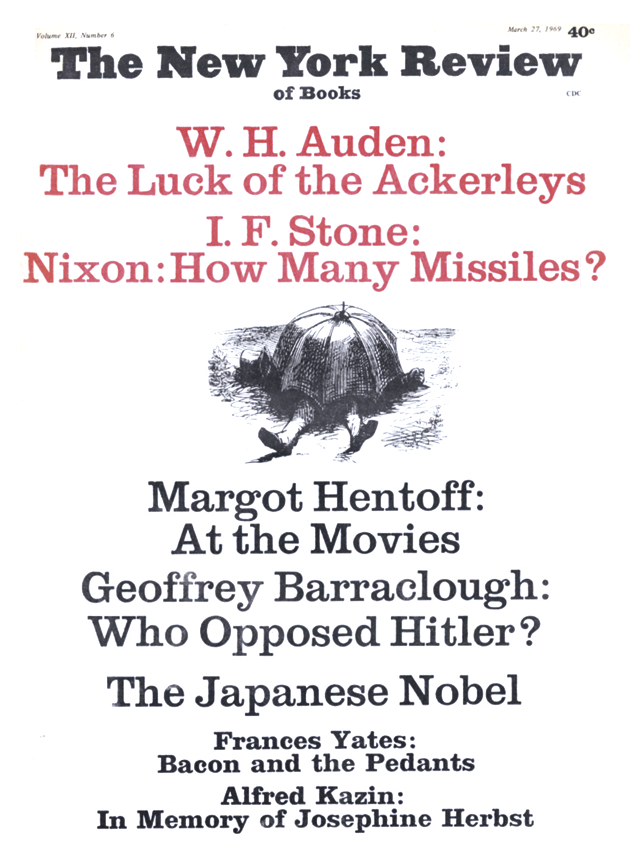
Contents

March 27, 1969 • Volume 12, Number 6

LETTERS

Contributors

W.H. Auden (1907–1973) was an English poet, playwright, and essayist who lived and worked in the United States for much of the second half of his life. His work, from his early strictly metered verse, and plays written in collaboration with Christopher Isherwood, to his later dense poems and penetrating essays, represents one of the major achievements of twentieth-century literature.

Geoffrey Barraclough (1908–1984) was a British historian.

D.J. Enright (1920–2002) was a British poet, novelist and critic. He held teaching positions in Egypt, Japan, Thailand, Singapore and the United Kingdom. In 1981 Enright was awarded the Queen’s Gold Medal for Poetry.

Stanley Hoffmann is Paul and Catherine Buttenwieser University Professor at Harvard. His most recent books are Chaos and Violence: What Globalization, Failed States, and Terrorism Mean for US Foreign Policy and Rousseau and Freedom, coedited with Christie McDonald.


Noam Chomsky is an Institute Professor and Professor Emeritus in the Department of Linguistics at MIT.

Alfred Kazin (1915–1998) was a writer and teacher. Among his books are On Native Grounds, a study of American literature from Howells to Faulkner, and the memoirs A Walker in the Cityand New York Jew. In 1996, he received the first Lifetime Award in Literary Criticism from the Truman Capote Literary Trust.

Martin Bernal is Professor Emeritus of Government at Cornell. His controversial study of Ancient Greece, Black Athena, explores the origins of Hellenic culture and, in particular, the influence of Egypt and Phoenicia on the development of Ancient Greece.

I.F. Stone (1907–1989) was an American journalist and publisher whose self-published newsletter, I.F. Stone’s Weekly, challenged the conservatism of American journalism in the midcentury. A Noncomformist History of Our Times (1989) is a six-volume anthology of Stone’s writings.

Frances A. Yates (1899–1981) was an English historian. She taught for many years at The Warburg Institute, where she studied the history of esotericism in the West.

Fanny Howe is the author of more than twenty books of poetry and prose. She was the recipient of the 2001 Lenore Marshall Poetry Prize for her Selected Poems, and has won awards from the National Endowment for the Arts, the National Poetry Foundation, the California Council for the Arts, and The Village Voice. She was short-listed for the Griffin Poetry Prize in 2001 and 2005.

Hannah Arendt (1906–1975) was a German political theorist who, over the course of many books, explored themes such as violence, revolution, and evil. Her major works include The Origins of Totalitarianism, The Human Condition, and the controversial Eichmann in Jerusalem, in which she coined the phrase “the banality of evil.”

Irving Howe (1920–1993) was an American literary and social critic. His history of Eastern-European Jews in America, World of Our Fathers, won the 1977 National Book Award in History.

Robert Lowell (1917–1977) was twice awarded the Pulitzer Prize for Poetry. Life Studies, For the Union Dead, and The Dolphin are among his many volumes of verse. He was confounder of and contributor to The New York Review of Books.

Norman Mailer (1923-2007) was born in Long Branch, New Jersey, and grew up in Brooklyn, New York. In 1955 he co-founded The Village Voice. He is the author of more than thirty books, including The Naked and the Dead; The Armies of the Night, for which he won a National Book Award and the Pulitzer Prize; The Executioner’s Song, for which he won his second Pulitzer Prize; Harlot’s Ghost; Oswald’s Tale; The Gospel According to the Son; and The Castle in the Forest.

Hans J. Morgenthau (1904–1980) was a legal scholar and theorist of international relations. Educated in Germany and Switzerland, Morgenthau taught for many years at the University of Chicago; later in life, he moved to The New School and The City University of New York. His books include In Defense of The National Interest, Politics Among Nations, and The Purpose of American Politics.

Meyer Schapiro, who died in 1996, taught for many years at Columbia. He was one of the most influential art historians of the last century and a contributor to The New York Review. Meyer Schapiro Abroad: Letters to Lillian and Travel Notebooks, in which the letters in this issue appear, will be published in January by Getty. (December 2008)

Arthur Schlesinger, Jr. (1917–2007) was an American historian and social critic. He served as adviser to Presidents Kennedy and Johnson. His Journals: 1952– 2000 were published in 2007.

William Styron (1925–2006) was the author of several novels, including Sophie’s Choice and The Confessions of Nat Turner.