Contents

December 5, 1985 • Volume 32, Number 19
  • John Bayley

    Big Three

    Letters: Summer 1926 by Boris Pasternak, by Rainer Maria Rilke, by Marina Tsvetayeva, edited by Yevgeny Pasternak, by Yelena Pasternak, by Konstantin M. Azadovsky, translated by Margaret Wettlin, by Walter Arndt

    Letters on Cézanne by Rainer Maria Rilke, edited by Clara Rilke, translated by Joel Agee

  • Timothy Garton Ash

    The Hungarian Lesson e-edition

  • Alain Finkielkraut

    What Is Europe? e-edition

  • Martin Filler

    Tall Stories e-edition

    The Tall Building Artistically Reconsidered: The Search for a Skyscraper Style by Ada Louise Huxtable

    Ada Louise Huxtable: An Annotated Bibliography by Lawrence Wodehouse

  • Mavis Gallant

    Limpid Pessimist e-edition

    Alexis translated in collaboration with the author by Walter Kaiser

    Coup de Grâce translated in collaboration with the author by Grace Frick

    A Coin in Nine Hands translated in collaboration with the author by Dori Katz

    Memoirs of Hadrian and Reflections on the Composition of Memoirs of Hadrian translated in collaboration with the author by Grace Frick

    With Open Eyes: Conversations with Matthieu Galey translated by Arthur Goldhammer

    The Abyss translated in collaboration with the author by Grace Frick

    Oriental Tales translated in collaboration with the author by Alberto Manguel

    The Dark Brain of Piranesi and Other Essays translated in collaboration with the author by Richard Howard

    Plays translated in collaboration with the author by Dori Katz

    Fires translated in collaboration with the author by Dori Katz

  • Carlos Drummond de Andrade,
    Thomas Colchie

    The Disappearance of Luisa Porto (poem) e-edition

  • David Joravsky

    Return of the Native e-edition

    Kapitza, Rutherford, and the Kremlin by Lawrence Badash

    Ispytuiushchie gody; Iz pisem P.L. Kapitsy k materi 1921–23 gg. (“Years of trial: From P.L. Kapitza’s Letters to his Mother, 1921–1923”) edited by P.E. Rubinin

    Dvadtsat’ dva otcheta akademika P.L. Kapitsy (“Twenty-three Reports of Academician P.L. Kapitza”) edited by P.E. Rubinin

  • D.J. Enright

    Depositions e-edition

    A Maggot by John Fowles

    Foreign Land by Jonathan Raban

    Family and Friends by Anita Brookner

  • Peter Partner

    On the Town e-edition

    Cities and People: A Social and Architectural History by Mark Girouard

  • Alistair Horne

    Algeria Rising e-edition

  • Roy Foster

    Master of Exceptions e-edition

    Workers: Worlds of Labor by Eric Hobsbawm

  • T.H. Breen

    Founding Sons e-edition

    A People’s Army: Massachusetts Soldiers and Society in the Seven Years’ War by Fred Anderson

    To Starve the Army at Pleasure: Continental Army Administration and American Political Culture, 1775–1783 by E. Wayne Carp

  • Anthony Quinton

    The Right Stuff e-edition

    Alfred North Whitehead: The Man and His Work Volume I: 1861–1910 by Victor Lowe
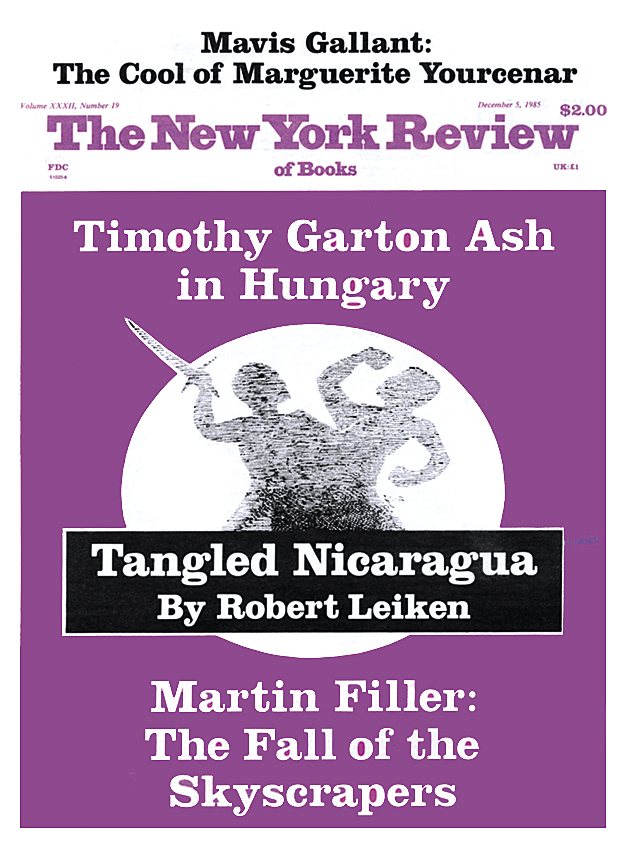
  • Robert S. Leiken

    The Nicaraguan Tangle e-edition

  • Stephen Spender

    Survivor e-edition

    The Assault by Harry Mulisch, translated by Claire Nicolas White

LETTERS

Contributors

John Bayley is a critic and novelist. His books include Elegy for Iris and The Power of Delight: A Lifetime in Literature.

D.J. Enright (1920–2002) was a British poet, novelist and critic. He held teaching positions in Egypt, Japan, Thailand, Singapore and the United Kingdom. In 1981 Enright was awarded the Queen’s Gold Medal for Poetry.

Martin Filler was the longtime architecture critic of House & Garden, until it ceased publication in 2007. He is the co-author, with Olivier Bossiere, of The Vitra Design Museum: Frank Gehry, Architect, and author of Makers of Modern Architecture, which is based on essays from The New York Review. A second volume of his writings on architecture is forthcoming from New York Review Books.


Timothy Garton Ash is Professor of European Studies and Isaiah Berlin Professorial Fellow at St. Antony’s College, Oxford, and a Senior Fellow at the Hoover Institution, Stanford. He is the author of many books, including The Magic Lantern, an eyewitness account of the velvet revolutions of 1989. His most recent book is Facts Are Subversive: Political Writing from a Decade Without a Name. He is currently leading an Oxford University 
research project for the discussion of global free speech norms (www.freespeechdebate.com) and working on a book about free speech.

Alistair Horne was educated in Switzerland, at Millbrook School, New York, and at Jesus College, Cambridge, where he played international ice hockey. In World War II, initially a volunteer in the RAF, he served with the Coldstream Guards between 1944 and 1947, ending as a captain attached to MI5 in the Middle East. In the 1950s he was a foreign correspondent for the Daily Telegraph until taking up a full-time writing career in 1955.

T.H. Breen is William Smith Mason Professor of American History at Northwestern. His most recent book is American Insurgents, American ­Patriots: The Revolution of the People. (April 2012)

Lord Zuckerman (1904–1993) was a British zoologist and military strategist. Having advised the Allies on bombing strategy during World War II, he spent much of his later life campaigning for nuclear non-proliferation. Zuckerman was knighted in 1956 and made a life peer in 1971.

David Joravsky is Professor Emeritus of History at Northwestern. His books include The Lysenko Affairand Russian Psychology: A Critical History.

Peter Partner’s books include Arab Voices and The Pope’s Men: The Papal Service in the Renaissance. His new book, God of Battles: Holy Wars of Christianity and Islam, has been published in the United Kingdom. (February 1998)

Anthony Quinton (1925–2010) was a British philosopher. Quinton served as president of Trinity College, Oxford and as chairman of the British Library. His works include The Nature of Things, Hume, and From Wodehouse to Wittgenstein.

Stephen Spender (1909–1995) was an English poet and essayist. As a young man, he became friends with W.H. Auden, Louis MacNeice, Cecil Day-Lewis, and Christopher Isherwood, a loose collection often referred to as “the Auden Group” or “MacSpaunday.” He published many collections of poems, including The Still Centre and Ruins and Visions, and numerous volumes of nonfiction and other works, including Learning Laughterand Love-Hate Relations.

Mavis Gallant was born in Montreal and worked as a journalist at the Montreal Standard before moving to Europe to devote herself to writing fiction. After traveling extensively she settled in Paris, where she still resides. She is the recipient of the 2002 Rea Award for the Short Story and the 2004 PEN/Nabokov Award for lifetime achievement. New York Review Books Classics has published two previous collections of Gallant’s stories, Paris Stories, selected and introduced by Michael Ondaatje (2002), and Varieties of Exile, selected and introduced by Russell Banks (2003).