Contents

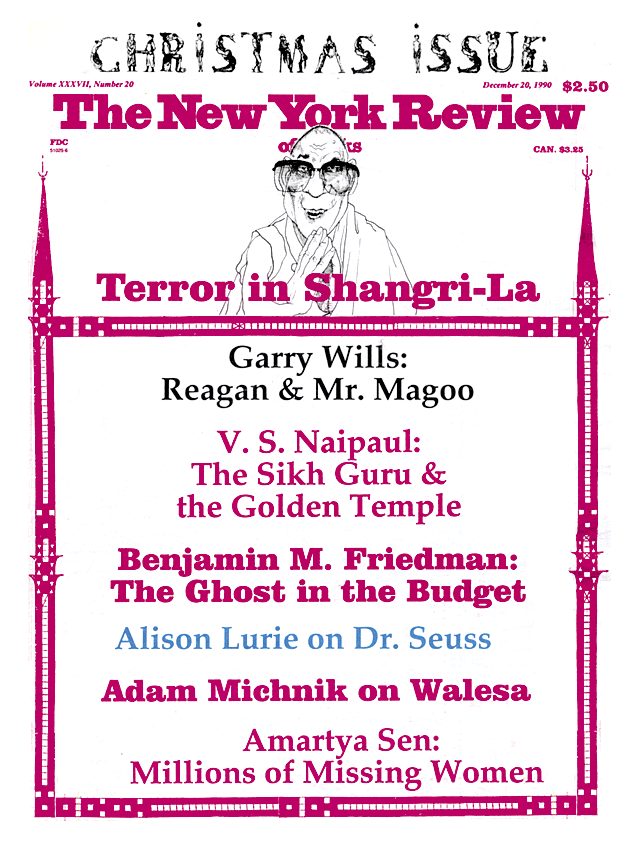
December 20, 1990 • Volume 37, Number 20
  • Garry Wills

    Mr. Magoo Remembers e-edition

    An American Life by Ronald Reagan

  • Geoffrey O’Brien

    The Sturges Style e-edition

    Preston Sturges by Preston Sturges adapted and edited by Sandy Sturges

    Between Flops: A Biography of Preston Sturges by James Curtis

    Madcap: The Life of Preston Sturges by Donald Spoto

    Five Screenplays by Preston Sturges edited and with an introduction by Brian Henderson

  • Preston Sturges

    FROM ‘THE LADY EVE’ e-edition

  • Roger Shattuck,
    Samba Ka

    Born Again African e-edition

    Black, French, and African: A Life of Léopold Sédar Senghor by Janet G. Vaillant

    Œuvre poétique by Léopold Sédar Senghor

    Ce que je crois by Léopold Sédar Senghor

  • Gabriele Annan

    Sociable Murder e-edition

    Symposium by Muriel Spark

  • Witold Rybczynski

    Getting Away from It All e-edition

    The Villa: Form and Ideology of Country Houses by James S. Ackerman

    The Architect and the American Country House, 1890–1940 by Mark Alan Hewitt, architectural photographs by Richard Cheek

    The American Country House by Roger W. Moss

    The American Country House by Clive Aslet

    Wheel Estate: The Rise and Decline of Mobile Homes by Allan D. Wallis

  • Benjamin M. Friedman

    Reagan Lives! e-edition

  • Ian Buruma

    There’s No Place Like Heimat e-edition

    Vom Glück und Unglück der Kunst in Deutschland nach dem Letzten Kriege by Hans-Jürgen Syberberg

    Patterns of Childhood by Christa Wolf, translated by Ursule Molinaro, by Hedwig Rappolt

    The Quest for Christa T. by Christa Wolf, translated by Christopher Middleton

    No Place on Earth by Christa Wolf, translated by Jan van Heurck

    Was bleibt (extracts entitled “What Remains” were published in English translation in Granta 33) by Christa Wolf

    Cassandra: A Novel and Four Essays by Christa Wolf, translated by Jan van Heurck

    The Fourth Dimension: Interviews with Christa Wolf translated by Hilary Pilkington, Introduction by Karin McPherson

  • Bernard Lewis

    At Stake in the Gulf e-edition

    Saddam Hussein and the Crisis in the Gulf by Judith Miller, by Laurie Mylroie

  • Adam Michnik

    My Vote Against Walesa e-edition

  • Alison Lurie

    The Cabinet of Dr. Seuss e-edition

    And to Think That I Saw It on Mulberry Street

    Horton Hatches the Egg

    McElligot’s Pool

    Bartholomew and the Oobleck

    Thidwick the Big-Hearted Moose

    Yertle the Turtle and Other Stories

    If I Ran the Zoo

    Horton Hears a Who

    On Beyond Zebra!

    If I Ran the Circus

    The Cat in the Hat

    One Fish Two Fish Red Fish Blue Fish

    I Can Lick 30 Tigers Today!

    The Lorax

    The Butter Battle Book

    You’re Only Old Once!

    Oh, the Places You’ll Go!

  • Jonathan Mirsky

    Lost Horizons e-edition

    The Myth of Shangri-La: Tibet, Travel Writing and the Western Creation of Sacred Landscape by Peter Bishop

    Freedom in Exile: The Autobiography of the Dalai Lama

    A History of Modern Tibet, 1913–1951: The Demise of the Lamaist State by Melvyn C. Goldstein

    My Tibet Dalai Lama, photographs and introduction by Galen Rowell

  • Amartya Sen

    More Than 100 Million Women Are Missing

  • Janet Adam Smith

    Rackhamland e-edition

    Arthur Rackham: A Biography by James Hamilton

  • V.S. Naipaul

    The Shadow of the Guru e-edition

  • John K. Fairbank

    History on the Wing e-edition

    Golden Inches: The China Memoir of Grace Service edited by John S. Service
LETTERS

Contributors

Amartya Sen is Lamont University Professor at Harvard. He received the Nobel Prize in Economics in 1998. His most recent book is The Idea of Justice. (May 2011)

Roger Shattuck (1923–2005) was an American writer and scholar of French culture. He taught at Harvard, the University of Texas at Austin, the University of Virginia, and Boston University, where he was named University Professor. His books includeForbidden Knowledge: From Prometheus to Pornography.

Gabriele Annan is a book and film critic living in London. (March 2006)

John K. Fairbank (1907–1991) was an American sinologist. His final book was China: A New History.

Benjamin M. Friedman is the William Joseph Maier Professor of Political Economy at Harvard. His most recent book is The Moral Consequences of Economic Growth.
 (October 2012)

Bernard Lewis is Cleveland E. Dodge Professor of Near Eastern Studies Emeritus at Princeton. His most recent books are Music of a Distant Drum and What Went Wrong: Western Impact and Middle Eastern Response. (May 2002)

Alison Lurie is a former Professor of English at Cornell. She is the author of two collections of essays on children’s literature, Don’t Tell the Grownups and Boys and Girls Forever, and the editor of The Oxford Book of Fairy Tales. Her most recent novel is Truth and Consequences.


Ian Buruma is the Henry R. Luce Professor at Bard. His books include Murderer in Amsterdam: The Death of Theo Van Gogh and the Limits of Tolerance, Taming the Gods: Religion and Democracy on Three Continents, and the novel The China Lover. His book Year Zero: A History of 1945 will be published in September 2013.

John Gregory Dunne (1932–2003) was a novelist, screenwriter and critic. His final novel is entitled Nothing Lost.

Diane Johnson is a novelist and critic. Her books include Lulu in Marrakechand Le Divorce. Her new book, Flyover Lives, will be published in January 2014.

Adam Michnik is Editor in Chief of the Warsaw daily newspaper Gazeta Wyborcza. His piece in this issue will appear in Andrei Sakharov and Human Rights, a collection of Sakharov’s writings that is being published by the Council of Europe this month. (January 2011)

Jonathan Mirsky is the former East Asia Editor of The Times of London. (June 2013)

V. S. Naipaul was born in Trinidad in 1932 and emigrated to England in 1950, when he won a scholarship to University College, Oxford. He is the author of many novels, including A House for Mr. Biswas, A Bend in the River, and In a Free State, which won the Booker Prize. He has also written several nonfiction works based on his travels, including India: A Million Mutinies Now and Beyond Belief: Islamic Excursions Among the Converted Peoples. He was knighted in 1990 and in 1993 was the first recipient of the David Cohen British Literature Prize.

Geoffrey O’Brien is Editor in Chief of the Library of America. His recent works include Early Autumn, The Fall of the House of Walworth and Stolen Glimpses, Captive Shadows: Writing on Film 2002–2012 .

Witold Rybczynski is the Meyerson Professor of Urbanism at the University of Pennsylvania, and is the architecture critic for Slate. His book on American building, Last Harvest, was published in 2007.

Robert M. Adams (1915-1996) was a founding editor of the Norton Anthology of English Literature. He taught at the University of Wisconsin, Rutgers, Cornell and U.C.L.A. His scholarly interested ranged from Milton to Joyce, and his translations of many classic works of French literature continue to be read to this day.

Janet Adam Smith (1905–1999) was a Scottish writer and critic. Educated at Oxford, she worked as an editor at a number of literary publications, including The Listener, The Criterion and New Statesman. She also edited the Faber Book of Modern Verse and its companion volume, the Faber Book of Children’s Verse. An accomplished mountaineer, Smith wrote about her adventures in Mountain Holidays; her other books include Life Among the Scots and John Buchnan and His World.

Garry Wills is Professor of History Emeritus at Northwestern. His study of Abraham Lincoln, Lincoln at Gettysburg: The Words That Remade America, was awarded the Pulitzer Prize in 1993. His latest book, Why Priests? A Failed Tradition, was published in February 2013.

Isaiah Berlin (1909–1997) was a political philosopher and historian of ideas. Born in Riga, he moved in 1917 with his family to Petrograd, where he witnessed the Russian Revolution. In 1921 he emigrated to England. He was educated at Corpus Christi College, Oxford, and became a Fellow of All Souls College, Oxford, where he was later appointed Professor of Social and Political Theory. He served as the first president of Wolfson College, Oxford, and as president of the British Academy.