Contents

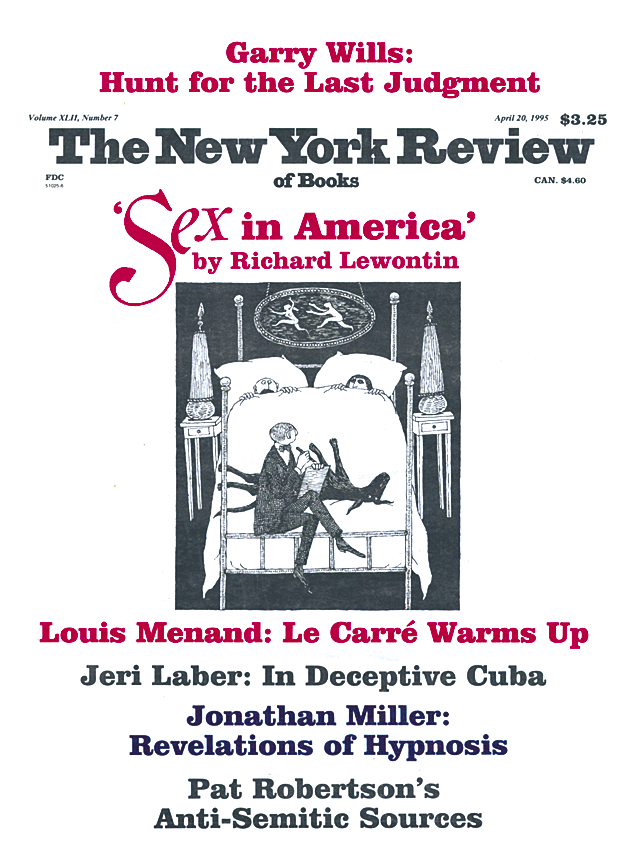
April 20, 1995 • Volume 42, Number 7

LETTERS

Contributors

Robert M. Adams (1915-1996) was a founding editor of the Norton Anthology of English Literature. He taught at the University of Wisconsin, Rutgers, Cornell and U.C.L.A. His scholarly interested ranged from Milton to Joyce, and his translations of many classic works of French literature continue to be read to this day.

Gabriele Annan is a book and film critic living in London. (March 2006)

Jasper Griffin is Emeritus Professor of Classical Literature and a Fellow of Balliol College, Oxford. His books include Homer on Life and Death.

Murray Kempton (1917-1997) was a columnist for Newsday, as well as a regular contributor to The New York Review of Books. His books include Rebellions, Perversities, and Main Events and The Briar Patch, as well as Part of Our Time. He won the Pulitzer Prize in 1985.

Jeri Laber, Senior Advisor to Human Rights Watch, was formerly executive director of its Helsinki division. She is the author, with Barnett R. Rubin, of ‘A Nation is Dying’: Afghanistan Under the Soviets, 1979—1987. (January 1997)

Sidney Morgenbesser (1921–2004) was a philosopher. Educated at CUNY, The Jewish Theological Seminary and The University of Pennsylvania, Morgenbesser taught at Columbia, where he was named John Dewey Professor of Philosophy.

Richard C. Lewontin is Alexander Agassiz Professor of Zoology and Professor of Biology at Harvard University. He is the author of The Genetic Basis of Evolutionary Change and Biology as Ideology, and the co-author of The Dialectical Biologist (with Richard Levins) and Not in Our Genes (with Steven Rose and Leon Kamin).

Robert Stone was born in Brooklyn in 1937. He is the author of seven novels: A Hall of Mirrors, the National Book Award–winning Dog Soldiers, A Flag for Sunrise, Children of Light, Outerbridge Reach, Damascus Gate, and Bay of Souls. He has also written short stories, essays, and screenplays, and published a short story collection, Bear and His Daughter, which was nominated for the Pulitzer Prize. He lives in New York City and in Key West, Florida.

Susan Sontag (1933–2004) was a novelist, playwright, filmmaker, and one of the most influential critics of her generation. Her books include Against Interpretation, On Photography, Illness as Metaphor, and The Volcano Lover.

Harold Pinter was born in London in 1930. His many plays include The Caretaker, The Birthday Party, and Moonlight. Please also see haroldpinter.org.

Norman Rush was raised in Oakland, California, and graduated from Swarthmore College in 1956. He has been an antiquarian book dealer, a college instructor, and, with his wife Elsa, he lived and worked in Africa from 1978 to 1983. They now reside in Rockland County, New York. His stories have appeared in The New Yorker, The Paris Review, and Best American Short Stories. Whites, a collection of stories, was published in 1986, and his first novel, Mating, the recipient of the National Book Award, was published in 1991. Mortals is his second novel. A new novel, Subtle Bodies, will be published in 2013.


Frederick C. Crews is Professor Emeritus of English at the University of California, Berkeley. He is the author of Follies of the Wise: Dissenting Essays.

Gordon A. Craig (1913–2005) was a Scottish-American historian of Germany. He taught at both Princeton and Stanford, where he was named the J.E. Wallace Sterling Professor of Humanities in 1979.

Louis Menand is the Anne T. and Robert M. Bass Professor of English at Harvard. His books include The Marketplace of Ideas, American Studies and The Metaphysical Club.

Jonathan Miller has directed operas and plays throughout the world, most recently Pelléas and Mélisande at the Metropolitan Opera. His many books include The Body in Question, States of Mind, On Reflection, and Nowhere in Particular. The article that appears in this issue is based on a talk given at the New York Public Library. (May 2000)

Darryl Pinckney is the author of a novel, High Cotton, and, in the Alain Locke Lecture Series, Out There: Mavericks of Black Literature.

Stephen Jay Gould (1941–2002) was an American geologist, biologist and historian of science. He taught at Harvard, where he was named Alexander Agassiz Professor of Zoology, and at NYU. His last book was Punctuated Equilibrium.

Garry Wills is Professor of History Emeritus at Northwestern. His study of Abraham Lincoln, Lincoln at Gettysburg: The Words That Remade America, was awarded the Pulitzer Prize in 1993. His latest book, Why Priests? A Failed Tradition, was published in February 2013.

Jonathan Raban’s books include Surveillance, My Holy War, Arabia, Old Glory, Hunting Mister Heartbreak, Bad Land, Passage to Juneau, and Waxwings. He is the recipient of the National Book Critics Circle Award, the Heinemann Award of the Royal Society of Literature, the PEN/West Creative Nonfiction Award, the Pacific Northwest Booksellers’ Award, and the Governor’s Award of the State of Washington. He is a frequent contributor to The New York Review of Books, The Guardian, and The Independent. He lives in Seattle.

Jonathan Spence is Professor of History Emeritus at Yale. Among his books are The Death of Woman Wang, Treason by the Book, The Question of Hu, and The Search for Modern China.