Table of Contents
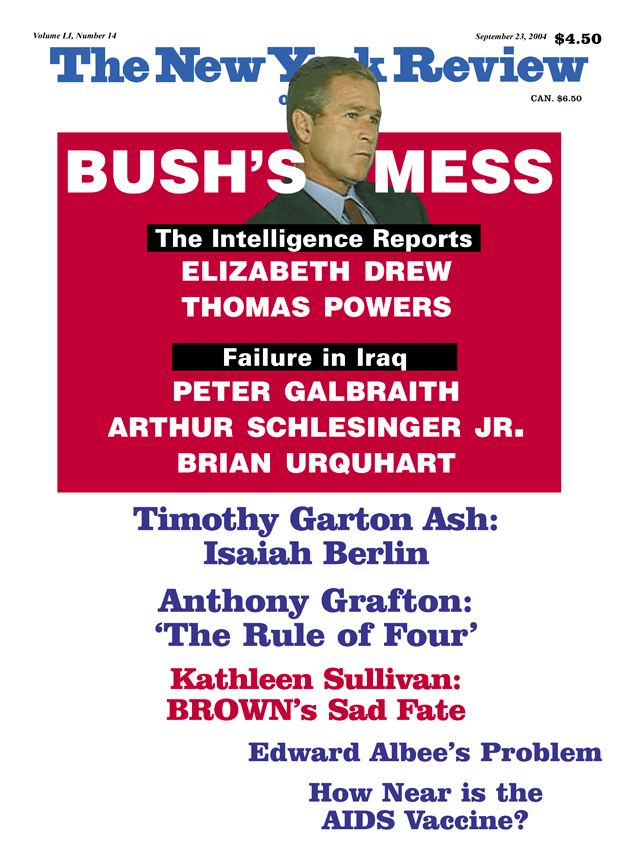
Volume 51, Number 14 · September 23, 2004
Elizabeth Drew, Pinning the Blame
The 9/11 Commission Report: Final Report of the National Commission on Terrorist Attacks Upon the United States
John Ashbery, Days of Reckoning (poem)
Luc Sante, Sander's Human Comedy
August Sander: People of the Twentieth Century A Photographic Portrait of Germany
People of the Twentieth Century by August Sander, edited by Die Photographische Sammlung/SK Stiftung Kultur, revised and newly compiled by Susanne Lange, Gabriele Conrath-Scholl, and Gerd Sander
Timothy Garton Ash, A Genius for Friendship
Letters, 1928–1946 by Isaiah Berlin, edited by Henry Hardy
Isaiah Berlin, A Letter on Human Nature
Brian Urquhart, The Good General
Battle Ready by Tom Clancy, with General Tony Zinni (Ret.) and Tony Koltz
You, the People: The United Nations, Transitional Administration, and State-Building by Simon Chesterman
Edmund S. Morgan, The Whirlwind
Alexander Hamilton by Ron Chernow
Arthur Schlesinger, Jr., The Making of a Mess
Rise of the Vulcans: The History of Bush's War Cabinet by James Mann
A Pretext for War: 9/11, Iraq, and the Abuse of America's Intelligence Agencies by James Bamford
After the Empire: The Breakdown of the American Order by Emmanuel Todd, translated from the French by C. Jon Delogu, with aforeword by Michael Lind
Fintan O'Toole, These Illusions Are Real
The Collected Plays of Edward Albee, Volume 1: 1958–65 by Edward Albee
Kathleen M. Sullivan, What Happened to 'Brown'?
Silent Covenants: Brown Board of Education and the Unfulfilled Hopes for Racial Reform by Derrick Bell
Simple Justice: The History of Brown v. Board of Education and Black America's Struggle for Equality by Richard Kluger, revised and expanded edition
All Deliberate Speed: Reflections on the First Half Century of Brown v. Board of Education by Charles J. Ogletree Jr.
Richard Horton, AIDS: The Elusive Vaccine
Ronald Steel, Where It Began
1912: Wilson, Roosevelt, Taft and Debs—The Election That Changed the Country by James Chace
Tim Judah, Uganda: The Secret War
Czeslaw Milosz, The Emperor Constantine
(poem)
Adam Zagajewski, On Czeslaw Milosz (1911–2004)
Anthony Grafton, Big Book on Campus
The Rule of Four by Ian Caldwell and Dustin Thomason
Peter W. Galbraith, Iraq: The Bungled Transition
Elaine Blair, New World Blues
Natasha and Other Stories by David Bezmozgis
Joseph Kerman, On Carlos Kleiber (1930–2004)
István Deák, Improvising the Holocaust
The Origins of the Final Solution: The Evolution of Nazi Jewish Policy, September 1939–March 1942 by Christopher R. Browning, with contributions by Jürgen Matthäus
Louis Begley, Ariadne's Own Story
James Fenton, John Clare's Genius
John Clare: A Biography by Jonathan Bate
'I Am': The Selected Poetry of John Clare edited by Jonathan Bate
John Clare and the Folk Tradition by George Deacon
Louis Menand, Edmund Wilson's Vanished World
Thomas Powers, How Bush Got It Wrong
Report on the US Intelligence Community's Prewar Intelligence Assessments on Iraq by the Senate Select Committee on Intelligence
Letters
Bruce Gilley, Nicholas D. Kristof, China's Mosaic
Kent G. Dedrick, Bill McKibben, The Red Line
W.J. McCormack, Colm Tóibín, The Black Diaries
Kenneth Gross, Query
Lawrence Dugan, Brad Leithauser, Keats Is the One
Contributors
John Ashbery is the author of twenty books of poetry, including Self-Portrait in a Convex Mirror (1975), which received the Pulitzer Prize for Poetry, the National Book Critics Circle Award, and the National Book Award; and Some Trees (1956), which was selected by W. H. Auden for the Yale Younger Poets Series. He has also published art criticism, plays, and a novel. Ashbery is currently the Charles P. Stevenson, Jr., Professor of Languages and Literature at Bard College.
Louis Begley is a novelist and retired lawyer. He has written eight novels, including Wartime Lies, About Schmidt, and Matters of Honor, which was published in 2007. He is a Chevalier de l'Ordre des Arts et Lettres of France and served as the president of PEN American Center from 1993 to 1995. He lives in New York with his wife, Anka Muhlstein, an historian of France.
Isaiah Berlin was born in Riga in 1909. In 1916 his family moved to Petrograd, where he witnessed the Russian Revolution, and in 1921 he emigrated to England. He was educated at Corpus Christi College, Oxford, and became a Fellow of All Souls College, Oxford, where he was later appointed Professor of Social and Political Theory. He served as the first president of Wolfson College, Oxford, and as president of the British Academy. He died in 1997. For more information, see the Isaiah Berlin Virtual Library.
Elaine Blair is the author of Literary St. Petersburg. (December 2009)
István Deák is Seth Low Professor Emeritus at Columbia and the author most recently of Essays on Hitler’s Europe. (November 2009)
Elizabeth Drew, who lives in Washington, is a regular contributor to The New York Review of Books. She is the author of twelve books.
James Fenton iis the editor of The New Faber Book of Love Poems and D.H. Lawrence's Selected Poems. (July 2009)
Peter W. Galbraith, a former US Ambassador to Croatia, is Senior Diplomatic Fellow at the Center for Arms Control and a principal at the Windham Resources Group, which has worked in Iraq. His new book, Unintended Consequences: How War in Iraq Strengthened America's Enemies, has just been released. (October 2008)
Timothy Garton Ash is Professor of European Studies and Isaiah Berlin Professorial Fellow at St. Antony's College, Oxford, and a Senior Fellow at the Hoover Institution, Stanford. His books include Facts Are Subversive: Political Writing from a Decade Without a Name and (as editor with Adam Roberts) Civil Resistance and Power Politics: The Experience of Non-Violent Action from Gandhi to the Present.
(December 2009)
Anthony Grafton teaches the history of Renaissance Europe at Princeton University. His books include Joseph Scaliger, Cardano's Cosmos, and Bring Out Your Dead.
Richard Horton is a physician. He edits The Lancet, a weekly medical journal based in London and New York. He is also a visiting professor at the London School of Hygiene and Tropical Medicine.
Tim Judah is the author of Kosovo: War and Revenge and The Serbs: History, Myth and the Destruction of Yugoslavia. He has reported on the Balkans, Afghanistan, Kurdistan, Iraq, and Sudan for The New York Review. (October 2006)
Joseph Kerman is emeritus professor of music at the University of California, Berkeley. He began writing music criticism for The Hudson Review in the 1950s, and is a longtime contributor to The New York Review of Books and many other journals. His books include Opera as Drama (1956; new and revised edition 1988), The Beethoven Quartets (1967), Contemplating Music (1986), Concerto Conversations (1999), and The Art of Fugue (2005).
Louis Menand is the Robert M. and Anne T. Bass Professor of English and American Literature and Language at Harvard University, and a staff writer at The New Yorker. He is the author of The Metaphysical Club—which won the Pulitzer Prize for History and the Francis Parkman Prize in 2002—and of American Studies, a collection of essays.
Czeslaw Milosz was born in Lithuania in 1911. Over the course of his long and prolific career he published works in many genres, including criticism (The Captive Mind), fiction (The Issa Valley), memoir (Native Realm), and poetry (New and Collected Poems, 1931-2001). He was a member of the American Academy and Institute of Arts and Letters and was awarded the Nobel Prize for Literature in 1980. He died in 2004.
Edmund S. Morgan is Sterling Professor of History Emeritus at Yale. His most recent book, The Genuine Article: A Historian Looks at Early America, was published in 2004. (October 2008)
Fintan O'Toole is a columnist and critic with The Irish Times. His new book, Ship of Fools: How Corruption and Stupidity Killed the Celtic Tiger, will be published in the fall. (August 2009)
Thomas Powers is the author of The Man Who Kept the Secrets: Richard Helms and the CIA (1979), Heisenberg's War: The Secret History of the German Bomb (1993), Intelligence Wars: American Secret History from Hitler to al-Qaeda (2002; revised and expanded edition, 2004), and The Confirmation (2000), a novel. He won a Pulitzer Prize for National Reporting in 1971 and has contributed to The New York Review of Books, The New York Times Book Review, Harper's, The Nation, The Atlantic, and Rolling Stone.
Luc Sante is the author of Low Life, Evidence, The Factory of Facts, and, most recently, Kill All Your Darlings: Pieces 1990–2005. He is a frequent contributor to The New York Review of Books and teaches writing and the history of photography at Bard College.
Arthur Schlesinger, Jr., the author of numerous books on American history, served as adviser to Presidents Kennedy and Johnson. He died this year. His Journals: 1952– 2000, from which an excerpt appears in this issue, will be published in October by Penguin. (October 2007)
Ronald Steel is Professor of International Relations at the University of Southern California, a recent fellow at the American Academy in Berlin, and the author of biographies of Walter Lippmann and Robert Kennedy. (June 2006)
Kathleen M. Sullivan was until recently the Dean of Stanford Law School, where she has returned to the faculty as the Stanley Morrison Professor of Law. (September 2004)
Brian Urquhart is a former Undersecretary-General of the United Nations. His books include Hammarskjöld, A Life in Peace and War, and Ralph Bunche: An American Life. (August 2009)
Adam Zagajewski's books include Another Beauty and Without End: New and Selected Poems. The poem in this issue is from his new book, Eternal Enemies, just published by Farrar, Straus and Giroux. (April 2008)