Contents

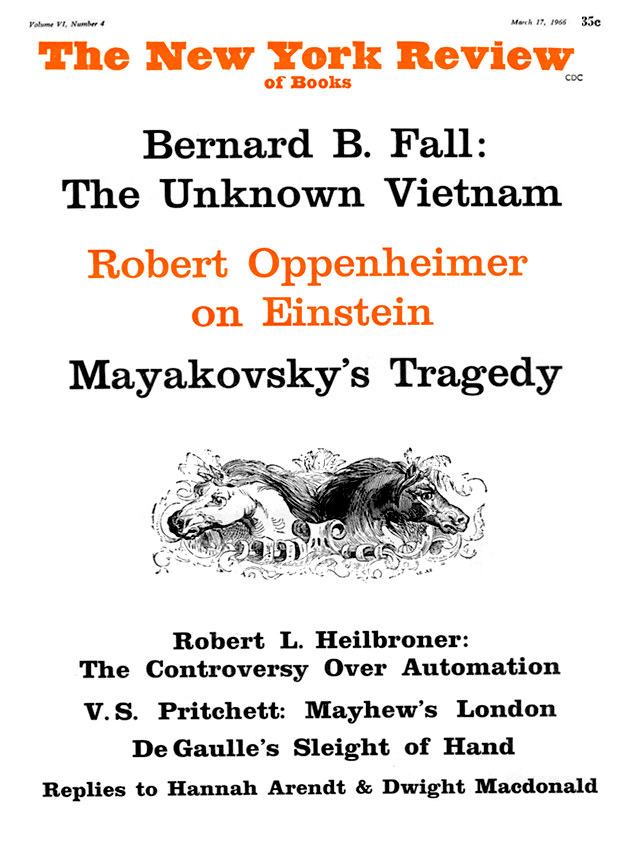
March 17, 1966 • Volume 6, Number 4

LETTERS

Contributors

Bernard Bergonzi is Emeritus Professor of English at the University of Warwick.

Edmund R. Leach (1910–1989) was a British anthropologist. He is widely credited with introducing Anglophone readers to the work of Claude Lévi-Strauss. Leach served as provost of King’s College, Cambridge from 1966 until 1979; he was made a Fellow of the British Academy in 1972 and knighted in 1975. A two-volume selection of his writings, The Essential Edmund Leach, was published by Yale University Press in 2001.

Elaine Dundy (1921–2008) grew up in New York City and Long Island. After graduating from Sweet Briar College in 1943 she worked as an actress in Paris and, later, London, where she met her future husband, the theater critic Kenneth Tynan. Dundy wrote three novels, The Dud Avocado (1958), The Old Man and Me (1964), and The Injured Party (1974); a play, My Place (produced in 1962); biographies of Elvis Presley and the actor Peter Finch; a study of Ferriday, Louisiana; and a memoir, Life Itself!

Dwight Macdonald (1906–1982) was born in New York City and educated at Exeter and Yale. On graduating from college, he enrolled in Macy’s executive training program, but soon left to work for Henry Luce at Time and Fortune, quitting in 1936 because of cuts that had been made to an article he had written criticizing U.S. Steel. From 1937 to 1943, Macdonald was an editor of Partisan Review and in 1944, he started a journal of his own, Politics, whose contributors included Albert Camus, Victor Serge, Simone Weil, Bruno Bettelheim, James Agee, John Berryman, Meyer Schapiro, and Mary McCarthy. In later years, Macdonald reviewed books for The New Yorker, movies for Esquire, and wrote frequently for The New York Review of Books.

Peter Gay is Director of the Center for Scholars and Writers at the New York Public Library. He wrote Schnitzler’s Century: The Making of Middle-Class Culture, 1815–1914.

Robert L. Heilbroner (1919–2005) was an American economist. He taught economic history at the New School, where he was appointed Norman Thomas Professor of Economics in 1971.

W.S. Merwin was born in New York City in 1927 and grew up in Union City, New Jersey, and in Scranton, Pennsylvania. From 1949 to 1951 he worked as a tutor in France, Portugal, and Majorca. He has since lived in many parts of the world, most recently on Maui in the Hawaiian Islands. He is the author of many books of poems, prose, and translations and has received both the Pulitzer and the Bollingen Prizes for poetry, among numerous other awards.

J.H. Plumb (1911–2001) was a British historian. He taught at Cambridge and Columbia. Plumb was elected a Fellow of the British Academy in 1968 and was knighted in 1982. His works include England in the Eighteenth Century, The Making of a Historian,and The American Experience.

V.S. Pritchett (1900–1997) was a British essayist, novelist and short story writer. He worked as a foreign correspondent for the The Christian Science Monitorand as a literary critic forNew Statesman. In 1968 Pritchett was made a Commander of the Order of the British Empire; he was knighted in 1975. His body of work includes many collections of short stories, in addition to travelogues, reviews, literary biographies and novels.

Meyer Schapiro, who died in 1996, taught for many years at Columbia. He was one of the most influential art historians of the last century and a contributor to The New York Review. Meyer Schapiro Abroad: Letters to Lillian and Travel Notebooks, in which the letters in this issue appear, will be published in January by Getty. (December 2008)

Ronald Steel is Professor of International Relations at the University of Southern California, a recent fellow at the American Academy in Berlin, and the author of biographies of Walter Lippmann and Robert Kennedy.

Hannah Arendt (1906–1975) was a German political theorist who, over the course of many books, explored themes such as violence, revolution, and evil. Her major works include The Origins of Totalitarianism, The Human Condition, and the controversial Eichmann in Jerusalem, in which she coined the phrase “the banality of evil.”