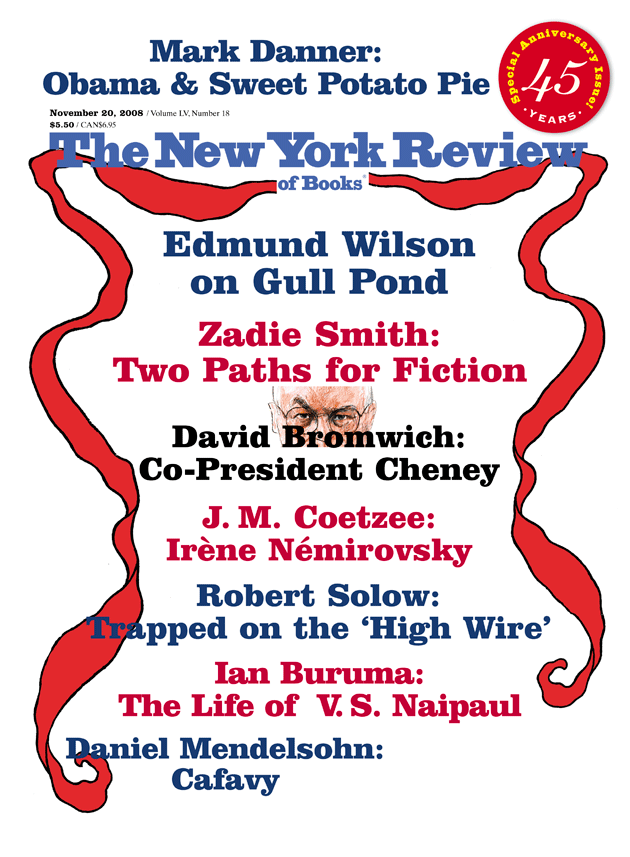
The World Is What It Is: The Authorized Biography of V.S. Naipaul
by Patrick French
The Dark Side: The Inside Story on How the War on Terror Turned into a War on American Ideals
by Jane Mayer
Angler: The Cheney Vice Presidency
by Barton Gellman
The Way of the World: A Story of Truth and Hope in an Age of Extremism
by Ron Suskind
Takeover: The Return of the Imperial Presidency and the Subversion of American Democracy
by Charlie Savage
What Happened: Inside the Bush White House and Washington’s Culture of Deception
by Scott McClellan
The Bush Tragedy
by Jacob Weisberg
Cheney: The Untold Story of America’s Most Powerful and Controversial Vice President
by Stephen F. Hayes
The War Within: A Secret White House History, 2006–2008
by Bob Woodward
David Golder, The Ball, Snow in Autumn, The Courilof Affair
by Irène Némirovsky, translated from the French by Sandra Smith, with an introduction by Claire Messud
Lion of Jordan: The Life of King Hussein in War and Peace
by Avi Shlaim
King Hussein of Jordan: A Political Life
by Nigel Ashton
The Arab Center: The Promise of Moderation
by Marwan Muasher
American Lightning: Terror, Mystery, Movie-Making, and the Crime of the Century
by Howard Blum
Frank Lloyd Wright in New York: The Plaza Years, 1954–1959
by Jane King Hession and Debra Pickrel, with a foreword by Mike Wallace
Frank Lloyd Wright: Essential Texts
edited by Robert Twombly
The Fellowship: The Untold Story of Frank Lloyd Wright and the Taliesin Fellowship
by Roger Friedland and Harold Zellman
Frank Lloyd Wright: The Heroic Years, 1920–1932
by Bruce Brooks Pfeiffer
Modern Architecture: Being the Kahn Lectures for 1930
by Frank Lloyd Wright, with a new introduction by Neil Levine
Pedro E. Guerrero: A Photographer’s Journey
by Pedro E. Guerrero
Death in a Prairie House: Frank Lloyd Wright and the Taliesin Murders
by William R. Drennan
Loving Frank: A Novel
by Nancy Horan
Darwin’s Garden: An Evolutionary Adventure
an exhibition at the New York Botanical Garden, April 25–July 20, 2008; and the Huntington Library and Botanical Gardens, San Marino, California, October 4, 2008– January 5, 2009
The Invention of Scotland: Myth and History
by Hugh Trevor-Roper
Scotland: The Autobiography
by Rosemary Goring
The Oxford Companion to Scottish History
edited by Michael Lynch
Rainbow Kiss
a play by Simon Farquhar, directed by Will Frears
Black Watch
a play by Gregory Burke, directed by John Tiffany
Words in Air: The Complete Correspondence Between Elizabeth Bishop and Robert Lowell
edited by Thomas Travisano with Saskia Hamilton
Giordano Bruno: Philosopher/Heretic
by Ingrid D. Rowland
High Wire: The Precarious Financial Lives of American Families
by Peter Gosselin
The Complete Works of W.H. Auden: Prose, Volume III: 1949–1955
edited by Edward Mendelson
Randall Jarrell on W.H. Auden
edited by Stephen Burt with Hannah Brooks-Motl

Subscribe and save 50%!
Read the latest issue as soon as it’s available, and browse our rich archives. You'll have immediate subscriber-only access to over 1,200 issues and 25,000 articles published since 1963.
Subscribe now
Subscribe and save 50%!
Get immediate access to the current issue and over 25,000 articles from the archives, plus the NYR App.
Already a subscriber? Sign in