Contents

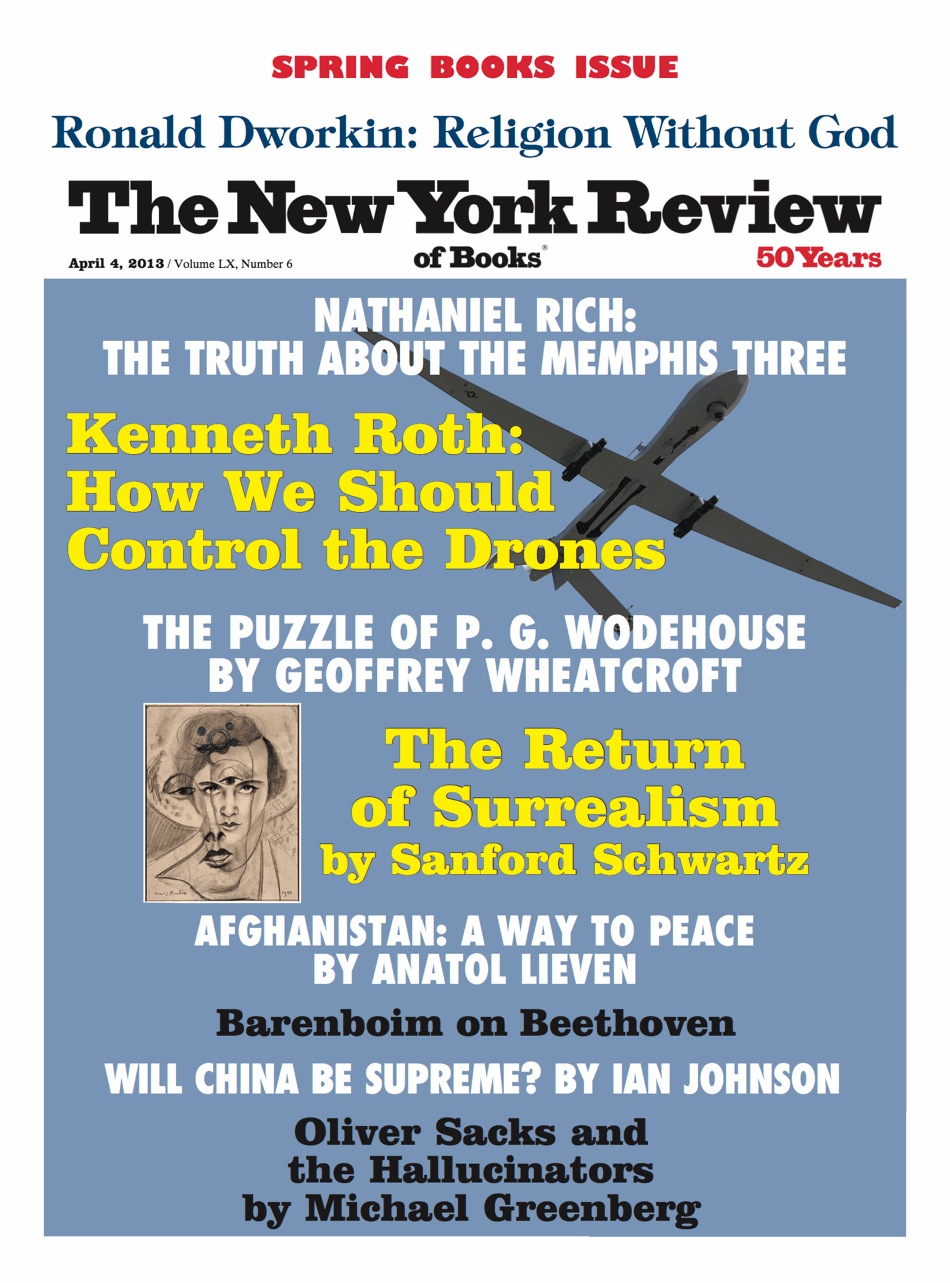
April 4, 2013 • Volume 60, Number 6

LETTERS

Contributors

Kenneth Roth is the Executive Director of Human Rights Watch. (April 2013)

Russell Baker is a former columnist and correspondent for The New York Times and The Baltimore Sun. His books include The Good Times, Growing Up, and Looking Back.

Miguel Hernández Gilabert (1910–1942) was born into a poor family in the city of Orihuela in southern Spain. His father raised goats and sheep, and Hernández was brought up to be a shepherd. At age eleven, he entered the Jesuit Colegio de Santo Domingo, where he learned to read and write, and started to compose poems whose uncanny virtuosity and wild inspiration earned the admiration of Pablo Neruda and Federico García Lorca. With the outbreak of the Spanish Civil War in 1936, his poetry took on a new public dimension, and Hernández would soon enlist in the Republican Army. In 1937, he married Josefina Manresa Marhuenda, the love of his life. The couple lost their first son to malnutrition; a second, Manuel Miguel, was born in 1939. After the defeat of the Republic, Hernández was condemned to death for his poetry by Francisco Franco, who called him “an extremely dangerous man,” a sentence that was subsequently reduced lest he become a martyr like Lorca. Hernández, imprisoned under brutal conditions and suffering from an advanced case of tuberculosis, continued to write until his death on March 28, 1942; he was thirty-one years old.

Don Share is the senior editor of Poetry magazine. His books of poetry include Squandermania, Union, and most recently, Wishbone. He is the editor of Seneca in English, Bunting’s Persia, and, with Christian Wiman, The Open Door: One Hundred Poems, One Hundred Years of Poetry Magazine. His translations of Miguel Hernández were awarded the Times Literary Supplement Translation Prize and the Premio Valle Inclán.

Jeffrey Yang is an editor at New York Review Books and New Directions. He recently edited Time of Grief: Mourning Poems. (April 2013)

Sanford Schwartz’s reviews have been collected in The Art Presence and Artists and Writers. (May 2013)

Edmund White has written biographies of Jean Genet, Marcel Proust, and Arthur Rimbaud. He has also written several novels; the most recent is Jack Holmes and His Friend: A Novel. He teaches creative writing at Princeton.

Anatol Lieven is a Professor in the War Studies Department of King’s College London and a fellow of the New America Foundation. His most recent book is Pakistan: A Hard Country.
 (April 2013)

Daniel Barenboim is General Music Director of the Berlin Staatsoper and its orchestra, the Berlin Staatskapelle. He is also the Music Director of the Teatro alla Scala and cofounder of the West-Eastern Divan Orchestra. (April 2013)

Martin Filler was the longtime architecture critic of House & Garden, until it ceased publication in 2007. He is the co-author, with Olivier Bossiere, of The Vitra Design Museum: Frank Gehry, Architect, and author of Makers of Modern Architecture, which is based on essays from The New York Review. A second volume of his writings on architecture is forthcoming from New York Review Books.


William R. Polk was Professor of History and Director of the Middle Eastern Studies Center of the University of Chicago and President of the Adlai Stevenson Institute of International Affairs. From 1961 to 1964 he was a member of the Policy Planning Council of the US Department of State. He is the author of Neighbors and Strangers: The Fundamentals of Foreign Affairs. (February 1999)

Jerome Groopman, M.D. is the Dina and Raphael Recanati Professor of Medicine at Harvard Medical School, Chief of Experimental Medicine at Beth Israel Deaconess Medical Center, and one of the world’s leading researchers in cancer and AIDS. He is a staff writer for The New Yorker and has written for The New York Times, The Wall Street Journal, The Washington Post and The New Republic. He is author of several books including Anatomy of Hope (2004), How Doctors Think (2007), and the recently released, Your Medical Mind.

Ian Johnson writes from Beijing and Berlin. His book on grassroots civil society, Wild Grass: Three Portraits of Change in Modern China, has recently been published in Chinese. 
(April 2013)

Geoffrey Wheatcroft is the author of The Controversy of Zion, The Strange Death of Tory England, and Yo, Blair!
 (April 2013)

Michael Greenberg is the author of Hurry Down Sunshine and Beg, Borrow, Steal: A Writer’s Life. From 2003 to 2009 he wrote the Freelance column in the TLS.
 (April 2013)

Robert Brustein is a playwright, director, critic, teacher, and founder of the Yale Repertory and American Repertory Theatres. His play The Last Will opens in New York in April at Abingdon’s June Havoc Theater, and then goes to the Wuzhen Festival in China. In 2010 he was awarded the National Medal of Arts. (April 2013)

Michael Gorra teaches English Literature at Smith College. He is the author of After Empire: Scott, Naipaul, Rushdie. His most recent book is Portrait of a Novel: Henry James and the Making of an American Masterpiece. He lives in Northampton, Massachusetts.

Nathaniel Rich’s second novel, Odds Against Tomorrow, is published this month. He lives in New Orleans. (April 2013)

Geoffrey O’Brien is Editor in Chief of the Library of America. His recent works include Early Autumn and The Fall of the House of Walworth. His new book Stolen Glimpses, Captive Shadows: Writing on Film 2002–2012 will be published in 2013.


Fred Anderson is Professor of History at the University of Colorado. He studied under the direction of Bernard Bailyn at Harvard. He is currently Archie K. Davis Fellow at the National Humanities Center in North Carolina.
 (April 2013).

Leonard Mlodinow’s books include The Drunkard’s Walk: How Randomness Rules Our Lives and Subliminal: How Your Unconscious Mind Rules Your Behavior. He teaches at Caltech.
 (April 2013)

Edward Jay Epstein is an investigative journalist. His new book, The Annals of Unsolved Crime, was published in March 2013. His Web site is edwardjayepstein.com.

David Cole is Professor of Law at Georgetown University Law Center. He is the award-winning author of several books, including The Torture Memos: Rationalizing the Unthinkable (2009), Less Safe, Less Free: Why America Is Losing the War on Terror (with Jules Lobel, 2007) and Enemy Aliens: Double Standards and Constitutional Freedoms in the War on Terrorism (2003) He has been awarded an Open Society Foundation Fellowship for 2012–2013 to write his next book, on the role of civil society in enforcing constitutional rights.


Fiona Maccarthy is the author of biographies of Eric Gill, William Morris, and Lord Byron. Her most recent book, The Last Pre-Raphaelite: Edward Burne-Jones and the Victorian Imagination, was published last year. (April 2013)

Ronald Dworkin (1931–2013) was Professor of Philosophy and Frank Henry Sommer Professor of Law at NYU. His books include Is Democracy Possible Here?, Justice in Robes, Freedom’s Law, and Justice for Hedgehogs. He was the 2007 winner of the Ludvig Holberg International Memorial Prize for “his pioneering scholarly work” of “worldwide impact” and he was recently awarded the Balzan Prize for his “fundamental contributions to Jurisprudence.”


Helen Epstein is an independent consultant and writer specializing in public health in developing countries, and an adjunct assistant professor at the Columbia University School of International and Public Affairs. She has advised numerous organizations, including the United States Agency for International Development, the World Bank, Human Rights Watch, and UNICEF. She writes frequently for various publications, including The New York Review of Books, The New York Times Magazine, and Granta, and is the author of The Invisible Cure: Why We Are Losing the Fight Against AIDS in Africa.

Luc Sante is the author of Low Life, Evidence, The Factory of Facts, Kill All Your Darlings, and Folk Photography. He has translated Félix Fénéon’s Novels in Three Lines and written the introduction to George Simenon’s The Man Who Watched Trains Go By (both available as NYRB Classics). He is a frequent contributor to The New York Review of Books and teaches writing and the history of photography at Bard College.

Darryl Pinckney is the author of a novel, High Cotton, and, in the Alain Locke Lecture Series, Out There: Mavericks of Black Literature.