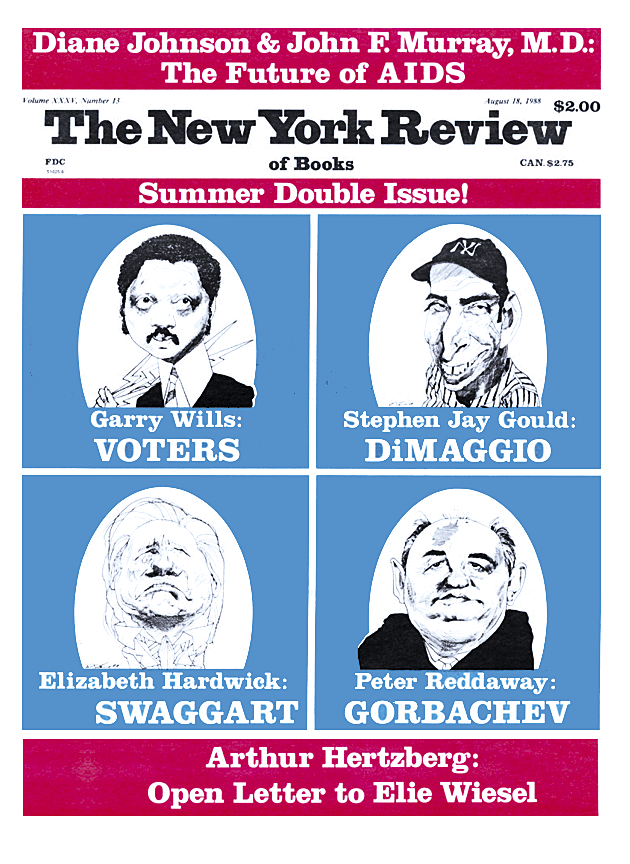
Contents

August 18, 1988 • Volume 35, Number 13

LETTERS

Contributors

Robert M. Adams (1915-1996) was a founding editor of the Norton Anthology of English Literature. He taught at the University of Wisconsin, Rutgers, Cornell and U.C.L.A. His scholarly interested ranged from Milton to Joyce, and his translations of many classic works of French literature continue to be read to this day.

Gabriele Annan is a book and film critic living in London. (March 2006)

István Deák is Seth Low Professor Emeritus at Columbia. He is the author, with Jan Gross and Tony Judt, of The Politics of Retribution in Europe: World War II and Its Aftermath.

Theodore H. Draper (1912–2006) was an American historian. Educated at City College, he wrote influential studies of the American Communist Party, the Cuban Revolution and the Iran-Contra Affair. Draper was a fellow of the American Academy of Arts and Sciences and the 1990 recipient of the Herbert Feis Award from the American Historical Association.

John Updike (1932–2009) was born in Shillington, Pennsylvania. In 1954 he began to publish in The New Yorker, where he continued to contribute short stories, poems, and criticism until his death. His major work was the set of four novels chronicling the life of Harry “Rabbit: Angstrom, he two of which, Rabbit is Richand Rabbit at Rest, won the Pulitzer Prize for Fiction. His last books were the novel The Widows of Eastwick and Due Considerations, a collection of his essays and criticism.

Robert Craft is a conductor and writer. Craft’s close working friendship with Igor Stravinsky is the subject of his memoir, An Improbable Life. In 2002 he was awarded the International Prix du Disque at the Cannes Music Festival.

John Kidd is the founding director of the James Joyce Research Centre at Boston University. (September 1997)

Arthur Hertzberg (1921–2006) was a Conservative rabbi, scholar and activist. His books include The French Enlightenment and the Jews: The Origins of Modern Anti-Semitism and The Zionist Idea.

Stanley Hoffmann is Paul and Catherine Buttenwieser University Professor at Harvard. His most recent books are Chaos and Violence: What Globalization, Failed States, and Terrorism Mean for US Foreign Policy and Rousseau and Freedom, coedited with Christie McDonald.


Diane Johnson is a novelist and critic. Her books include Lulu in Marrakechand Le Divorce. Her new book, Flyover Lives, will be published in January 2014.

John F. Murray is the author of Intensive Care: A Doctorå?s Journal. (October 2008)

Joseph Kerman is emeritus professor of music at the University of California, Berkeley. He began writing music criticism for The Hudson Review in the 1950s, and is a longtime contributor to The New York Review of Books and many other journals. His books include Opera as Drama (1956; new and revised edition 1988), The Beethoven Quartets (1967), Contemplating Music (1986), Concerto Conversations (1999), and The Art of Fugue (2005).

Stephen Jay Gould (1941–2002) was an American geologist, biologist and historian of science. He taught at Harvard, where he was named Alexander Agassiz Professor of Zoology, and at NYU. His last book was Punctuated Equilibrium.

Elizabeth Hardwick (1916-2007) was born in Lexington, Kentucky, and educated at the University of Kentucky and Columbia University. A recipient of a Gold Medal from the American Academy of Arts and Letters, she is the author of three novels, a biography of Herman Melville, and four collections of essays. She was a co-founder and advisory editor of The New York Review of Books and contributed more than one hundred reviews, articles, reflections, and letters to the magazine. NYRB Classics publishes Sleepless Nights, a novel, and Seduction and Betrayal, a study of women in literature.

Gore Vidal (1925–2012) was an American novelist, essayist, and playwright. His many works include the memoirs Point to Point Navigation and Palimpsest, the novels The City and the Pillar, Myra Breckinridge, and Lincoln, and the collection United States: Essays 1952–1992.

Bill McKibben is Schumann Distinguished Scholar at Middlebury College, and the author of The End of Nature, Deep Economy: The Wealth of Communities and the Durable Future, Eaarth: Making a Life on a Tough New Planet and of the forthcoming Oil and Honey: The Education of an Unlikely Activist.. He is also the founder of 350.org, the global climate campaign that has been actively involved in the fight against natural gas fracking.

Irving Howe (1920–1993) was an American literary and social critic. His history of Eastern-European Jews in America, World of Our Fathers, won the 1977 National Book Award in History.

Darryl Pinckney is the author of a novel, High Cotton, and, in the Alain Locke Lecture Series, Out There: Mavericks of Black Literature.

Peter B. Reddaway is Professor Emeritus of Professor Emeritus of Political Science and International Affairs at George Washington University.

Robert Towers (1923–1995) was an American critic and novelist. Born in Virginia, Towers was educated at Princeton and served for two years as Vice Counsel at the American Consulate General in Calcutta before dedicating himself to literary studies. He taught English literature and creative writing at Princeton, Queens College and Columbia.

Garry Wills is Professor of History Emeritus at Northwestern. His study of Abraham Lincoln, Lincoln at Gettysburg: The Words That Remade America, was awarded the Pulitzer Prize in 1993. His latest book, Why Priests? A Failed Tradition, was published in February 2013.

Murray Kempton (1917-1997) was a columnist for Newsday, as well as a regular contributor to The New York Review of Books. His books include Rebellions, Perversities, and Main Events and The Briar Patch, as well as Part of Our Time. He won the Pulitzer Prize in 1985.