Contents

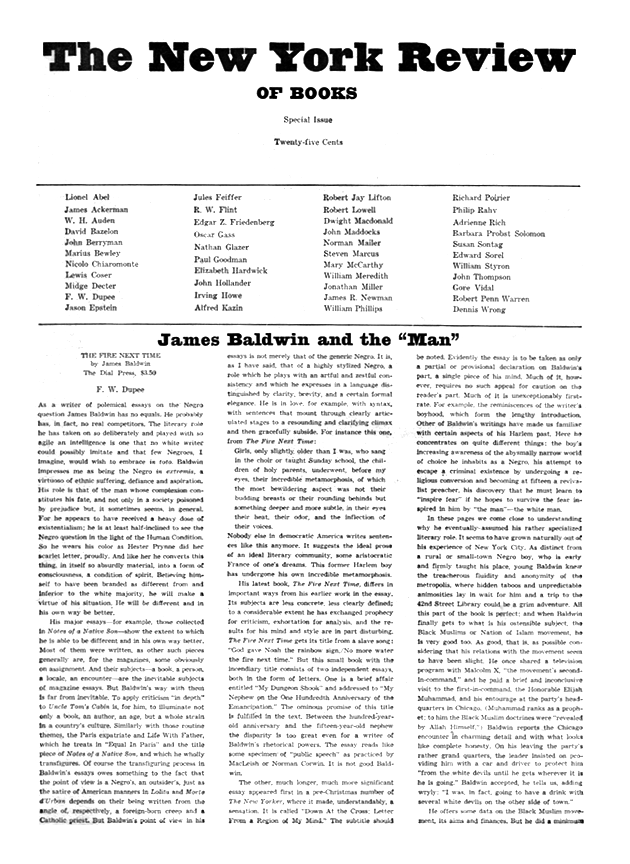
February 1, 1963 • Volume 1, Number 1

LETTERS

Contributors

W.H. Auden (1907–1973) was born in North Yorkshire, England, the son of a doctor. He studied at Oxford and published his first book, Poems, in 1930, immediately establishing himself as one of the outstanding voices of his generation. Auden emigrated to New York in 1939, where he became a US citizen and converted to Anglicanism. He wrote essays, critical studies, plays, and opera librettos for such composers as Benjamin Britten, Igor Stravinsky, and Hans Werner Henze, as well as the poems for which he is most famous.

Jason Epstein launched the trade paperback format in the US in 1952 as a young editor at Doubleday. In 1963 he was a founder of The New York Review and in 1979 cofounder with the late Edmund Wilson of the Library of America. In 2007 he cofounded On Demand Books. Among his many awards are the National Book Award Medal for Distinguished Contribution to American Letters, the Lifetime Achievement Award of the National Book Critics Circle, and the Curtis Benjamin Award given by the American Association of Publishers for enriching the world of books.
 (February 2011)

R.W. Flint translated, edited, and introduced The Selected Works of Cesare Pavese in 1968 and Marinetti: Selected Writings in 1971. He has contributed interviews, essays, translations, and reviews on Italian writers to various journals including Parnassus, Canto, and The Italian Quarterly. He lives in Cambridge, Massachusetts.

Paul Goodman (1911–1972) was an American social critic, psychologist, poet, novelist, and anarchist, whose writings appeared in Politics, Partisan Review, The New Republic, Commentary, The New Leader, Dissent, and The New York Review of Books. He published several well-regarded but little-known books in a variety of fields—including city planning, Gestalt therapy, educational reform, literary criticism, and politics—before Growing Up Absurd, cancelled by its original publisher and turned down by a further eighteen, was brought out by Random House in 1960 and became an instant bestseller. Its author became an influential leader of the New Left and anti-war movements and a model for a new generation of critics like Susan Sontag, who wrote: “There is no living American writer for whom I have left the same simple curiosity to read as quickly as possible anything he wrote on any subject.” “Paul Goodman Changed My Life,” a 2011 documentary directed by Jonathan Lee and distributed by Zeitgeist Films, continues to play at film festivals and independent cinemas. The film received excellent reviews in such publications as The New York Times, Variety, The New York Post, Village Voice, and Time Out New York.

Elizabeth Hardwick (1916-2007) was born in Lexington, Kentucky, and educated at the University of Kentucky and Columbia University. A recipient of a Gold Medal from the American Academy of Arts and Letters, she is the author of three novels, a biography of Herman Melville, and four collections of essays. She was a co-founder and advisory editor of The New York Review of Books and contributed more than one hundred reviews, articles, reflections, and letters to the magazine. NYRB Classics publishes Sleepless Nights, a novel, and Seduction and Betrayal, a study of women in literature.

John Hollander is Sterling Professor Emeritus of English at Yale. His new book of poems, A Draft of Light, will be published by Knopf in May. (March 2008)

Alfred Kazin’s most recent book is God and the American Writer. (April 1998)

Robert Lowell died in 1977. His Collected Poems was published this summer. The letters in this issue will be included in The Letters of Robert Lowell, edited by Saskia Hamilton, to be published next year by Farrar, Straus and Giroux, LLC. (November 2003)

Norman Mailer (1923-2007) was born in Long Branch, New Jersey, and grew up in Brooklyn, New York. In 1955 he co-founded The Village Voice. He is the author of more than thirty books, including The Naked and the Dead; The Armies of the Night, for which he won a National Book Award and the Pulitzer Prize; The Executioner’s Song, for which he won his second Pulitzer Prize; Harlot’s Ghost; Oswald’s Tale; The Gospel According to the Son; and The Castle in the Forest.

Mary McCarthy (1912-1989) was a novelist, essayist, and critic. Her political and social commentary, literary essays, and drama criticism appeared in magazines such as Partisan Review, The New Yorker, Harper’s, and The New York Review of Books, and were collected in On the Contrary (1961), Mary McCarthy’s Theatre Chronicles 1937-1962 (1963), The Writing on the Wall (1970), Ideas and the Novel (1980), and Occasional Prose (1985). Her novels include The Company She Keeps (1942), The Oasis (1949), The Groves of Academe (1952), A Charmed Life (1955), The Group (1963), Birds of America (1971), and Cannibals and Missionaries (1979). She was the author of three works of autobiography, Memories of a Catholic Girlhood (1957), How I Grew (1987), and the unfinished Intellectual Memoirs (1992), and two travel books about Italy, Venice Observed (1956) and The Stones of Florence (1959). Her essays on the Vietnam War were collected in The Seventeenth Degree (1974); her essays on Watergate were collected in The Mask of State (1974).

Jonathan Miller has directed operas and plays throughout the world, most recently Pelléas and Mélisande at the Metropolitan Opera. His many books include The Body in Question, States of Mind, On Reflection, and Nowhere in Particular. The article that appears in this issue is based on a talk given at the New York Public Library. (May 2000)

Susan Sontag (1933-2004) is the author of four novels, The Benefactor, Death Kit, The Volcano Lover, and In America, which won the 2000 National Book Award for Fiction; a collection of stories, I, Etcetera; several plays, including Alice in Bed and Lady from the Sea; and seven works of nonfiction, among them Where the Stress Falls and Regarding the Pain of Others. Her books have been translated into thirty-two languages. In 2001, she was awarded the Jerusalem Prize for the body of her work; in 2003, she received the Prince of Asturias Prize for Literature and the Peace Prize of the German Book Trade.

Gore Vidal’s most recent novel is The Golden Age. (February 2002)

Dwight Macdonald (1906–1982) was born in New York City and educated at Exeter and Yale. On graduating from college, he enrolled in Macy’s executive training program, but soon left to work for Henry Luce at Time and Fortune, quitting in 1936 because of cuts that had been made to an article he had written criticizing U.S. Steel. From 1937 to 1943, Macdonald was an editor of Partisan Review and in 1944, he started a journal of his own, Politics, whose contributors included Albert Camus, Victor Serge, Simone Weil, Bruno Bettelheim, James Agee, John Berryman, Meyer Schapiro, and Mary McCarthy. In later years, Macdonald reviewed books for The New Yorker, movies for Esquire, and wrote frequently for The New York Review of Books.