Contents

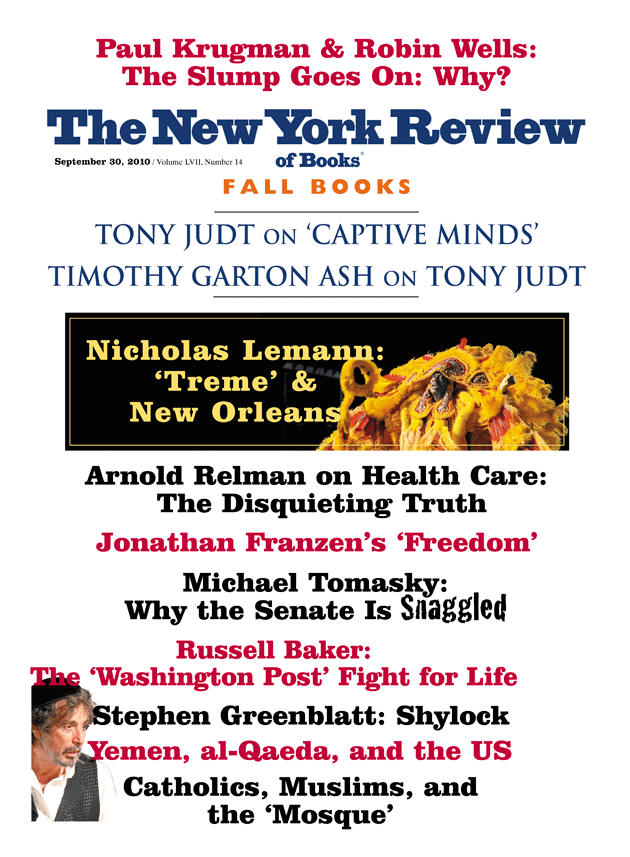
September 30, 2010 • Volume 57, Number 14

LETTERS

Contributors

Timothy Garton Ash is Professor of European Studies and Isaiah Berlin Professorial Fellow at St. Antony’s College, Oxford, and a Senior Fellow at the Hoover Institution, Stanford. He is the author of many books, including The Magic Lantern, an eyewitness account of the velvet revolutions of 1989. His most recent book is Facts Are Subversive: Political Writing from a Decade Without a Name. He is currently leading an Oxford University 
research project for the discussion of global free speech norms (www.freespeechdebate.com) and working on a book about free speech.

Tony Judt (1948–2010) was the founder and director of the Remarque Institute at NYU and the author of Postwar: A History of Europe Since 1945, Ill Fares the Land, and The Burden of Responsibility: Blum, Camus, Aron, and the French Twentieth Century, among other books.

Charles Baxter is the Edelstein-Keller Professor in Creative Writing at the University of Minnesota. His latest book, Gryphon: New and Selected Stories, was published in paperback in February. (December 2012)

Willibald Sauerländer is a former Director of the Central Institute for Art History in Munich. His latest book is Manet malt Monet: Ein Sommer in Argenteuil. (June 2013)

David Dollenmayer is Emeritus Professor of German at Worcester Polytechnic Institute.
 (June 2013)

Michael Tomasky is Special Correspondent for Newsweek/
The Daily Beast and Editor of Democracy: A Journal of Ideas.
 (April 2013)

Paul Krugman is a columnist for The New York Times and Professor of Economics and International Affairs at Princeton. He was awarded the 2008 Nobel Prize in Economics. (June 2013)

Robin Wells is the coauthor, along with Paul Krugman, of Economics and has taught economics at Princeton, Stanford Business School, and MIT.
 (July 2012)

Nicholas Lemann is Dean and Henry R. Luce Professor at the Columbia Graduate School of Journalism.


Arnold Relman is Professor Emeritus of Medicine and Social Medicine at Harvard Medical School. He is former Editor in Chief of The New England Journal of Medicine and the author of A Second Opinion: Rescuing America’s Health Care.
 (October 2012)

Garry Wills is Professor of History Emeritus at Northwestern. His study of Abraham Lincoln, Lincoln at Gettysburg: The Words That Remade America, was awarded the Pulitzer Prize in 1993. His latest book, Why Priests? A Failed Tradition, was published in February 2013.

Russell Baker is a former columnist and correspondent for The New York Times and The Baltimore Sun. His books include The Good Times, Growing Up, and Looking Back.

Daniel Mendelsohn’s reviews and essays on literary and cultural subjects appear frequently in The New York Review of Books and The New Yorker. He is the author, most recently, of the collection Waiting for the Barbarians: Essays from the Classics to Pop Culture, which was a finalist for the 2012 National Book Critics Circle Award. His other books include two memoirs, a translation of the complete works of C.P. Cavafy, and a study of Greek tragedy, Gender and the City in Euripides’ Political Plays. He teaches at Bard College.

Max Rodenbeck is The Economist’s Mideast Correspondent. He lives in Cairo. (May 2013)

Cathleen Schine is the author of several novels, including Rameau’s Niece, The Love Letter, She is Me, The New Yorkers, and The Three Weissmanns of Westport. Her latest novel, Fin & Lady, will be published in July 2013. She is a frequent contributor to The New York Review of Books.

R. Scott Appleby is the John M. Regan Jr. Director of the Kroc Institute for International Peace Studies at Notre Dame.

John T. McGreevy is the I.A. O’Shaughnessy Dean of the College of Arts and Letters at the University of Notre Dame.

Mary Beard is Professor of Classics at the University of Cambridge. Her new book, Confronting the Classics: Traditions, Adventures, and Innovations, will be published in the US in 
September. She has just been appointed Royal Academy of Arts Professor of Ancient Literature. (May 2013)

Philippe Sands QC is Professor of Law at University College London. His most recent book is Torture Team. (September 2010)

David Thomson, a British film critic and historian based in the United States, is the author of more than twenty books, including the prestigious reference works *Have You Seen…?: A Personal Introduction to 1,000 Films* and *The New Biographical Dictionary of Film*. He has been a regular contributor and film critic for *The New York Times*, *Film Comment, Movieline*, *The New Republic*, and *Salon*. He lives in San Francisco with his family and has taught at Dartmouth College.

Roger Cohen is a columnist for The New York Times and the International Herald Tribune. He is completing a family memoir, to be published next year. (June 2013)

Marcia Angell is a Senior Lecturer in Social Medicine at Harvard Medical School and former Editor in Chief of The New England Journal of Medicine.
 
(May 2013)

Ian Johnson writes from Beijing and Berlin. His book on grassroots civil society, Wild Grass: Three Portraits of Change in Modern China, has recently been published in Chinese. 
(April 2013)

Anthony Grafton is Henry Putnam University Professor of History and the Humanities at Princeton University. His most recent book is The Culture of Correction in Renaissance Europe.


Jeffrey Hamburger is Kuno Francke Professor of German Art and Culture at Harvard University.

Timothy Snyder is Housum Professor of History at Yale. His books include Thinking the Twentieth Century, a book of conversations with Tony Judt, and Bloodlands: Europe Between Hitler and Stalin, both of which were recently published in paperback.
 (March 2013)

Steve Coll will take up the post of Dean of the Columbia University Graduate School of Journalism in July. He is a staff writer at The New Yorker and the author, most recently, of Private Empire: ExxonMobil and American Power.
 (July 2013)

Stephen Greenblatt is John Cogan University Professor of the Humanities at Harvard. His latest book, The Swerve: How the World Became Modern, received the National Book Award and the Pulitzer Prize for nonfiction.

William Pfaff’s latest book is The Irony of Manifest Destiny: The Tragedy of America’s Foreign Policy.
 (June 2013)

Jonathan Raban’s books include Surveillance, My Holy War, Arabia, Old Glory, Hunting Mister Heartbreak, Bad Land, Passage to Juneau, and Waxwings. He is the recipient of the National Book Critics Circle Award, the Heinemann Award of the Royal Society of Literature, the PEN/West Creative Nonfiction Award, the Pacific Northwest Booksellers’ Award, and the Governor’s Award of the State of Washington. He is a frequent contributor to The New York Review of Books, The Guardian, and The Independent. He lives in Seattle.

Richard C. Lewontin is Alexander Agassiz Professor of Zoology and Professor of Biology at Harvard University. He is the author of The Genetic Basis of Evolutionary Change and Biology as Ideology, and the co-author of The Dialectical Biologist (with Richard Levins) and Not in Our Genes (with Steven Rose and Leon Kamin).

Janet Malcolm was born in Prague. She was educated at the High School of Music and Art, in New York, and at the University of Michigan. Along with In the Freud Archives, her books include Diana and Nikon: Essays on Photography, Psychoanalysis: The Impossible Profession, The Journalist and the Murderer, The Purloined Clinic: Selected Writings, The Silent Woman: Sylvia Plath and Ted Hughes, The Crime of Sheila McGough, and Reading Chekhov: A Critical Journey. She wrote about the trial of Mazoltuv Borukhova, the mother of Michelle, in her book Iphigenia in Forest Hills, just out in paperback. Her collection Forty-One False Starts: Essays on Artists and Writers will be published in the spring of 2013.


She lives in New York.

Elaine Blair is a regular contributor to The New York Review. (July 2013)